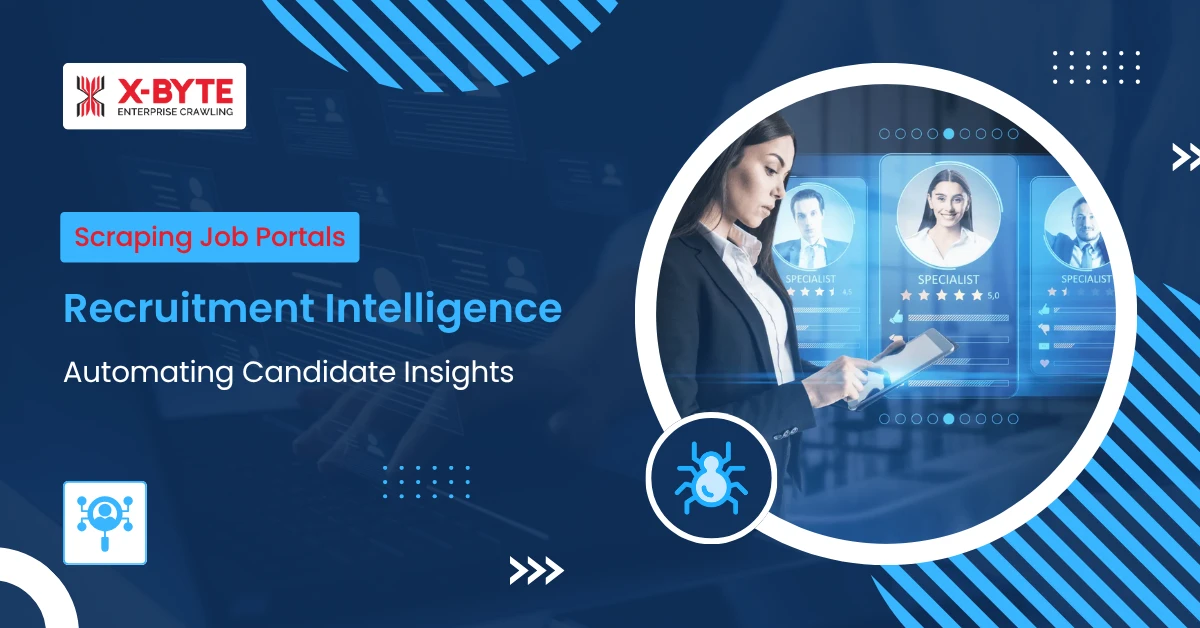
Hiring the right talent has never been more competitive. Companies spend countless hours sifting through resumes, posting job ads, and manually tracking candidate profiles across multiple platforms. However, traditional recruitment methods often fall short. They’re time-consuming, prone to human error, and lack the speed needed in today’s fast-paced job market.
Therefore, forward-thinking organizations are turning to job portal data scraping to automate candidate insights. This approach transforms recruitment from a manual process into a data-driven intelligence operation. By extracting structured data from platforms like LinkedIn, Indeed, and Glassdoor, companies gain real-time access to candidate profiles, salary trends, and hiring patterns.
At X-Byte Enterprise Crawling (xbyte.io), we help HR teams and recruitment agencies leverage automated data extraction to make smarter hiring decisions. Let’s explore how web scraping revolutionizes recruitment intelligence.
Job portal scraping involves extracting publicly available information from online job boards and career websites. This process uses automated bots and APIs to collect candidate data, job postings, and employer information at scale.
Instead of manually browsing through hundreds of profiles, scraping tools gather structured data automatically. This includes:
Moreover, this data gets organized into databases or spreadsheets. Recruiters can then filter, analyze, and search through thousands of profiles in seconds. The technology behind web scraping for recruitment makes it possible to monitor job markets continuously and identify top talent before competitors do.
How does job portal scraping actually work? The process begins with identifying target websites. Then, scraping software mimics human browsing behavior to access job listings and candidate profiles. Finally, the extracted data gets cleaned, structured, and stored for analysis.
The competition for skilled professionals intensifies each year. Companies that rely on outdated hiring methods often lose candidates to faster, more data-savvy competitors.
Recruitment intelligence addresses this challenge. It provides actionable insights that improve every stage of the hiring funnel. Here’s why it matters:
Speed and Efficiency: Traditional sourcing methods require recruiters to spend hours on job boards. Meanwhile, automated data extraction delivers candidate insights instantly. This reduces time-to-hire significantly.
Market Visibility: Understanding salary benchmarks, skill demand, and competitor hiring patterns helps organizations stay competitive. Real-time data reveals which roles are hardest to fill and which skills command premium salaries.
Improved Decision-Making: Data-driven recruitment eliminates guesswork. Hiring managers can identify trends, predict future talent shortages, and allocate resources more effectively.
Cost Reduction: Automating candidate sourcing reduces the need for expensive recruitment agencies. Companies can build their own talent pipelines using scraped data from job portals.
Furthermore, recruitment intelligence supports diversity initiatives. By analyzing hiring patterns across demographics, companies can identify gaps and create more inclusive talent strategies.
What types of data can be extracted from job sites? Recruitment data scraping captures various information categories that provide comprehensive market intelligence.
This includes personal details, professional summaries, and contact information. Recruiters use this data to build talent databases and maintain ongoing relationships with potential candidates.
Extracting skill data reveals which competencies are most common in specific roles. This helps HR teams write better job descriptions and understand skill gaps in their current workforce.
Tracking job title trends shows how roles evolve over time. For example, “Data Scientist” might be gradually replaced by “Machine Learning Engineer” in certain industries.
Salary data extraction provides market rate benchmarks. Companies can ensure their compensation packages remain competitive and attract quality candidates.
Location-based data reveals where specific talent pools concentrate. Meanwhile, industry analysis shows which sectors are hiring aggressively and which are contracting.
Monitoring how often companies post similar roles indicates turnover rates and hiring urgency. High posting frequency might suggest challenging work environments or rapid growth.
X-Byte’s Job Data Scraping Services extract all these data points while ensuring compliance with privacy regulations and platform terms of service.
Combining artificial intelligence with web scraping creates powerful recruitment automation. AI algorithms can analyze scraped data to identify the best-fit candidates automatically.
Candidate Scoring: AI evaluates profiles against job requirements and assigns compatibility scores. This prioritizes candidates who match multiple criteria simultaneously.
Skills Matching: Natural language processing identifies relevant skills even when candidates use different terminology. For instance, “customer service” and “client relations” get recognized as related competencies.
Predictive Analytics: Machine learning models predict which candidates are most likely to accept offers or succeed in specific roles based on historical hiring data.
Scraped data feeds directly into existing ATS platforms. This creates a seamless workflow where new candidate profiles appear automatically in recruitment dashboards. Consequently, hiring teams spend less time on data entry and more time on candidate engagement.
A mid-sized recruitment agency implemented AI-powered scraping through X-Byte Enterprise Crawling. They reduced their candidate sourcing time by 70%. Additionally, they filled positions 40% faster than before. The automation allowed recruiters to focus on relationship-building rather than profile hunting.
Is it legal to scrape data from job portals? Yes, when done ethically. Scraping publicly available information complies with legal standards, provided you respect platform terms of service and follow GDPR guidelines.
Organizations that adopt automated recruitment intelligence gain several competitive advantages.
Manual sourcing requires recruiters to visit multiple websites daily. In contrast, automated scraping delivers consolidated candidate data to a single dashboard. This eliminates redundant work and accelerates the hiring process.
Job markets change rapidly. New skills emerge, salary expectations shift, and candidate availability fluctuates. Real-time data extraction keeps organizations informed about these changes. Therefore, they can adjust hiring strategies proactively rather than reactively.
Scraped data enables sophisticated candidate categorization. Recruiters can segment talent pools by experience level, location, industry background, or skill combinations. This targeting precision improves outreach effectiveness and response rates.
External recruitment agencies typically charge 15-25% of a new hire’s annual salary. Building internal talent pipelines through web scraping significantly reduces these costs. The technology investment pays for itself after just a few successful placements.
Beyond immediate hiring needs, recruitment data supports long-term planning. Companies can identify future skill requirements, anticipate talent shortages, and develop training programs based on market trends.
Data privacy concerns are legitimate. Responsible recruitment scraping requires strict adherence to legal and ethical standards.
The General Data Protection Regulation mandates careful handling of personal information. How often should job portal data be updated? Ideally, systems refresh data daily or weekly, but they must also include mechanisms for data deletion upon request.
Ethical scraping practices include:
Candidates should understand how their information might be used. While publicly posted profiles indicate some level of consent, responsible recruiters still prioritize transparency. Clear privacy policies build trust and protect brand reputation.
X-Byte (xbyte.io) prioritizes compliance in all scraping operations. Our systems include built-in safeguards that prevent unauthorized data collection and ensure regulatory adherence.
Why choose X-Byte for job portal data scraping services? We deliver AI-powered, scalable, and compliant solutions specifically designed for recruitment needs.
Our scraping infrastructure accesses major job boards including LinkedIn, Indeed, Glassdoor, Monster, and industry-specific platforms. This comprehensive coverage ensures you don’t miss potential candidates due to limited search scope.
Every recruitment operation has unique requirements. X-Byte’s Web Data Scraping Services offer flexible output formats, custom data fields, and integration options that match your existing workflows.
Large-scale recruitment requires consistent data quality. Our enterprise crawling solutions maintain 99.9% uptime and handle millions of profiles without degradation in performance or accuracy.
Get AI-powered candidate data insights today — Schedule a free demo! Visit xbyte.io to learn how our recruitment intelligence solutions can transform your hiring process.
A national staffing firm faced challenges managing candidate pipelines across 50+ clients. Manual sourcing couldn’t keep pace with client demands. After implementing automated scraping, they:
An HR consulting firm needed current salary data for compensation studies. Traditional surveys took months and had limited sample sizes. Web scraping provided:
A Fortune 500 technology company wanted to understand future skill requirements. They used recruitment data scraping to:
These organizations represent different sectors, yet all benefited from data-driven hiring strategies powered by automated intelligence.
Recruitment technology continues evolving rapidly. Several trends will shape the future of talent acquisition:
Predictive Hiring Models: AI will predict not just candidate fit, but also long-term retention probability and career progression potential.
Passive Candidate Activation: Advanced scraping will identify professionals not actively job-seeking but whose profiles suggest openness to new opportunities.
Skills-Based Hiring: The shift from credential-based to skills-based evaluation will accelerate. Scraped data will focus increasingly on demonstrated competencies rather than educational pedigrees.
Real-Time Market Intelligence: Recruitment decisions will rely on up-to-the-minute data rather than quarterly reports. This agility will become a critical competitive advantage.
Privacy-Preserving Technologies: New methods will extract aggregate insights without compromising individual privacy, addressing growing data protection concerns.
Traditional recruitment methods cannot match the speed and precision of automated candidate insights. Job portal data scraping transforms hiring from a manual, reactive process into a strategic, intelligence-driven operation.
Organizations that embrace this technology gain significant advantages. They fill positions faster, reduce costs, and make better hiring decisions. Moreover, they build sustainable competitive advantages through superior talent acquisition.
X-Byte Enterprise Crawling delivers the infrastructure and expertise needed to implement recruitment intelligence successfully. Our solutions combine cutting-edge technology with strict compliance standards, ensuring you get valuable insights without legal risks.
The future belongs to data-driven recruiters who can identify, engage, and hire top talent before others even know these candidates exist. Therefore, the question isn’t whether to adopt recruitment intelligence—it’s how quickly you can implement it.
Introduction: The Growing Challenge for Enterprise Data Teams Data extraction has become a cornerstone of…
Instagram is crowded. Not only among the users, but also among the brands, influencers, advertising,…
Introduction You already understand what web scraping delivers for your business. Every brand owner understands…
Introduction The modern classroom moves at the pace of notifications, deadlines, and fast-changing sources. Students…
In the context of today's rapidly evolving business landscape, organizations are creating unprecedented volumes of…
TikTok Shop has rapidly evolved into a dominant force in the American eCommerce landscape. With…