


The State of Data Scraping 2025: Trends, Technologies, and Enterprise Applications

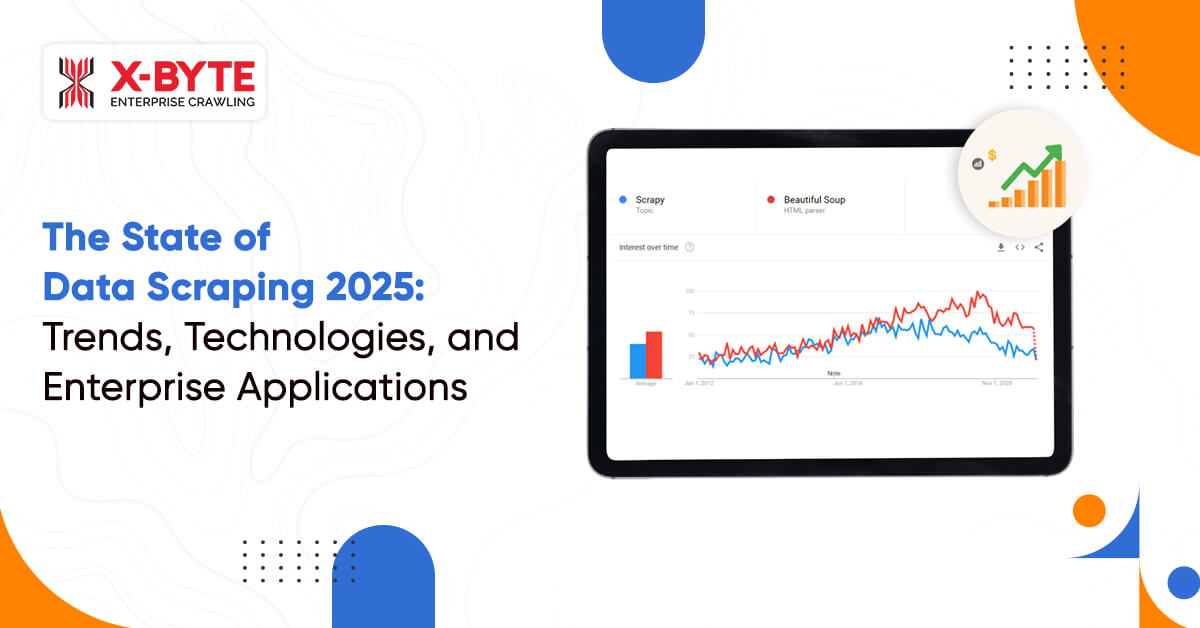
By 2023, its value had grown to $4.09 billion, with an annual growth rate of 28%. If we look at 2024, the market of data scripting tools alone reached $1.01 billion, and by 2023, it is expected to more than double to $2.49 billion. The amount of generated data is generated on a regular basis globally is expected to exceed 175 zettabytes by 2025. It shows that the demand for dependable and expandable web scraping solutions is rising along with these markets. We have discovered some of the latest breakthroughs in data scraping trends, technologies, and how enterprises are using them for smarter decision-making.
Data Sources
Our Data Scraping Analysis of 2025 uses publicly available data trends, latest technologies, and large-scale tools that can be used by businesses to automate daily operations, analyze data, and boost decision-making.
Key Insights
This analysis focuses on the technologies, trends, and business applications of data scraping.
- Data Extraction is highly utilized by 95% of businesses in the USA in various sectors such as retail, healthcare, real estate, travel, finance, and more to get crucial clickable insights and stay competitive.
- More than 85% of enterprises rely on scraped data to know their pricing strategies, consumer sentiment, market trends, and make decisions.
- Modern scraping solutions in 2025 use AI/ML to scrape data from websites, reduce errors, and automate workflows.
- Nowadays, 75% of organizations are using automated API to access richer datasets in real-time.
- Regulations such as the CCPA, DPDP, and GDPR have caused businesses to prioritize different ethical and legal scraping practices.
Key Performance Indicators (KPIs) of Data Scraping
- Data accuracy rate measures the precision of scraped data. If we consider an AI-powered data extractor that handles dynamic website content can maintain a high accuracy rate. It helps with analytics reporting and automation.
- Scrapping success rate that can mature web scraper’s resilience against: CAPTCHA challenges, JavaScript-heavy pages, and anti-bot mechanisms.
- Real-time data for financial monitoring, the scraping API must update data continuously so that it can be used effectively.
- A dashboard that provides real-time insights can empower business responsiveness.
- Evaluating the speed and efficiency with which scraped data can be integrated into any environment.
Data Scraping’s Driving Technologies in 2025
| Technologies | Role in Data Scraping |
| AI/ML Models | Interpret visual layouts, extract unstructured data. |
| Data Pipelines & ETL Tools | Structure and load scraped data into warehouses or lakes. |
| Scraping Frameworks | Scrapy, Selenium, BeautifulSoup, Apify. |
| Headless Browsers | Render JavaScript-heavy websites, simulate real users. |
| Data Format Adapters | Convert HTML/XML/JSON into a structured schema. |
Major Goals of the Report
- Showcase Industry-Wide Adoption and Increasing Usage
To highlight how data extraction becomes a great enterprise tool across industries such as travel, finance, healthcare, retail, and real estate.
- Find Key Trends and Technological Changes
To examine the impact of Artificial Intelligence, hybrid data scraping strategies, automation, and compliance frameworks on the future of data scraping.
- Address Legal Concerns
Comprehend privacy laws and regulations about web scraping, making sure that CCPA, GDPR, and DPDP are followed.
- Future of Data Scraping:
To forecast the trend of data scraping technologies such as real-time edge scraping, LLM-integrated extractors, and autonomous agents, and how they can provide useful insights for US businesses.
- Provides Strategic Decision Making:
To equip business owners with insights that help them invest in ideal scraping tools, technology, and service models to drive more ROI.
Benefits of Data Scraping for Enterprises
Research shows that enterprise gains the following benefits by using data scraping:
- Enterprises can track and compare their competitors’ pricing to lead in a dynamic market.
- They can drive business sales by pulling out data from Social media sites, databases, and websites.
- Businesses can understand consumer behavior and preferences by analyzing reviews, trends, and feedback.
- Businesses can Lots of time is being saved due to automating the data collection process from online sources.
- Access updated and precise data for better decision-making.
- Grab listings, blogs, news, or legal updates for monitoring, research, or reporting purposes.
Challenges in Data Scraping
- GDPR and CCPA regulations require US enterprises to comply with sustainable mechanisms and ethical data practices.
- Websites use a variety of tactics to prevent automated data scraping, which poses difficulties for developers.
- Blocking of Captchas and IP addresses makes automated scraping difficult.
- The accuracy and consistency of scraped data can be inconsistent. It results in additional processing and validation.
Conclusion
The future of web scraping technologies is very bright in 2025 and beyond. It will be characterized by AI, automation, real-time features, ethical behavior, and reliable data. Enterprises that accept these transformations are expected to leverage data for insights and maintain their competitive position in the digital marketplace.