

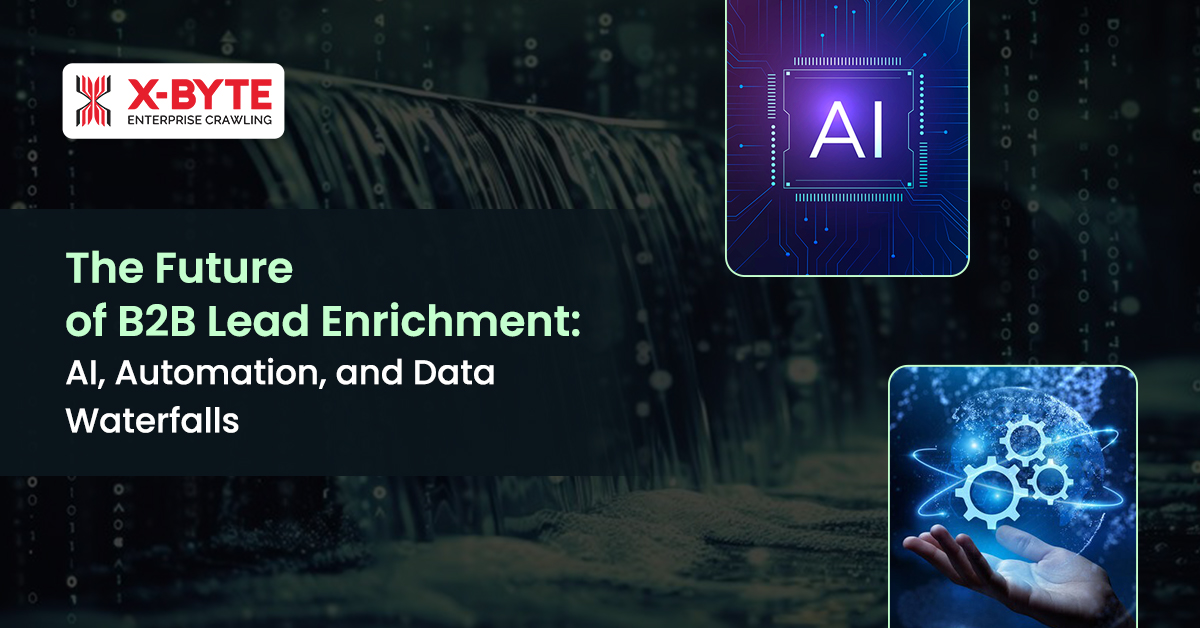
In B2B marketing and sales, accurate and actionable data is more valuable than ever. The days of simply providing sales teams with a list of leads that lists names and email addresses alone are long gone, and more importantly, we know that sales teams need rich, dynamic, and contextual information to run a greater opportunity process personally, ultimately leading to informed decisions, personalized outreach, and improved conversion rates. It brings us to B2B lead enrichment. Enrichment is a part of a sales success process that has radically transformed through AI systems, automation, and data waterfalls. This article explores how these technologies are redefining B2B lead enrichment in 2025.
What Is B2B Lead Enrichment?
Lead enrichment involves adding information to leads, e.g., job titles, company size, industry, and social media links. It becomes meaningful as businesses enrich their raw leads so they can better segment their audiences, personalize messaging, improve lead scoring, and lower email bounce rates. Essentially, lead enrichment enables sales and marketing teams to be fully armed with up-to-date, real-time information to allow them to close their deals more quickly and effectively. Without the proper lead enrichment in place, outdated or incomplete information hinders effective communication and slows down the sales funnel. Fortunately, the right enriched leads will allow sales and marketers to communicate with the right person, with the right message, at the right time.
In sales and marketing, lead enrichment also plays a critical part in account-based marketing (ABM) because it allows you to customize and precision-target your campaigns. Now that the competition is so fierce, businesses that do not have a proper lead enrichment set up will fall behind as they miss opportunities and waste time chasing irrelevant leads.
What Is The Role Of AI In Lead Enrichment?
Artificial Intelligence (AI) has fundamentally reshaped the way companies process, analyze, and manage data. When used during the lead enrichment phase, AI allows for healthier, faster, and more results-driven decisions. AI improves data matching with the ability to learn from past results, correct errors, and dedupe. Additionally, AI identifies real-time intent signals by monitoring online behaviors, such as specific content or web page interactions, and scoring leads based on their likelihood to convert.
Tools with capable Natural Language Processing (NLP) components can read job postings, news articles, or social posts to uncover potential buying signals. There’s also predictive enrichment, which uses machine learning models to infer information about missing data points like company size or tech stack based on known data points.
It allows organizations to pick and elevate the interactions with high-value leads. A recent study shows that more than 83% of organizations consider artificial intelligence (AI) essential for their sales and marketing strategies. Additionally, AI-enabled enrichment tools can boost conversion rates by as much as 50% and reduce sales cycles by 30%.
How Can Automation Help Scale Lead Enrichment Processes?
Automation is the operational foundation of lead enrichment today – making lead enrichment efficient, quick, and consistent. Automation takes existing enrichment workflows and derives them instantly. Trigger workflows begin enriching leads as soon as they are captured, such as when a form is submitted or an email is opened. This process ensures that lead enrichment occurs instantly instead of days later. Furthermore, automation platforms create seamless, instantaneous connections between lead enrichment tools and CRMs like Salesforce or marketing platforms like HubSpot.
Integrating these technologies allows lead enrichment to improve lead scoring in real-time, or automatically route leads to a rep, allowing the rep to act immediately on a lead they deem worthy of their time (timely lead responses are critical). Automation can also help maintain data hygiene by standardizing fields, removing duplicates, and flagging incomplete entries. Automation is consistent and auditable, and helps ensure compliance with any data regulations.
With fewer manual processes, automation gives sales and marketing teams the time to focus on high-value activities (like closing deals or optimizing strategy) vs tedious lead tasks. In the end, relevant lead enrichment automation enables the lead enrichment process to be a scalable, easy-to-execute, and reliable method.
What Are Data Waterfalls and How Are They Changing Lead Enrichment?
Data waterfalls are a significant shift in how companies think about lead enrichment. Rather than one data provider (which inherently collects poorer leads), with a waterfall, you will query data providers in a predetermined priority. Thus, the data waterfall will pipe the query to the next specific data provider when there is no match, for example, for an email domain, to the next, and down the line. It prevents one provider from taking you down the same line, but builds in redundancy to increase the match rate and coverage. Waterfall enrichment can push coverage over 80%, depending on the provider. You will be lucky to achieve 50-60% using a single source of data waterfall enrichment.
Similarly, data waterfalls can utilize AI for query logic. AI will know the history of each provider’s performance, accuracy at the field level by provider, and the total spend in terms of price. For example, if Provider A is best in accurate job titles while Provider B is best in the accuracy of phone numbers, the AI could route job titles to Provider A and phone numbers to Provider B. Further, the waterfalls also function collectively to utilize the AI to reduce unnecessary API calls and reduce costs.
Data waterfalls particularly well for niche verticals or limited roles that otherwise would be impossible to find and cover entirely. From a demand basis for real-time and accurate data from sales and marketing professionals, you can appreciate their desire for the fastest, most complete profiles with reasonable consistency. The waterfall approach also fosters healthy competition among those providers to keep improving and innovating in lead enrichment.
We anticipate more innovative systems being developed around waterfalls for lead enrichment as AI, automation, and other technologies become more prevalent – think automated self-learning systems that can dictate which new providers will be added to the waterfall, with no human intervention through the enrichment logic in real-time. With the factors above stated, data waterfalls as component(s) for B2B lead generation will continue to be prominent in developing an advanced system, now and in the future.
What Metrics Define Success in B2B Lead Enrichment?
When assessing the success of a lead enrichment strategy, an organization should track the most relevant key performance indicators (KPI) for the strategy executed. The metrics and description of how to understand the metric are provided below in the table.
| Metric | Description |
| Data Completeness Rate | The percentage of leads that have all key fields entered (e.g., job title, company size, etc.) |
| Lead-to-Opportunity Rate | The percentage of enriched leads that converted to sales-qualified opportunities. |
| Email Bounce Rate | The percentage of emails that are not delivered shows data inaccuracy. |
| Speed-to-lead | The time it takes to contact a lead upon entering a funnel. |
| Sales Cycle Time | The average time it takes to close a deal from first contact. |
| Cost per Enriched Lead | The total cost to enrich is divided by the total number of leads enriched. |
In addition to organizational decision-making to assess the overall effectiveness of previous ROI, monitoring these KPIs will help identify financially underperforming data sources and workflows. When the use of AI and automation is appropriately implemented, you should observe incremental improvements over time for the respective metrics in a lead’s journey through your funnel, allowing you to optimize and further improve revenue outcomes continuously.
How Does Lead Enrichment Work in Real-World B2B Scenarios?
The impact of modern lead enrichment is real, with much proof. Companies using AI and automation as part of their enrichment processes are reporting increases in conversion rates of up to 50%. Overall time spent in the sales cycle is down 30% because sales reps can prioritize and reach decision-makers faster than other sellers.
Businesses are reporting as much as 95% accuracy with outbound contact information, which means they are seeing lower bounce rates and sales teams can be more effective and efficient in their calls, emails, and meetings. A SaaS company that incorporated dynamic waterfall enrichment in its contact data gathering may have come across direct dials for decision makers that they did not get from their preferred provider. With enriched data in real-time, sales teams can reach these decision-makers quickly and avoid potential gatekeepers.
Another B2B marketing agency that was a customer of a venture partner of Kompass used AI to find intent signals, developing more aggressive targeting for their leads, and reducing the time it took them to ramp their campaigns. From these real-world situations, we can see how enriched data plays a vital role in making smarter decisions and ultimately better business acumen across various industries.
What Are The Challenges In Executing AI and Automation?
AI and automation can deliver tremendous benefits to any organization.
- Overconfidence in a single provider or single slice of data results in overall reduced coverage and accuracy across source comparisons. Best to look for a waterfall approach with the use of LOTS of different sources.
- Real-time enrichment at the lead capture point will maintain engagement and conversion.
- There are lots of rules and regulations about compliance, like GDPR, CCPA, etc. Don’t get hit with a costly lawsuit. Make sure you carefully vet your data sources for compliance, and you’re clear on how they use your data.
- Too much data leads to paralysis. Collect only actionable data like job title, revenue, and intent.
- Work simply festers, and siloed data occurs with each missed opportunity to automate. Link your enrichment tools to engaged CRM workflows and automate processing with your leads.
By working through the roadblock above, organizations will create a more accurate, efficient, and compliant lead enrichment process.
How Is Predictive Engagement Shaping the Future of Lead Enrichment?
The future of lead enrichment, ultimately, is predictive engagement, or having the ability to do more than simply collect data; to take preemptive action based on insight. With AI, platforms can accurately suggest the best time to reach a lead, via which channel to communicate, and even what message will deliver the highest engagement.
This evolution could not have occurred without enriched data, in conjunction with behavioral signals, such as web page visits, email opens, or content engagement. Many platforms now utilize AI to trigger automated engagement sequences based on user behavior. No longer are the human aspects of outreach paramount to engaging leads, as this methodology dictates timely and relevant outreach.
In the grand scheme of things, automation is needed to remove the guesswork and human biases. It is especially true when we are talking about managing interactions with numerous leads. Thoughtful predictive engagement bridges the gap between marketing and sales, guaranteeing qualified leads that are nurtured towards conversion.
A growing trend in the industry is the shift toward fully autonomous pipelines that manage the entire process from outreach to scheduling to closing, and everything in between, with the support of enriched data. The focus has shifted from merely knowing about your leads to actively engaging with them.
Final Thoughts
Lead enrichment has changed from simply a CRM feature to a strategic, AI-based process that drives today’s B2B sales and marketing. With the increased availability of automation, dynamic data waterfalls, and predictive engagement, organizations can exploit new levels of personalization, speed, and accuracy. In 2025, the companies that succeed will view enriched data as a competitive advantage and build systems that convert enriched data into future actions.
Whether you are building an outbound sales strategy, improving your ABM campaigns, or advancing your inbound qualification of leads, the appropriate lead enrichment strategy can yield significant production improvements. The key is to have the right tech stack, purposeful process alignment, and, of course, quality data.
That is where platforms like X-byte play an essential role by providing high-volume, AI-powered lead enrichment solutions that seamlessly fit into your sales ecosystem, automating data flows, and giving you a premium category of contact intelligence.
As the B2B space continues to progress, organisations that adopt intelligent lead
enrichment now will benefit from speed, efficiency, and the ability to scale with a competitive advantage tomorrow. Lead enrichment is no longer just another tactic; it’s the foundation of a more intelligent go-to-market strategy.
 ✯ Alpesh Khunt ✯

Related Blogs
The Role of Data Annotation in Large Language Model Training and Performance
How Web Scraping Is Used to Extract eCommerce Data From eBay