

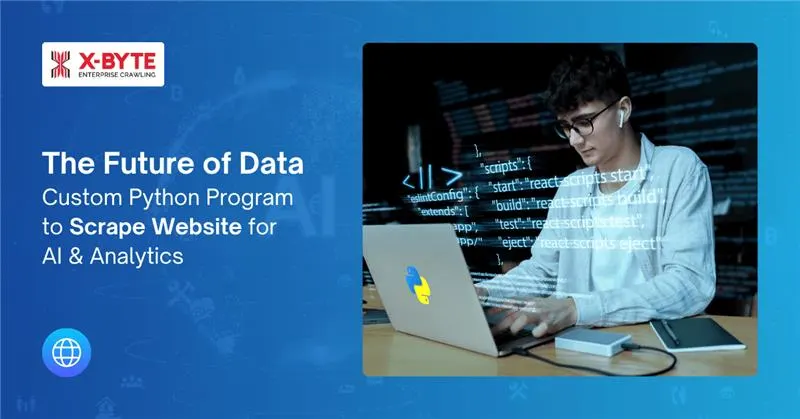
The digital economy runs on data, and in 2025, businesses face an unprecedented challenge: while AI capabilities have exploded, the quality and specificity of data feeding these systems often determines success or failure. Traditional data collection methods are proving inadequate for enterprises seeking competitive advantages through artificial intelligence and advanced analytics.
Enter custom Python web scraping—a strategic approach that transforms how organizations collect, process, and leverage web-based data. Unlike generic scraping tools, a custom Python program to scrape website data offers precision, scalability, and the flexibility needed to fuel sophisticated AI models and analytics pipelines.
Why Data Quality Defines AI Success in 2025?
Artificial intelligence systems are fundamentally data-hungry. Machine learning models require massive datasets to train effectively, while real-time analytics depend on fresh, structured information to generate actionable insights. The challenge isn’t just collecting data—it’s collecting the right data, in the right format, at the right frequency.
Generic data sources and off-the-shelf scraping solutions often fall short because they lack customization for specific business needs. A financial services company tracking market sentiment requires different data points than an e-commerce business monitoring competitor pricing. This specificity drives the need for custom web scraping solutions that can adapt to unique requirements and evolve with changing business objectives.
Research from leading data science organizations indicates that companies using custom data collection methods see 23% better performance in their AI initiatives compared to those relying solely on public datasets or generic tools. The reason is clear: custom scrapers provide cleaner, more relevant data that directly aligns with business intelligence goals.
Python’s Dominance in Enterprise Web Scraping
Python has cemented its position as the preferred language for web scraping, and for good reason. Its extensive ecosystem of libraries, readable syntax, and robust community support make it ideal for building scalable scraping solutions. The language’s versatility allows developers to handle everything from simple data extraction to complex, multi-threaded scraping operations that can process thousands of pages per hour.
Key Python libraries that power modern scraping operations include:
Requests and urllib3 for handling HTTP operations with advanced session management, authentication, and proxy support. These libraries excel at managing complex request patterns that mimic human browsing behavior.
BeautifulSoup and lxml for parsing HTML and XML documents with precision. They handle malformed markup gracefully and provide intuitive methods for extracting specific data elements.
Scrapy for large-scale, distributed scraping projects. This framework offers built-in support for handling robots.txt files, managing request delays, and implementing sophisticated data pipelines.
Selenium and Playwright for scraping JavaScript-heavy websites and single-page applications. These tools control actual browsers, making them invaluable for sites that rely heavily on client-side rendering.
The combination of these tools allows developers to build custom Python scrapers that can handle virtually any web scraping challenge, from simple static sites to complex, dynamically-generated content.
What Sets Custom Python Web Scraping Apart?
Building a custom Python program to scrape website data differs fundamentally from using pre-built scraping tools. Custom solutions are engineered for specific data requirements, website structures, and business workflows. This tailored approach addresses several critical limitations of generic tools.
Precision Data Extraction: Custom scrapers can target exact data elements needed for AI training or analytics. Instead of collecting broad datasets, they focus on specific metrics, text patterns, or structured information that directly serves business objectives.
Advanced Anti-Detection Capabilities: Modern websites employ sophisticated bot detection systems. Custom Python scrapers can implement rotating user agents, proxy networks, CAPTCHA solving integrations, and human-like browsing patterns to maintain consistent data access.
Dynamic Content Handling: Many websites now rely on JavaScript frameworks and AJAX loading. Custom scrapers can integrate browser automation tools to handle dynamic content loading, infinite scroll implementations, and complex user interactions.
Scalable Architecture: Enterprise-grade custom scrapers are built with scalability in mind. They can distribute scraping tasks across multiple servers, implement intelligent rate limiting, and handle failures gracefully to maintain data collection continuity.
import asyncio
import aiohttp
from bs4 import BeautifulSoup
import json
from datetime import datetime
class CustomWebScraper:
def __init__(self, max_concurrent=10):
self.max_concurrent = max_concurrent
self.session = None
async def create_session(self):
“””Initialize aiohttp session with custom headers”””
headers = {
‘User-Agent’: ‘Mozilla/5.0 (Windows NT 10.0; Win64; x64) AppleWebKit/537.36’,
‘Accept’: ‘text/html,application/xhtml+xml,application/xml;q=0.9,*/*;q=0.8’,
‘Accept-Language’: ‘en-US,en;q=0.5’,
‘Accept-Encoding’: ‘gzip, deflate’,
‘Connection’: ‘keep-alive’,
}
self.session = aiohttp.ClientSession(headers=headers)
async def scrape_page(self, url, data_selectors):
“””Scrape specific data from a webpage using CSS selectors”””
try:
async with self.session.get(url) as response:
if response.status == 200:
content = await response.text()
soup = BeautifulSoup(content, ‘html.parser’)
extracted_data = {}
for key, selector in data_selectors.items():
elements = soup.select(selector)
extracted_data[key] = [elem.get_text().strip() for elem in elements]
return {
‘url’: url,
‘timestamp’: datetime.now().isoformat(),
‘data’: extracted_data
}
except Exception as e:
return {‘url’: url, ‘error’: str(e)}
async def close_session(self):
if self.session:
await self.session.close()
Real-World Applications Driving Business Value
Custom Python web scraping has transformed how enterprises approach data collection across multiple industries. These applications demonstrate the strategic value of tailored scraping solutions.
AI Model Training and Enhancement: Companies developing large language models or machine learning systems use custom scrapers to collect domain-specific training data. A healthcare AI company might scrape medical journals and research papers, while a legal tech firm focuses on court documents and regulatory filings. This targeted data collection results in more accurate, specialized AI models.
Competitive Intelligence and Market Analysis: E-commerce businesses deploy custom scrapers to monitor competitor pricing, product launches, and inventory levels in real-time. Financial services firms scrape news sources, regulatory filings, and market data to feed algorithmic trading systems and risk assessment models.
Content Aggregation and Curation: Media companies and content platforms use sophisticated scraping systems to aggregate relevant content from across the web. These systems can identify trending topics, extract key insights, and feed content recommendation engines.
Supply Chain and Inventory Management: Manufacturers and retailers scrape supplier websites, logistics platforms, and market data sources to optimize procurement decisions and predict supply chain disruptions.
Each of these applications requires custom logic, specific data extraction rules, and integration with existing business systems—requirements that generic tools cannot adequately address.
How Fresh Data Powers AI-Driven Analytics?
The relationship between data freshness and AI performance is crucial but often underestimated. Static datasets quickly become obsolete in fast-moving markets, while real-time data collection enables predictive analytics and responsive decision-making.
Custom Python scrapers excel at maintaining data freshness through automated collection schedules, change detection algorithms, and incremental data updates. This approach ensures that AI models and analytics systems always work with current information, leading to more accurate predictions and insights.
Consider a retail company using AI for demand forecasting. Static historical sales data provides a foundation, but real-time competitor pricing , social media sentiment, and market trend data scraped from various sources dramatically improves forecast accuracy. Custom scrapers can collect this diverse data, standardize formats, and feed integrated datasets directly into machine learning pipelines.
The implementation of such systems requires sophisticated data orchestration:
import schedule
import time
from datetime import datetime, timedelta
class DataPipeline:
def __init__(self):
self.scrapers = {}
self.data_store = []
def register_scraper(self, name, scraper_config):
“””Register a scraper with specific configuration”””
self.scrapers[name] = scraper_config
def execute_scraping_cycle(self):
“””Execute all registered scrapers and process data”””
collected_data = {}
for scraper_name, config in self.scrapers.items():
try:
# Execute scraper based on configuration
data = self.run_scraper(config)
collected_data[scraper_name] = data
# Data quality checks
if self.validate_data(data):
self.process_and_store(scraper_name, data)
except Exception as e:
self.log_error(f”Scraper {scraper_name} failed: {e}”)
return collected_data
def run_scraper(self, config):
“””Execute individual scraper based on configuration”””
# Implementation depends on scraper type and requirements
pass
def validate_data(self, data):
“””Implement data quality validation”””
# Check for completeness, format, and consistency
return True
def process_and_store(self, source, data):
“””Process scraped data and store for AI/analytics use”””
processed_data = {
‘source’: source,
‘collected_at’: datetime.now(),
‘data’: data,
‘processed’: True
}
self.data_store.append(processed_data)
# Schedule different scrapers at optimal intervals
pipeline = DataPipeline()
schedule.every(15).minutes.do(pipeline.execute_scraping_cycle)
Overcoming Modern Web Scraping Challenges
Today’s web presents numerous challenges that generic scraping tools struggle to handle effectively. Custom Python solutions can address these challenges through sophisticated techniques and adaptive strategies.
Anti-Bot Detection Systems: Websites increasingly deploy advanced bot detection that analyzes browsing patterns, mouse movements, and request timing. Custom scrapers can implement human-like behavior simulation, including random delays, realistic user agent rotation, and interaction pattern mimicry.
JavaScript-Heavy Websites: Single-page applications and dynamic content loading require browser automation. Custom solutions can integrate headless browsers efficiently, minimizing resource usage while ensuring complete content access.
Rate Limiting and IP Blocking: Enterprise scraping operations need to respect website resources while maintaining data collection efficiency. Custom systems can implement intelligent rate limiting, distributed IP rotation, and graceful error handling to maintain long-term access.
Data Quality and Consistency: Raw scraped data often requires significant cleaning and normalization. Custom solutions can implement data validation pipelines, duplicate detection, and format standardization to ensure AI-ready data quality.
Legal and Ethical Compliance: Custom scrapers can incorporate compliance checks, robots.txt respect, and data usage tracking to maintain ethical scraping practices while meeting business objectives.
The Evolution of Intelligent Scraping Systems
The future of web scraping lies in the integration of AI technologies within the scraping process itself. Advanced custom Python programs are beginning to incorporate machine learning algorithms that can adapt to website changes, predict optimal scraping schedules, and automatically adjust extraction patterns.
Adaptive Content Recognition: Machine learning models can identify content patterns across different website layouts, reducing the need for manual selector updates when sites change their structure.
Intelligent Scheduling: AI algorithms can analyze website traffic patterns and server response times to optimize scraping schedules, reducing server load while maximizing data freshness.
Automated Quality Assessment: Neural networks can evaluate scraped data quality in real-time, flagging potential issues and triggering data re-collection when necessary.
Predictive Maintenance: Machine learning models can predict when websites might implement changes that could affect scraping operations, allowing proactive adjustments.
Building Scalable Data Infrastructure
Enterprise-grade custom web scraping requires robust infrastructure that can handle growing data volumes, increasing website complexity, and evolving business requirements. Modern scraping architectures leverage cloud computing, containerization, and microservices to achieve scalability and reliability.
Distributed Scraping Networks: Custom solutions can deploy scraping tasks across multiple geographic locations and IP ranges, improving data collection speed while reducing the risk of IP-based blocking.
Containerized Deployment: Docker containers enable consistent scraping environments that can scale horizontally based on demand. This approach simplifies deployment across different environments and facilitates automatic scaling.
Event-Driven Architecture: Modern scraping systems use message queues and event-driven patterns to handle large volumes of scraping tasks efficiently. This architecture supports real-time data processing and integration with existing business systems.
Monitoring and Analytics: Comprehensive monitoring systems track scraping performance, data quality metrics, and system health. These insights enable continuous optimization and proactive issue resolution.
Integration with Business Intelligence Ecosystems
The true value of custom web scraping emerges when scraped data integrates seamlessly with existing business intelligence and analytics platforms. Modern scraping solutions are designed with integration in mind, supporting multiple output formats and direct database connections.
Custom Python scrapers can output data in formats optimized for specific analytics tools, whether that’s JSON for NoSQL databases, CSV for traditional data warehouses, or real-time streams for event processing platforms. This flexibility ensures that scraped data can immediately contribute to business intelligence initiatives without extensive transformation processes.
Conclusion: The Strategic Imperative of Custom Web Scraping
As businesses increasingly rely on AI and advanced analytics for competitive advantage, the quality and specificity of data become critical success factors. Custom Python programs to scrape website data represent a strategic investment in data infrastructure that pays dividends through more accurate AI models, better business insights, and faster decision-making processes.
The evolution toward more sophisticated, AI-integrated scraping solutions will continue accelerating as businesses recognize the limitations of generic data collection methods. Organizations that invest in custom scraping capabilities today position themselves for success in an increasingly data-driven economy.
For enterprises serious about leveraging web data for AI and analytics, the question isn’t whether to implement custom scraping solutions, but how quickly they can deploy systems that transform the vast web of information into competitive business intelligence.
The future belongs to organizations that can efficiently convert web-based information into actionable insights. Custom Python web scraping provides the foundation for this transformation, enabling businesses to harness the full potential of web data for artificial intelligence and advanced analytics initiatives.
 ✯ Alpesh Khunt ✯

Related Blogs
The Role of Data Annotation in Large Language Model Training and Performance
How Web Scraping Is Used to Extract eCommerce Data From eBay