

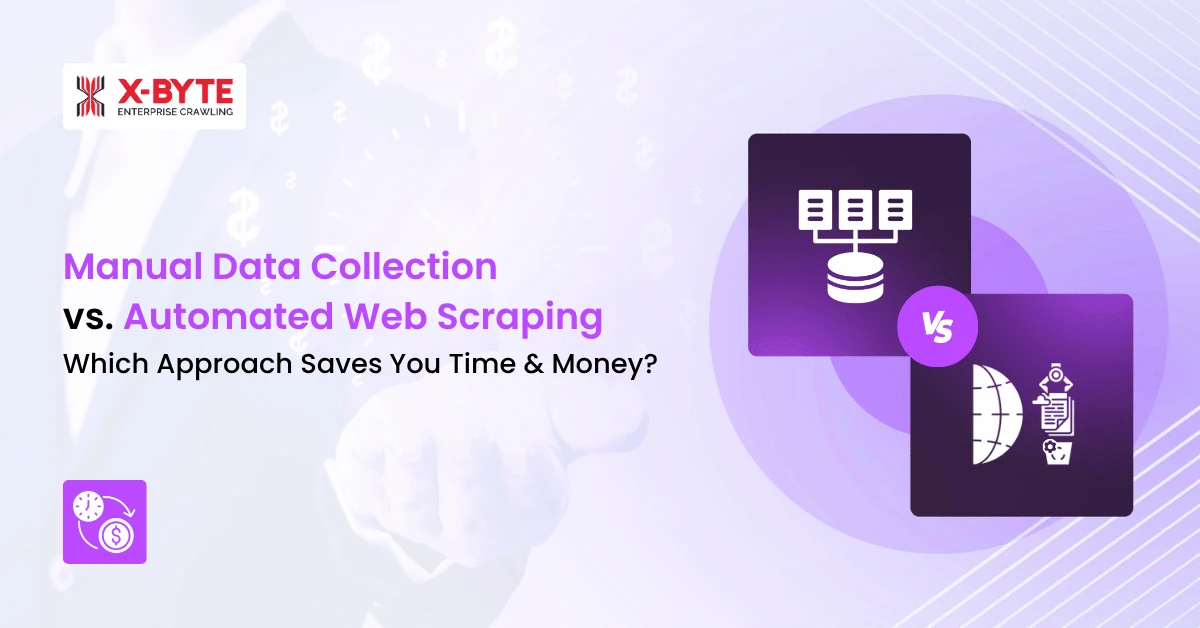
Data drives every business decision you make today. However, the method you choose to collect that data determines your success, efficiency, and bottom line. Companies face a critical choice: should they rely on manual data collection or embrace automated web scraping?
This question affects businesses across all industries. From e-commerce giants tracking competitor prices to startups researching market trends, the approach you select impacts your time, budget, and competitive advantage. Therefore, understanding the differences between these two methods is essential for making informed decisions.
In this comprehensive guide, we’ll compare manual data collection with automated web scraping. You’ll discover which approach saves time and money while delivering the insights your business needs to thrive.
What Is Manual Data Collection?
Manual data collection refers to the process where humans gather information by hand. This traditional approach involves several methods that many businesses still use today.
Common Manual Data Collection Methods
Teams typically collect data manually through these activities:
- Copy-pasting information from websites into spreadsheets
- Filling out forms based on research findings
- Taking notes during market research sessions
- Compiling data from multiple sources into reports
- Conducting surveys and recording responses
Industries Still Using Manual Methods
Several sectors continue to rely heavily on manual data collection. For instance, small retail businesses often track competitor prices by visiting websites daily. Meanwhile, research firms employ teams to gather information for client reports. Academic institutions frequently use manual methods for specific studies requiring human judgment.
Advantages of Manual Data Collection
Manual collection offers certain benefits that matter for specific use cases. First, it provides complete control over what data you collect and how you interpret it. Human insight allows for nuanced understanding of context and quality.
Second, manual collection requires minimal technical setup. Anyone with basic computer skills can start gathering data immediately. This accessibility makes it appealing for small teams with limited resources.
Third, humans can identify relevant information that automated systems might miss. They apply judgment to filter out irrelevant data and focus on what truly matters.
Drawbacks of Manual Data Collection
Despite these advantages, manual data collection comes with significant limitations. The process is extremely time-consuming. A single person might spend hours or days collecting data that automated systems gather in minutes.
Furthermore, manual collection proves costly in the long run. Companies must pay employees for hours spent on repetitive data gathering tasks. These labor costs add up quickly, especially for ongoing data needs.
Human error represents another major concern. People make mistakes when copying data, especially during lengthy, monotonous tasks. A single typo or missed entry can compromise entire datasets and lead to flawed business decisions.
Finally, manual methods don’t scale well. As your data needs grow, you must hire more people. This linear scaling makes expansion expensive and difficult to manage.
What Is Automated Web Scraping?
Automated web scraping transforms how businesses collect data from the internet. This technology-driven approach uses software to extract structured information from websites quickly and efficiently.
How Automated Web Scraping Works
Web scraping tools operate through several mechanisms. First, they send requests to target websites, just like a web browser does. Then, they parse the HTML structure of web pages to locate specific data points.
Modern scraping solutions use various technologies:
- Bots and crawlers that navigate websites systematically
- APIs that connect directly to data sources
- Parsers that extract and structure information
- Schedulers that run data collection at specified intervals
X-Byte Enterprise Crawling specializes in these advanced scraping technologies. Our solutions handle complex websites and deliver clean, structured data ready for analysis.
Key Advantages of Automated Web Scraping
Automated scraping offers compelling benefits that manual methods simply cannot match.
Speed and Efficiency: Scraping tools collect data in seconds or minutes rather than hours or days. They work 24/7 without breaks, vacations, or sick days. This constant operation means you always have current information.
Scalability: Automation handles unlimited data volumes effortlessly. Whether you need data from 10 websites or 10,000, the process remains consistent. You can expand your data collection without proportionally increasing costs.
Real-Time Updates: Automated systems provide continuous data streams. They monitor websites for changes and update your databases instantly. This real-time capability is crucial for dynamic markets.
Cost Efficiency: While initial setup requires investment, automation dramatically reduces long-term costs. You eliminate ongoing labor expenses associated with manual collection. Therefore, the return on investment compounds over time.
Consistency and Accuracy: Automated tools extract data exactly as programmed. They don’t get tired, distracted, or make transcription errors. This consistency ensures reliable datasets for critical business decisions.
Considerations for Automated Scraping
However, automated web scraping does require careful planning. Technical setup demands expertise in programming, web technologies, and data structures. Companies must either develop in-house capabilities or partner with specialists like X-Byte.
Additionally, businesses must stay aware of compliance requirements. Responsible scraping respects website terms of service, robots.txt files, and data protection regulations. X-Byte helps clients navigate these considerations to ensure ethical, compliant data collection.
Manual vs Automated: A Side-by-Side Comparison
Let’s examine how these approaches compare across key business factors. This direct comparison reveals why more companies are transitioning to automation.
Time Efficiency
Manual collection moves slowly. A researcher might spend 8 hours gathering data from 50 product listings. In contrast, automated scraping completes the same task in under 10 minutes. This time difference multiplies across daily, weekly, and monthly operations.
Cost Analysis
Manual methods create ongoing expenses. If you pay an employee $20 per hour for 20 hours of weekly data collection, that’s $1,600 monthly or $19,200 annually. Meanwhile, automated solutions from providers like X-Byte typically cost a fraction of this amount while delivering superior results.
Accuracy and Reliability
Human error rates in manual data entry range from 1% to 4% depending on task complexity. Therefore, in a dataset of 10,000 entries, you might expect 100-400 errors. Automated scraping eliminates these transcription mistakes, delivering consistent accuracy.
Scalability Potential
Manual collection scales linearly with labor. Doubling your data needs means doubling your workforce. However, automated scraping scales exponentially. Once set up, systems handle 10x or 100x more data with minimal additional cost.
Data Freshness
Manual collection provides static snapshots. By the time someone finishes collecting data, early entries may already be outdated. Conversely, automated systems deliver dynamic, continuously updated information. They capture changes as they happen across the web.
Comparison Table
| Factor | Manual Collection | Automated Web Scraping |
| Time | Slow, repetitive tasks | Real-time data updates |
| Cost | High ongoing labor costs | Lower long-term investment |
| Accuracy | Prone to human error | Consistent, reliable results |
| Scalability | Limited by workforce | Unlimited data volume |
| Data Type | Static snapshots | Dynamic, continuous streams |
| Flexibility | Easy to adjust on-the-fly | Requires programming changes |
Real-World Scenarios: Which Approach Works Better?
Different business situations call for different data collection strategies. Let’s explore specific use cases where each method shines.
Market Research and Analysis
Companies conducting market research face enormous data requirements. They need information about consumer preferences, industry trends, and market conditions.
Manual collection works for small-scale qualitative research. For example, a startup might manually gather insights from 20-30 industry expert articles. This approach allows for deep analysis and contextual understanding.
However, comprehensive market research demands automation. Tracking thousands of consumer reviews, social media mentions, and competitor activities exceeds manual capabilities. X-Byte’s data scraping services enable businesses to monitor entire markets continuously, identifying trends and opportunities in real-time.
Competitive Price Monitoring
E-commerce businesses must track competitor pricing to remain competitive. Price changes happen daily or even hourly in dynamic markets.
Manual price monitoring becomes impractical quickly. Checking 50 competitor products across multiple websites takes hours. By the time you finish, prices may have changed again.
Automated scraping solves this challenge elegantly. Systems monitor competitor prices continuously, alerting you to changes instantly. This real-time intelligence lets you adjust your pricing strategy proactively. X-Byte has helped numerous e-commerce clients implement automated price monitoring that increased their competitiveness and profit margins.
Competitor Analysis
Understanding competitor strategies requires gathering data from multiple sources. You need information about their products, marketing campaigns, customer reviews, and market positioning.
Manual competitive analysis is resource-intensive. Analysts might spend weeks compiling comprehensive competitor reports. This delay means you’re always reacting to old information.
Automated web scraping transforms competitive intelligence. Systems track competitor websites, social media, and public data sources continuously. You receive alerts when competitors launch new products, change strategies, or face customer complaints. This proactive intelligence gives you strategic advantages.
Lead Generation and Sales Intelligence
Sales teams need fresh leads to drive revenue growth. Finding qualified prospects requires gathering contact information, company details, and behavioral signals from across the web.
Manual lead generation proves extremely tedious. Sales representatives waste valuable selling time searching for contact information and researching prospects. This inefficiency directly impacts revenue potential.
Automated data collection revolutionizes lead generation. X-Byte’s data automation services gather prospect information from professional networks, company websites, and industry directories. Your sales team receives pre-qualified leads with complete profiles, letting them focus on building relationships and closing deals.
Cost and ROI Analysis: The Financial Impact
Understanding the financial implications helps justify investment in automation. Let’s examine the real costs and returns.
Calculating Time Savings
Consider a mid-size company that needs daily data on 500 products across 10 competitor websites. Manual collection requires approximately 4 hours daily.
Annual manual cost calculation:
- 4 hours × 5 days × 52 weeks = 1,040 hours annually
- At $25/hour labor cost = $26,000 yearly
- Plus benefits and overhead (30%) = $33,800 total annual cost
Automated scraping investment:
- Initial setup and configuration: $3,000-$5,000
- Monthly maintenance and hosting: $500
- Annual total: $9,000-$11,000
Net savings: $22,800-$24,800 in the first year alone. Subsequent years save even more since setup costs don’t recur.
ROI Improvements Through Automation
Beyond direct cost savings, automation delivers measurable ROI improvements:
Faster decision-making: Real-time data lets you respond to market changes immediately rather than waiting for weekly reports. This agility translates to captured opportunities and avoided risks.
Increased data volume: Automated systems gather 10-100x more data than manual methods. Richer datasets lead to better insights and more confident decisions.
Reduced errors: Eliminating human error prevents costly mistakes. One major pricing error caught through accurate automated monitoring can save thousands in lost revenue.
Competitive advantages: Companies using automation gain strategic edges over competitors still relying on manual methods. They identify trends earlier, respond faster, and make more informed decisions.
Long-Term Value Proposition
The financial benefits of automation compound over time. As your business grows, automated systems scale effortlessly while manual methods become increasingly expensive and impractical.
X-Byte clients typically see full ROI within 3-6 months. After that, the cost savings and business benefits become pure profit. Therefore, automation isn’t just a cost-reduction strategy—it’s a growth enabler.
Ensuring Compliance in Automated Scraping
Responsible data collection requires attention to legal and ethical considerations. Businesses must balance efficiency with compliance.
Data Protection and Privacy Laws
Several regulations govern automated data collection. The General Data Protection Regulation (GDPR) protects EU citizens’ personal data. California’s Consumer Privacy Act (CCPA) provides similar protections in the United States. Other regions have their own requirements.
These laws don’t prohibit web scraping. However, they require that you:
- Respect user privacy and data rights
- Have legitimate purposes for data collection
- Store and process data securely
- Honor opt-out requests
Ethical Scraping Practices
Beyond legal requirements, ethical scraping follows industry best practices:
Respect robots.txt files: These files tell crawlers which parts of websites owners want excluded. Responsible scrapers honor these instructions.
Implement rate limiting: Don’t overwhelm websites with excessive requests. Proper rate limiting ensures your scraping doesn’t impact site performance.
Identify your scraper: Use clear user-agent strings that identify your scraping activity. Transparency builds trust and reduces conflicts.
Follow terms of service: Each website sets usage terms. Review and comply with these guidelines for every data source.
How X-Byte Ensures Compliant Data Collection?
X-Byte prioritizes compliance and ethical practices in all our data scraping services. We help clients navigate complex legal landscapes while achieving their data objectives.
Our compliance framework includes:
- Legal review of all scraping projects
- Technical implementation of ethical scraping practices
- Regular compliance audits and updates
- Clear documentation and transparency
For more detailed guidance on compliance, explore our comprehensive article on ensuring compliance in data scraping at xbyte.io.
How X-Byte Helps You Automate Data Collection?
X-Byte Enterprise Crawling specializes in transforming business data collection from manual burden to automated advantage. We’ve helped companies across industries achieve dramatic efficiency improvements.
Our Comprehensive Solutions
X-Byte offers end-to-end data scraping services tailored to your specific needs:
Custom scraping development: We build solutions that target your exact data requirements. Whether you need product information, market data, or competitive intelligence, we create systems that deliver.
API development and integration: Our team develops custom APIs that connect your business systems directly to web data sources. This seamless integration means data flows automatically into your workflows.
Data automation services: Beyond scraping, we offer comprehensive data automation services that process, clean, and deliver information in your preferred format.
Scalable infrastructure: Our enterprise-grade infrastructure handles projects of any size. From small datasets to billions of data points, our systems deliver reliability and performance.
The X-Byte Advantage
What sets X-Byte apart in the data scraping industry?
Expertise: Our team brings years of experience solving complex data collection challenges. We understand web technologies, anti-scraping measures, and data processing at expert levels.
Reliability: We build robust systems with redundancy and monitoring. Your data flows continuously without interruption.
Compliance focus: We prioritize legal and ethical data collection. Our compliance-first approach protects your business from risks.
Custom solutions: We don’t offer one-size-fits-all products. Every solution we build addresses your specific challenges and integrates with your existing systems.
Ongoing support: Our relationship doesn’t end at deployment. We provide continuous monitoring, maintenance, and optimization to ensure long-term success.
Getting Started with X-Byte
Transforming your data collection process starts with a conversation. We want to understand your challenges, goals, and requirements.
Schedule a consultation with X-Byte today. Our experts will assess your current data collection methods and design an automation strategy tailored to your needs. Visit xbyte.io to learn more about how we can help your business work smarter, not harder.
Conclusion: Making the Right Choice for Your Business
The comparison between manual data collection and automated web scraping reveals a clear winner for most business scenarios. While manual methods offer simplicity and human insight for small-scale projects, they simply cannot compete with automation’s speed, accuracy, scalability, and cost-efficiency.
Key Takeaways
Manual collection makes sense in limited situations—small qualitative research projects, one-time data gathering tasks, or contexts requiring significant human judgment. However, for ongoing business intelligence, competitive monitoring, market research, and lead generation, automated web scraping delivers superior results.
The financial case for automation is compelling. Companies save thousands of dollars annually while gaining strategic advantages through real-time, accurate, and comprehensive data. These benefits multiply as your business grows and your data needs expand.
The Future Is Automated
Forward-thinking companies recognize that data automation isn’t optional—it’s essential for competitive survival. Markets move too quickly for manual methods. Competitors using automation will consistently outpace those relying on traditional approaches.
Therefore, the question is not whether to automate data collection. The question is when and how to implement automation effectively.
Take Action Today
Don’t let outdated data collection methods hold your business back. X-Byte Enterprise Crawling offers the expertise, technology, and support you need to transition from manual to automated data collection.
Transform your data collection process with X-Byte’s proven automation solutions. Our team of experts will design and implement a system that saves you time, reduces costs, and delivers the competitive intelligence your business needs.
Book a consultation with X-Byte today to discover how automated web scraping can revolutionize your business operations. Visit xbyte.io or contact our team to get started. Your competitive advantage is just one conversation away.
Frequently Asked Questions
 ✯ Alpesh Khunt ✯

Related Blogs
The Role of Data Annotation in Large Language Model Training and Performance
How Web Scraping Is Used to Extract eCommerce Data From eBay