

Why Real Estate Needs Automated Data Intelligence?
Real estate data sits scattered across thousands of websites. Property listings appear on Zillow, Trulia, Realtor.com, MLS portals, and brokerage sites. Meanwhile, investors, marketplaces, and PropTech platforms struggle to consolidate this information manually. The result? Missed opportunities, outdated pricing, and slow decision-making.
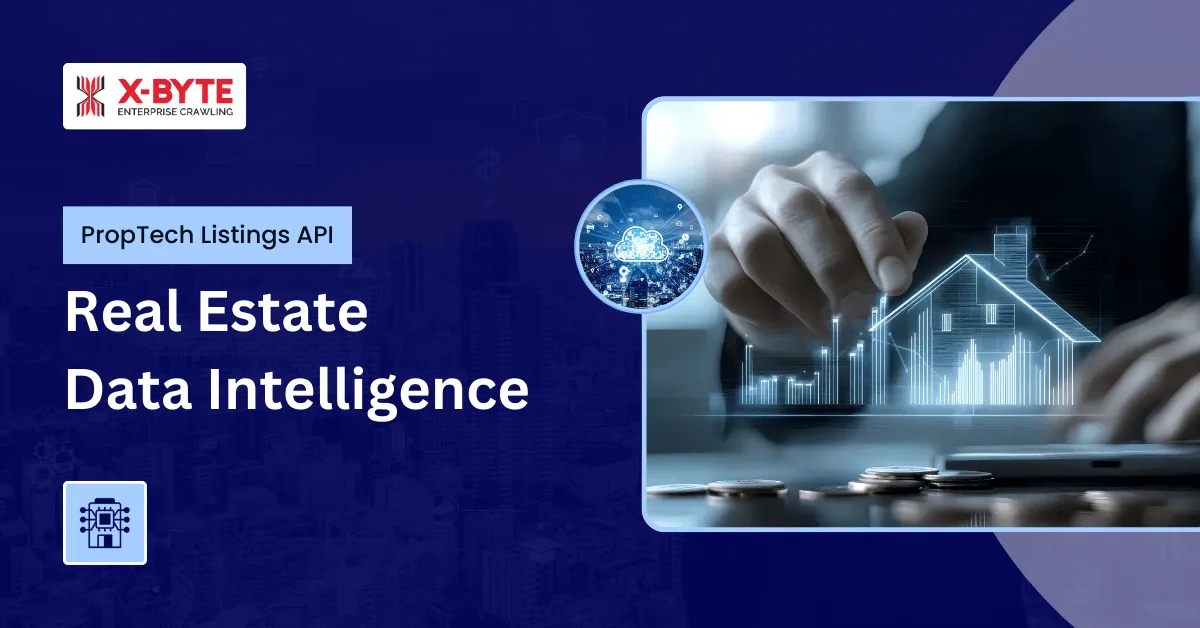
PropTech Listings API solves this problem. It automates property data extraction, delivering structured real estate intelligence in real time. Consequently, businesses gain speed, accuracy, and competitive advantage without building complex scraping infrastructure themselves.
Traditional methods involve manual data entry or basic web scraping tools. However, these approaches fail when dealing with anti-bot measures, dynamic JavaScript rendering, and frequent website changes. Therefore, enterprise-grade solutions like X-Byte Enterprise Crawling deliver reliable, scalable real estate data intelligence that powers modern PropTech applications.
The market demands automation. Property investors need real-time pricing signals. Marketplaces require fresh listings every hour. Real estate SaaS platforms must provide accurate valuations. As a result, PropTech Listings APIs have become essential infrastructure for any data-driven real estate business.
What Is a PropTech Listings API?
A PropTech Listings API is a programmatic interface that extracts property data from real estate websites automatically. It delivers structured information about listings, prices, property attributes, and market trends through standardized endpoints.
How Does It Work?
The process begins with automated crawlers that visit real estate websites systematically. These crawlers extract listing information, including property details, images, pricing history, and agent contacts. Next, the system normalizes data into consistent formats, regardless of source. Finally, the API delivers this structured intelligence through JSON endpoints, webhooks, or direct database feeds.
X-Byte Enterprise Crawling handles millions of property listings monthly. The system adapts to website changes automatically, ensuring continuous data flow without manual intervention. Moreover, advanced duplicate detection algorithms identify the same property listed across multiple platforms, providing unified property profiles.
Key Components You Get
Property listings APIs deliver comprehensive data points. First, you receive basic property attributes like address, square footage, bedrooms, and bathrooms. Second, pricing intelligence includes current list price, historical price changes, and days on market. Third, rich media assets contain high-resolution images, virtual tours, and floor plans. Fourth, location intelligence provides neighborhood details, school ratings, and walkability scores.
Additionally, APIs include agent information, property status updates, amenities lists, and transaction history. Therefore, developers can build sophisticated applications without worrying about data collection complexity.
Why Real-Time Real Estate Data Intelligence Matters?
How Does Price Tracking Improve Investment Decisions?
Real-time pricing data reveals market movements before they become obvious. Investors spot undervalued properties by comparing current prices against historical trends. Similarly, sellers optimize listing prices by analyzing comparable properties in real time.
For example, when a neighborhood experiences sudden price increases, API-powered alerts notify investors immediately. This advantage translates to thousands of dollars in potential profit. Furthermore, automated price monitoring eliminates the need for manual market research, saving countless hours weekly.
What Makes Competitive Listings Analysis Valuable?
Understanding competitor inventory drives strategic advantages. Real estate marketplaces track which properties competitors feature prominently. Brokerages analyze how competing firms price similar properties. Consequently, businesses adjust their strategies based on actual market data rather than assumptions.
X-Byte’s real estate data scraping service monitors competitor listings across multiple platforms simultaneously. This comprehensive view reveals pricing strategies, inventory levels, and market positioning instantly.
Why Do Location Intelligence Insights Matter?
Property value depends heavily on location attributes. Schools, crime rates, transportation access, and local amenities significantly impact prices. Therefore, PropTech platforms integrate location intelligence to provide context beyond basic property features.
APIs deliver walkability scores, nearby points of interest, demographic data, and development plans. These insights help buyers evaluate properties holistically. Moreover, developers can build recommendation engines that match properties to buyer preferences based on location attributes.
How Do Demand and Sentiment Signals Work?
Market sentiment reveals where demand trends before prices adjust. APIs track listing view counts, time on market, and price reduction patterns. These signals indicate whether properties sell quickly or languish unsold.
For instance, increasing view counts combined with rapid sales suggest strong demand. Conversely, frequent price reductions signal weak interest. Therefore, investors use these signals to time their transactions optimally.
Core Data You Can Extract Using a PropTech Listings API
Comprehensive property data extraction includes multiple layers. First, property details cover address, type (single-family, condo, townhouse), year built, lot size, and living space. Second, rich media includes professional photos, 3D tours, drone footage, and floor plans.
Third, pricing intelligence encompasses current list price, original list price, price history with dates, property tax amounts, and HOA fees. Fourth, property status indicators show whether listings are active, pending, under contract, or sold.
Fifth, comparative market analysis data provides similar properties sold recently, rental comparables, and neighborhood pricing trends. Sixth, time-based metrics include days on market, listing date, and status change dates. Seventh, agent and agency details contain contact information, brokerage names, and agent performance statistics.
Eighth, amenity details list features like pools, garages, updated kitchens, smart home technology, and outdoor spaces. Finally, location attributes include school districts, crime statistics, walkability scores, and nearby services.
X-Byte Enterprise Crawling delivers all these data points through a unified API. Therefore, developers access comprehensive property intelligence without managing multiple data sources.
How Do PropTech Listings APIs Help Different Businesses?
What Do Real Estate Marketplaces Gain?
Marketplaces require fresh listings constantly. Manual updates create delays and errors. However, automated APIs refresh inventory every few minutes, ensuring users see the latest available properties.
For example, a marketplace using PropTech Listings API displays newly listed properties within minutes of their appearance on source websites. This speed attracts serious buyers who want immediate access to new opportunities. Additionally, automatic status updates prevent showing sold properties, improving user experience significantly.
How Do Brokerage Firms Benefit?
Brokerages need competitive intelligence and lead scoring capabilities. APIs provide real-time data about market conditions, helping agents price listings accurately. Furthermore, lead scoring algorithms identify high-intent buyers based on their search patterns and property views.
Price accuracy matters tremendously. Overpriced listings languish unsold. Underpriced properties leave money on the table. Therefore, data-driven pricing recommendations increase close rates and maximize commission values.
Why Do Investors and REITs Rely on APIs?
Investment firms analyze hundreds of markets simultaneously. Manual analysis becomes impossible at scale. However, PropTech APIs deliver predictive analytics based on comprehensive market data.
Investors identify emerging markets by tracking price velocity, inventory levels, and days-on-market trends. They spot distressed properties through price reduction patterns. They evaluate renovation opportunities by comparing property conditions against neighborhood averages. Consequently, data-driven investment strategies outperform intuition-based approaches consistently.
What Can Real Estate SaaS Platforms Build?
SaaS platforms create sophisticated applications using API data. Property recommendation engines match buyers with ideal homes based on preferences, budget, and lifestyle factors. Valuation tools estimate property worth using comparable sales data. Market analytics dashboards reveal trends across multiple dimensions.
Moreover, these platforms integrate location intelligence data scraping from X-Byte to enrich property profiles with neighborhood insights. This combination creates compelling user experiences that differentiate products in competitive markets.
Features That Make X-Byte’s Real Estate API Stand Out
What Makes Enterprise-Grade Crawling Infrastructure Different?
Scale and reliability separate enterprise solutions from basic scrapers. X-Byte Enterprise Crawling processes over 10 million properties monthly without failures. The distributed infrastructure adapts automatically to traffic spikes, website changes, and anti-bot measures.
Redundancy ensures continuous operation. If one crawler encounters issues, others compensate automatically. Therefore, data flows consistently regardless of technical challenges.
How Does Multi-Source Data Normalization Work?
Different websites format data differently. Addresses might appear as “123 Main St” on one site and “123 Main Street” on another. Square footage might be listed as “sqft” or “sq ft.” Bedrooms might be “3 BR” or “3 beds.”
Normalization algorithms standardize all variations into consistent formats. This process enables accurate comparisons across sources. Consequently, developers receive clean, structured data that integrates seamlessly into applications.
Why Does AI-Powered Duplicate Detection Matter?
The same property often appears on multiple websites. Without deduplication, databases fill with redundant entries. However, AI algorithms identify identical properties across platforms by analyzing addresses, images, and attributes.
This technology creates unified property profiles combining information from all sources. Users see complete property histories rather than fragmented data. Therefore, decision quality improves significantly.
How Do Real-Time Delivery Options Work?
APIs offer flexible delivery mechanisms. RESTful endpoints provide on-demand access to property data. Webhooks push updates immediately when changes occur. Direct database feeds enable bulk data transfers for analytical applications.
Real-time delivery means businesses react instantly to market changes. When prices drop on target properties, investors receive immediate notifications. When new listings match buyer criteria, alerts trigger automatically. This responsiveness creates competitive advantages in fast-moving markets.
Practical Use Cases of PropTech Listings API
Price comparison dashboards display properties side-by-side with detailed attribute comparisons. Users filter by price per square foot, location, amenities, and other criteria simultaneously.
Property investment risk models evaluate neighborhoods using historical price trends, days-on-market patterns, and inventory levels. These models assign risk scores helping investors avoid problematic markets.
Location scoring algorithms rank neighborhoods based on schools, safety, transportation, and lifestyle amenities. Buyers discover areas matching their priorities automatically.
Rent estimation engines predict rental income using comparable properties, occupancy rates, and market conditions. Investors calculate potential returns before purchasing.
Appraisal and valuation tools estimate property worth using automated valuation models trained on millions of transactions. These tools reduce appraisal costs while maintaining accuracy.
Market trend forecasting analyzes seasonal patterns, supply-demand dynamics, and economic indicators. Forecasts help investors time their transactions optimally.
Real Case Study: How PropTech APIs Accelerate Growth?
Large-scale structured data extraction transforms business operations. Consider retail data extraction examples where businesses scrape millions of product listings to optimize pricing strategies. Similarly, real estate platforms extract comprehensive property data to power sophisticated applications.
One PropTech startup used X-Byte’s API to build a property recommendation engine. Initially, they manually collected data from 20 cities, spending weeks on research. However, growth required covering 200+ cities, making manual methods impossible.
After implementing the PropTech Listings API, they accessed nationwide property data within days. Consequently, their user base grew 10x in six months. Investors responded positively to their data-driven approach, leading to successful funding rounds.
The API eliminated engineering resources previously spent maintaining scrapers. The team focused on building unique features instead of fighting anti-bot measures. Therefore, product quality improved while development costs decreased.
How Do You Integrate a PropTech Listings API Into Your Platform?
What Do API Endpoints and JSON Structures Look Like?
Modern APIs use RESTful designs with intuitive endpoints. For example:
- GET /properties?city=Miami&status=active returns active listings in Miami
- GET /property/{id} retrieves detailed information about specific properties
- GET /property/{id}/history shows price changes over time
JSON responses follow standardized schemas. Developers receive consistent data structures regardless of source websites. Therefore, integration requires minimal custom parsing logic.
What Are Scalability Requirements?
Applications must handle data volume and request frequency. Small platforms might query APIs hundreds of times daily. Large marketplaces might make millions of requests.
Plan infrastructure accordingly. Use caching to reduce redundant requests. Implement rate limiting to prevent overwhelming your systems. Design databases to handle rapid data ingestion. Therefore, your platform scales smoothly as usage grows.
How Do You Address Data Governance and Compliance?
Legal compliance matters tremendously. Respect robots.txt files. Follow website terms of service. Avoid accessing password-protected areas without permission.
X-Byte’s real estate data scraping service maintains strict compliance standards. We extract only publicly available information. We respect rate limits. We implement ethical scraping practices that protect source websites. Consequently, clients avoid legal complications while accessing valuable data.
What Monitoring and Infrastructure Setup Do You Need?
Production systems require monitoring. Track API response times to detect performance issues. Monitor error rates to identify problems quickly. Set up alerts for unusual patterns.
Infrastructure must handle peak loads. Real estate searches spike during weekends and evenings. Therefore, auto-scaling capabilities ensure consistent performance regardless of traffic patterns.
Why Choose X-Byte for Real Estate Data Intelligence?
X-Byte delivers 99% accuracy across millions of property records. Our quality control processes verify data against multiple sources. Consequently, businesses rely on our data for critical decisions.
We capture over 10 million properties monthly across major markets. This comprehensive coverage ensures clients access complete market intelligence. Moreover, our geographic reach expands continuously as markets evolve.
Zero-maintenance crawling eliminates technical headaches. We handle website changes automatically. We adapt to anti-bot measures without client intervention. We maintain consistent data flow regardless of technical challenges. Therefore, clients focus on building applications rather than managing infrastructure.
Industry-grade compliance protects clients legally. We follow best practices for ethical data extraction. We provide documentation demonstrating compliance. We support clients through legal review processes. Consequently, businesses confidently integrate our data into their platforms.
Conclusion: The Future of Real Estate Belongs to Automated Data Intelligence
PropTech combined with APIs and automation creates undeniable competitive advantages. Businesses making data-driven decisions outperform those relying on intuition. Real-time insights enable faster, smarter transactions. Comprehensive market intelligence reveals opportunities others miss.
The real estate industry continues digitizing rapidly. Winners will be platforms providing superior data, better insights, and faster responses. X-Byte Enterprise Crawling powers these winning platforms through reliable, comprehensive real estate data intelligence.
Therefore, forward-thinking businesses invest in PropTech Listings APIs today. They build sustainable competitive moats based on superior information access. They create user experiences that competitors cannot match without similar data infrastructure.
Frequently Asked Questions
 ✯ Alpesh Khunt ✯

Related Blogs
The Role of Data Annotation in Large Language Model Training and Performance
How Web Scraping Is Used to Extract eCommerce Data From eBay