

What Is Real-Time Data Scraping and Why Does It Matter?
Real-time data scraping is the automated process of extracting information from websites as it updates, giving businesses immediate access to competitive intelligence. For e-commerce companies, this technology provides instant visibility into competitor pricing, inventory levels, product descriptions, and market trends.
The difference between success and failure in online retail often comes down to speed. When a competitor drops their price by 10%, waiting 24 hours to respond can cost thousands in lost sales. Real-time data scraping from X-Byte Enterprise Crawling eliminates this delay, allowing brands to react within minutes rather than days.
According to recent market analysis, e-commerce businesses using real-time pricing intelligence see an average revenue increase of 15-25% compared to those relying on manual monitoring. This dramatic difference stems from the ability to make informed decisions instantly, capturing demand at optimal price points before market conditions shift.
How Does Real-Time Data Scraping Work in E-Commerce?
Real-time scraping operates through automated bots that continuously monitor target websites. These systems detect changes as they occur, whether it’s a price adjustment, stock status update, or new product launch. The technology works in four key stages.
First, the scraping system identifies target URLs across competitor websites. Second, it extracts specific data points like prices, availability, and specifications. Third, it processes this raw data into structured formats. Finally, it delivers actionable insights through dashboards or direct API integration.
X-Byte Enterprise Crawling uses advanced parsing algorithms that adapt to website structure changes automatically. This means your data collection continues uninterrupted even when competitors redesign their sites. Moreover, the system handles JavaScript-heavy pages and dynamic content that traditional scrapers miss.
The technology respects rate limits and employs ethical scraping practices. This ensures compliance with website terms of service while maintaining data accuracy. Businesses receive clean, normalized data ready for immediate analysis without manual cleanup.
Why Is Speed Critical in E-Commerce Data Collection?
Speed determines competitive advantage in digital commerce. Markets shift rapidly, with price changes occurring multiple times daily across major retail categories. Electronics, fashion, and consumer goods see particularly volatile pricing patterns driven by demand fluctuations and inventory pressures.
Consider this scenario: A competitor runs a flash sale on a popular product. With real-time scraping from xbyte.io, you detect this change within minutes. Your pricing algorithm automatically adjusts your offer to remain competitive, capturing sales that would otherwise go to competitors. Without real-time data, you discover the sale hours later, missing the peak traffic window entirely.
Seasonal trends amplify this need for speed. During Black Friday or holiday shopping periods, prices change hourly. Retailers who monitor competitors in real-time can optimize their positioning throughout the day, maximizing both sales volume and profit margins. Research shows that dynamic pricing strategies based on real-time data increase conversion rates by 20-35% during peak seasons.
Furthermore, inventory availability changes constantly. Knowing when competitors stock out allows you to adjust your marketing spend, targeting customers searching for now-unavailable products. This strategic timing converts frustrated shoppers into your customers.
What Are the Key Benefits of Real-Time Price Monitoring?
Real-time price monitoring transforms how e-commerce brands approach market positioning. The primary benefit is competitive pricing accuracy. Instead of guessing or using outdated information, you know exactly where your prices stand relative to competitors at any moment.
Dynamic pricing becomes truly effective with real-time data. Your systems can automatically adjust prices based on current market conditions, competitor actions, and inventory levels. This automation eliminates manual price checks and reduces the risk of human error in pricing decisions.
Market intelligence improves dramatically with continuous monitoring. You identify pricing patterns, understand competitor strategies, and predict market movements before they fully materialize. For instance, if multiple competitors gradually increase prices on a category, you can anticipate an industry-wide adjustment and position accordingly.
Revenue optimization occurs naturally when pricing decisions use current data. X-Byte Enterprise Crawling enables brands to find the sweet spot between competitiveness and profitability. You avoid leaving money on the table by underpricing while staying attractive enough to convert price-sensitive shoppers.
Additionally, real-time monitoring reveals product gaps and opportunities. When competitors stock out or discontinue items, you can quickly capitalize by adjusting your catalog and marketing focus. This agility creates unexpected revenue streams that static monitoring would miss entirely.
How Does Real-Time Scraping Support Dynamic Pricing Strategies?
Dynamic pricing requires constant market awareness to function effectively. Real-time data scraping provides the foundation for algorithmic pricing that responds to market conditions automatically. This technology enables several sophisticated pricing approaches.
Competitive-based pricing adjusts your rates based on competitor positions. When rivals change their prices, your system responds according to predetermined rules. For example, you might maintain a 5% discount versus the market leader or match the lowest competitor price within a certain threshold.
Demand-based pricing incorporates real-time market data with internal metrics like conversion rates and inventory velocity. If data shows competitors raising prices while your conversion rate remains strong, the system can incrementally test higher price points to maximize margin without sacrificing volume.
Time-based pricing leverages hourly or daily patterns revealed through continuous monitoring. Certain products show predictable price fluctuations throughout the week. Knowing these patterns allows strategic positioning during low-competition windows and defensive pricing during peak competition periods.
X-Byte Enterprise Crawling integrates seamlessly with pricing engines, feeding fresh data directly into decision algorithms. This integration eliminates delays between data collection and price updates, ensuring your strategy executes in real-time rather than reacting to yesterday’s market conditions.
What Industries Benefit Most from Real-Time E-Commerce Data?
While all e-commerce sectors gain advantages from real-time scraping, certain industries see particularly dramatic impacts. Electronics and consumer technology rank highest due to rapid price volatility and fierce competition. Products like smartphones, laptops, and accessories experience multiple daily price changes across retailers.
Fashion and apparel benefit significantly, especially fast-fashion brands operating on tight trend cycles. Real-time monitoring reveals style trends, popular colors, and pricing strategies across competitors. This intelligence informs buying decisions and helps brands stay ahead of shifting consumer preferences.
The travel and hospitality sector, including vacation rentals and booking platforms, relies heavily on real-time pricing data. Rates fluctuate based on demand, seasonality, and competitive positioning. Companies using real-time intelligence optimize occupancy rates and revenue per booking more effectively than those with delayed data.
Home goods and furniture retailers use real-time scraping to monitor extensive product catalogs across multiple competitors. Given the long consideration periods for furniture purchases, staying competitively positioned throughout the customer journey proves essential for conversion.
Grocery and consumables, particularly online grocery services, depend on real-time data to maintain competitive edge on everyday items where consumers show high price sensitivity. Small price differences directly influence purchase decisions in these categories.
How Can Small E-Commerce Businesses Compete Using Data Scraping?
Small retailers often assume sophisticated data scraping belongs exclusively to enterprise operations. However, modern solutions like X-Byte Enterprise Crawling make real-time competitive intelligence accessible to businesses of all sizes. This democratization levels the playing field significantly.
Small businesses actually gain proportionally larger advantages from real-time data. Unlike large retailers with substantial market research budgets, smaller operations historically lacked comprehensive competitive intelligence. Real-time scraping provides SMEs with enterprise-level insights at accessible price points.
Implementation doesn’t require technical expertise. X-Byte Enterprise Crawling offers turnkey solutions with intuitive dashboards that display competitive data clearly. Business owners make informed decisions without writing code or managing complex infrastructure. The platform handles technical complexity while delivering actionable intelligence.
Focus becomes a strategic advantage for smaller retailers. While major competitors monitor thousands of SKUs, small businesses can concentrate scraping resources on their core product categories. This focused approach often yields more actionable insights than broad but shallow monitoring across entire catalogs.
Moreover, agility favors smaller operations. Large retailers often require approvals and coordination before implementing price changes. Small businesses can adjust instantly based on real-time data from xbyte.io, capturing opportunities that bureaucratic competitors miss. This speed advantage compensates for scale disadvantages.
What Data Points Should E-Commerce Brands Monitor in Real-Time?
Effective scraping strategies prioritize the most impactful data points. Pricing naturally leads the list, including list prices, sale prices, and promotional discounts. Understanding the complete pricing picture across competitors informs strategic positioning decisions.
Product availability status proves equally critical. Knowing when competitors stock out creates immediate opportunities to capture demand. Conversely, tracking restock patterns helps predict competitive intensity changes. This intelligence shapes inventory and marketing decisions.
Product descriptions and specifications reveal competitive positioning strategies. Changes in how competitors describe products indicate shifts in messaging or target audience focus. These insights inform your own content strategy and differentiation efforts.
Customer reviews and ratings, while not changing as rapidly as prices, provide valuable context for competitive analysis. Products with deteriorating review scores present opportunities for competitive positioning. Similarly, highly-rated competitor products warrant close examination for feature or quality gaps.
Shipping costs and delivery times increasingly influence purchase decisions. Monitoring these data points across competitors reveals service level expectations and identifies opportunities to differentiate through superior fulfillment. Many shoppers abandon carts when discovering unexpectedly high shipping costs during checkout.
X-Byte Enterprise Crawling can track all these data points simultaneously, providing comprehensive competitive intelligence. The system prioritizes data collection based on your business priorities, ensuring you focus on metrics that directly impact revenue and growth.
How Does Real-Time Data Improve Inventory Management?
Real-time competitive data transforms inventory planning from reactive to predictive. By monitoring competitor stock levels continuously, brands anticipate demand patterns and adjust purchasing accordingly. This intelligence prevents both stockouts and overstock situations.
When popular items show widespread availability across competitors, aggressive inventory positions make sense. Conversely, when monitoring reveals competitors struggling with stock, conservative inventory approaches protect margins by avoiding deep discounts to clear excess stock.
Seasonal demand becomes more predictable with real-time data. Observing when competitors begin clearing seasonal inventory signals optimal timing for your own seasonal transitions. This coordination prevents being caught with off-season inventory while competitors have already moved to new collections.
Product lifecycle management improves through continuous monitoring. Detecting when competitors discontinue products or introduce replacements guides your own product evolution strategy. Being early or late in product cycles significantly impacts profitability.
Furthermore, real-time stock monitoring reveals supply chain disruptions affecting competitors. This early warning system allows proactive communication with your suppliers and customers, managing expectations and adjusting strategies before problems reach your operation.
What Are the Risks of Not Using Real-Time Data Scraping?
Operating without real-time competitive intelligence creates multiple vulnerabilities. The most obvious risk is price blindness, making decisions based on outdated information that no longer reflects market reality. This often results in being either uncompetitively expensive or unnecessarily cheap.
Opportunity costs accumulate rapidly without real-time monitoring. Every competitor stockout, price increase, or promotional gap represents potential sales. Missing these opportunities day after day significantly impacts annual revenue totals. Studies indicate that retailers without competitive intelligence miss 15-30% of available market opportunities.
Brand reputation suffers when customers discover better prices immediately after purchasing from you. In the age of instant price comparison apps, shoppers quickly identify overpricing. This damages trust and reduces customer lifetime value even when your overall pricing strategy seems reasonable.
Strategic planning becomes guesswork without continuous data collection. Major decisions about product selection, pricing positioning, and market entry rely on understanding competitive dynamics. Outdated or incomplete intelligence leads to expensive strategic mistakes that real-time data would prevent.
Competitive pressure increases as rivals adopt real-time intelligence. Markets tend toward efficiency, meaning competitors using advanced tools gain growing advantages over those relying on manual methods. The performance gap widens over time as data-driven competitors optimize while others stagnate.
How Should Businesses Choose a Data Scraping Solution?
Selecting the right scraping provider requires evaluating several critical factors. Data accuracy tops the list since decisions based on incorrect information cause more harm than no data at all. X-Byte Enterprise Crawling maintains 99%+ accuracy through advanced validation and error detection systems.
Update frequency determines how “real-time” your intelligence actually becomes. Solutions offering hourly updates provide limited advantage over daily scraping for most categories. True real-time solutions from xbyte.io update within minutes of changes, enabling genuinely responsive strategies.
Scalability matters as businesses grow. Starting with 100 monitored products seems manageable, but expanding to 10,000 SKUs across dozens of competitors requires robust infrastructure. Choose providers capable of scaling without performance degradation or proportional cost increases.
Integration capabilities determine operational efficiency. Manual data exports and imports create delays and errors. API-based integration from X-Byte Enterprise Crawling feeds data directly into pricing engines, business intelligence tools, and inventory systems automatically.
Compliance and ethical practices protect your business from legal exposure. Reputable providers like xbyte.io employ ethical scraping methods that respect robots.txt files, maintain reasonable request rates, and comply with data protection regulations. This safeguards your brand reputation.
Support and customization options ensure the solution meets your specific needs. Off-the-shelf scraping tools often miss unique data points or fail to parse specialized website structures. Providers offering customization adapt to your exact requirements.
What Implementation Steps Ensure Successful Data Scraping?
Successful implementation begins with clearly defining objectives. Identify which competitors matter most, which product categories require monitoring, and which metrics directly influence decisions. This focus prevents overwhelming teams with irrelevant data while ensuring critical intelligence flows reliably.
Start with a pilot program covering a limited product range. This approach tests the technology, validates data accuracy, and allows teams to develop processes before full-scale deployment. Lessons learned during pilots prevent costly mistakes during expansion.
Integration planning deserves careful attention. Determine how scraped data will flow into existing systems and who needs access to various data types. X-Byte Enterprise Crawling supports multiple integration methods, from simple dashboard access to sophisticated API connections feeding directly into pricing algorithms.
Training ensures teams understand and utilize available intelligence. Even perfect data provides no value if decision-makers don’t know it exists or how to interpret it. Invest time educating stakeholders on accessing, interpreting, and acting on competitive intelligence.
Establish clear governance around pricing decisions. Define who can adjust prices based on competitive data, what thresholds require approval, and how to document decision rationale. This governance prevents reactive price wars while enabling strategic responsiveness.
Continuous optimization follows implementation. Regularly review which data points prove most valuable and adjust scraping priorities accordingly. Markets evolve, so competitive intelligence strategies must evolve too. X-Byte Enterprise Crawling works with clients to refine strategies as businesses grow and change.
How Does Real-Time Scraping Support Market Expansion?
Entering new markets or categories requires extensive competitive research. Real-time scraping accelerates this research dramatically, providing comprehensive competitive landscapes within days rather than months. This speed reduces time-to-market and associated opportunity costs.
Geographic expansion particularly benefits from automated competitive intelligence. Understanding pricing norms, popular products, and competitive intensity across regions guides market entry strategy. Manual research across multiple countries proves prohibitively expensive and slow, while scraping provides consistent intelligence globally.
Product category expansion relies on understanding established competitor positioning. Before launching in new categories, brands need clarity on price points, feature expectations, and competitive gaps. Real-time data from xbyte.io reveals these dynamics quickly, informing product development and go-to-market strategies.
Testing market viability becomes less risky with comprehensive data. Rather than committing significant resources based on limited information, brands can pilot new markets with confidence grounded in detailed competitive intelligence. This reduces failed expansion attempts and associated losses.
Conclusion: Transform Your E-Commerce Strategy with Real-Time Intelligence
Real-time data scraping has evolved from a competitive advantage to a business necessity. E-commerce markets move too quickly for manual monitoring or delayed data collection. Brands that embrace real-time intelligence from providers like X-Byte Enterprise Crawling position themselves for sustainable growth in increasingly competitive digital markets.
The technology delivers measurable results through improved pricing accuracy, enhanced inventory management, and strategic market positioning. Whether you operate a small boutique or a large retail operation, real-time competitive intelligence scales to meet your needs.
Success in modern e-commerce requires making better decisions faster than competitors. Real-time data scraping provides the intelligence foundation enabling this performance advantage. Companies that delay adoption cede market share to more informed rivals.
Start winning the pricing battle today. Visit xbyte.io to discover how X-Byte Enterprise Crawling can transform your competitive intelligence and accelerate e-commerce growth. Our experts are ready to design a real-time scraping solution tailored to your specific market challenges and business objectives.
Frequently Asked Questions
 ✯ Alpesh Khunt ✯

Related Blogs
The Role of Data Annotation in Large Language Model Training and Performance
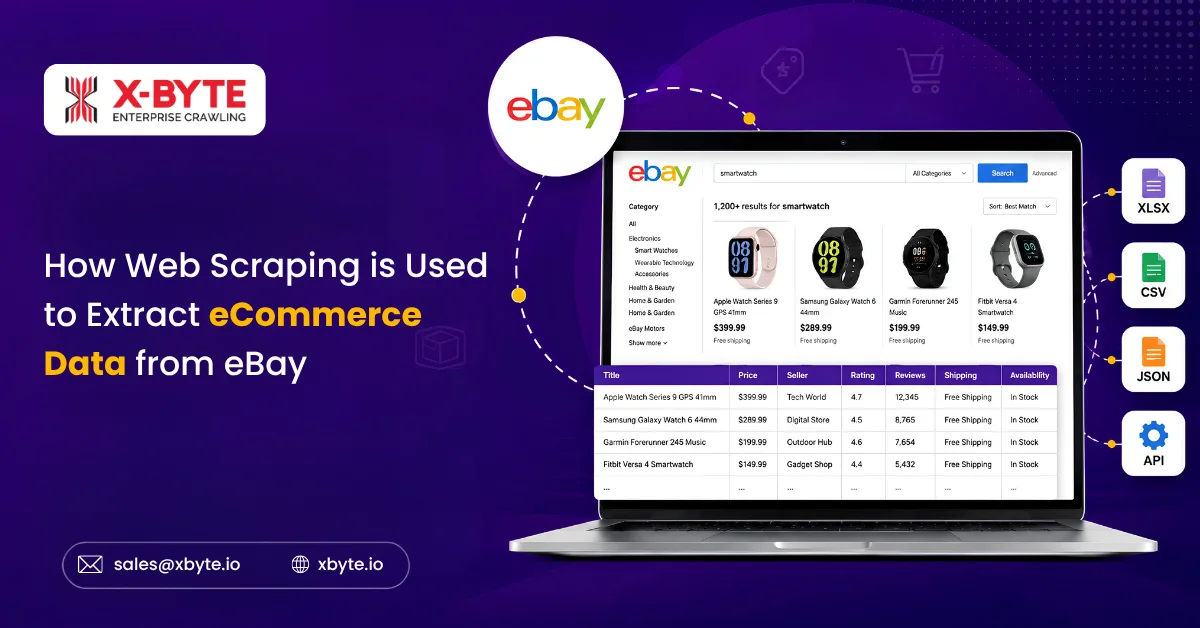
How Web Scraping Is Used to Extract eCommerce Data From eBay