

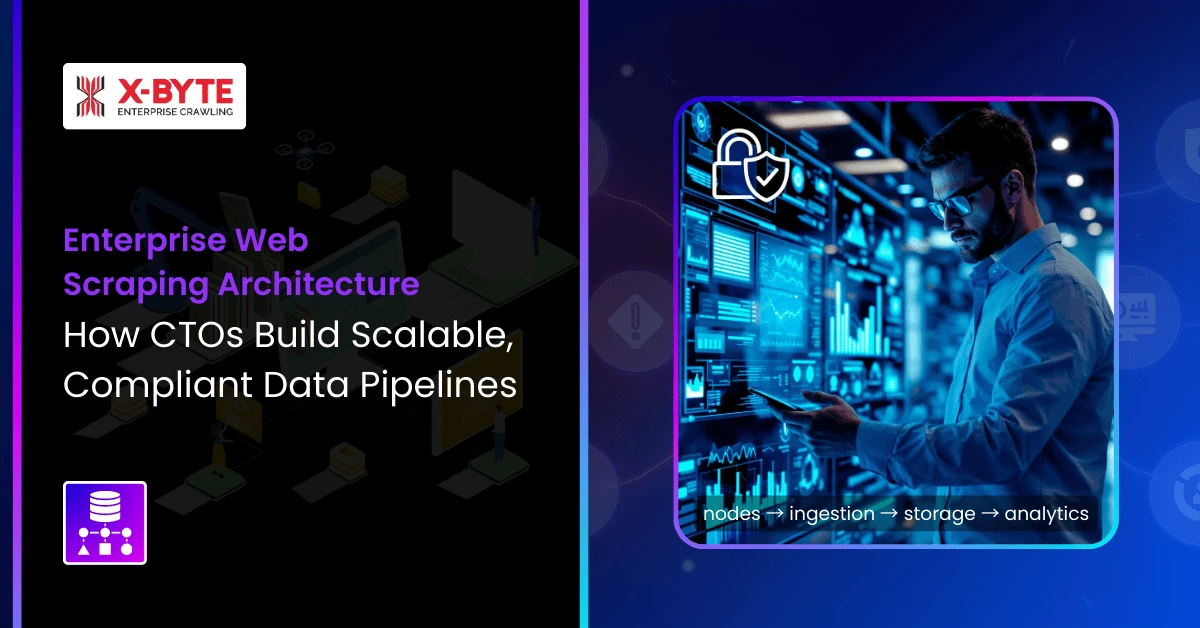
Enterprise web scraping architecture refers to the systematic framework and infrastructure that organizations use to extract, process, and store large volumes of data from websites while maintaining scalability, security, and legal compliance. For CTOs and technical leaders, building compliant data pipelines means creating systems that can handle massive data volumes, adapt to changing requirements, and operate within legal boundaries.
Modern enterprises rely on web scraping to gather competitive intelligence, monitor market trends, and power AI-driven decision-making. However, building these systems requires careful planning. According to industry research, 67% of enterprises cite compliance concerns as their primary barrier to scaling web scraping operations. Therefore, understanding how to architect these systems properly becomes critical for business success.
Why Does Web Scraping Architecture Matter for Enterprises?
Enterprise-level data scraping differs fundamentally from small-scale operations. CTOs face unique challenges that require sophisticated solutions.
First, volume presents a significant challenge. Enterprise systems must process millions of web pages daily without degradation in performance. Second, compliance requirements have become stricter. Regulations like GDPR and CCPA impose severe penalties for data misuse. Third, reliability is non-negotiable. Business decisions depend on consistent, accurate data flows.
X-Byte Enterprise Crawling specializes in addressing these challenges through proven architectural frameworks. Our clients typically see 10x improvements in data processing speeds while maintaining 100% compliance with regional data protection laws.
The role of technical leadership extends beyond simply choosing tools. CTOs must balance competing priorities: speed versus compliance, cost versus reliability, and flexibility versus security. Moreover, they need to future-proof systems against evolving legal landscapes and technical requirements.
What Are the Key Challenges in Enterprise Web Scraping?
Building scalable data pipelines involves overcoming several critical obstacles.
Legal and Compliance Risks
Data privacy laws vary significantly across jurisdictions. GDPR in Europe requires explicit consent for personal data collection. CCPA in California grants consumers the right to know what data companies collect. Meanwhile, other regions have their own frameworks.
Website terms of service add another layer of complexity. Some sites explicitly prohibit automated access. Others implement technical barriers like CAPTCHAs and rate limiting. Consequently, legal review becomes essential before launching any scraping initiative.
Technical Scalability Issues
As data volumes grow, systems face bottlenecks. Network bandwidth limitations slow down requests. Server capacity constraints prevent parallel processing. Additionally, target websites may implement anti-scraping measures that require sophisticated workarounds.
Storage becomes another concern. Raw scraped data can consume terabytes of space monthly. Therefore, efficient data compression, deduplication, and archival strategies are necessary.
Data Quality and Consistency
Websites constantly change their structure. A layout update can break existing scrapers. Furthermore, inconsistent data formats across different sources create integration challenges. Data validation, error handling, and automated monitoring become critical components of any enterprise architecture.
How Do You Design Scalable Web Scraping Pipelines?
Building scalable web scraping infrastructure requires a methodical approach. Here’s a proven framework that X-Byte Enterprise Crawling uses with enterprise clients.
Step 1: Define Clear Objectives and Requirements
Start by identifying exactly what data you need and why. Document the specific fields, update frequencies, and volume requirements. This clarity drives all subsequent architectural decisions.
For example, real-time pricing data requires different infrastructure than monthly market reports. Similarly, scraping 100 websites demands a different approach than scraping 10,000 sites.
Step 2: Choose the Right Architecture Pattern
Three primary patterns exist for enterprise web scraping:
Centralized Architecture: A single coordinated system manages all scraping activities. This approach simplifies monitoring but can create single points of failure.
Distributed Architecture: Multiple independent scrapers operate in parallel across different geographic locations. This pattern improves reliability and speed but requires more sophisticated coordination.
Hybrid Architecture: Combines centralized control with distributed execution. X-Byte Enterprise Crawling recommends this approach for most enterprises because it balances control with scalability.
Step 3: Implement Parallel Processing
Sequential scraping cannot achieve enterprise scale. Instead, implement parallel processing using these techniques:
- Use multiple worker nodes to scrape different websites simultaneously
- Implement asynchronous requests within each worker to maximize throughput
- Deploy scrapers across multiple IP addresses to avoid rate limiting
- Leverage cloud infrastructure that can scale dynamically based on demand
Python’s asyncio library, combined with frameworks like Scrapy, enables efficient parallel processing. However, proper coordination prevents duplicate requests and ensures consistent data collection.
Step 4: Build Robust Error Handling
Enterprise systems must handle failures gracefully. Implement these error handling strategies:
- Automatic retry logic with exponential backoff for temporary failures
- Dead letter queues for requests that consistently fail
- Comprehensive logging to diagnose issues quickly
- Alerting systems that notify engineers of critical problems
X-Byte Enterprise Crawling has found that robust error handling reduces manual intervention by up to 80%, allowing teams to focus on strategic initiatives rather than operational firefighting.
Step 5: Optimize for Performance
Performance optimization involves multiple layers:
Network Level: Use connection pooling, HTTP/2, and compression to reduce latency. Configure appropriate timeout values to avoid wasting resources on slow responses.
Application Level: Cache frequently accessed data. Minimize parsing overhead by processing only necessary fields. Use efficient data structures that reduce memory consumption.
Infrastructure Level: Deploy scrapers geographically close to target websites. Use CDNs and proxy networks to distribute load. Implement auto-scaling to handle traffic spikes.
How Do You Ensure Compliance in Enterprise Web Scraping?
Compliant web scraping solutions for enterprises require proactive legal and technical measures.
Understanding Legal Frameworks
GDPR imposes strict requirements on personal data processing. Organizations must have a lawful basis for collection, implement privacy by design, and honor data subject rights. Violations can result in fines up to 4% of annual global revenue.
CCPA grants California residents specific rights regarding their personal information. Companies must provide transparency about data collection and allow consumers to opt out.
Therefore, legal counsel should review scraping initiatives before launch. Document the business justification, data minimization practices, and security measures.
Implementing Technical Compliance Measures
Technical implementation of compliance involves several key practices:
Respect robots.txt: This file tells automated systems which parts of a website they can access. While not legally binding in all jurisdictions, respecting robots.txt demonstrates good faith and reduces legal risk.
Implement Rate Limiting: Avoid overwhelming target websites with requests. X-Byte Enterprise Crawling recommends staying well below a website’s capacity, typically limiting requests to 1-2 per second unless higher rates are explicitly permitted.
Use Proper Identification: Configure user-agent strings to clearly identify your scraper and provide contact information. Transparency reduces the likelihood of being perceived as malicious.
Honor Do-Not-Scrape Signals: Some websites implement technical measures to indicate they don’t want to be scraped. Respecting these signals demonstrates ethical behavior.
Data Privacy Best Practices
Once collected, data must be protected:
- Encrypt data both in transit and at rest using industry-standard protocols
- Implement role-based access controls to limit who can view sensitive information
- Maintain detailed audit logs of data access and processing
- Establish data retention policies that automatically delete data when no longer needed
- Anonymize or pseudonymize personal data wherever possible
Furthermore, implement data classification systems. Not all scraped data requires the same protection level. Customer email addresses demand stronger safeguards than public product descriptions.
What Are the Best Practices for Secure Data Pipelines?
Security must be built into every layer of your web scraping architecture.
Secure Data Collection
During the collection phase, implement these security measures:
Use HTTPS: Always connect to target websites using encrypted connections. This prevents man-in-the-middle attacks that could compromise data integrity.
Validate Inputs: Even scraped data can contain malicious content. Sanitize all inputs before processing to prevent injection attacks.
Rotate Credentials: If your scrapers use API keys or authentication credentials, rotate them regularly. Store credentials in secure vaults, never in source code.
Secure Data Storage
Storage security involves multiple considerations:
Encryption: Use AES-256 encryption for data at rest. Manage encryption keys separately from data, preferably using dedicated key management services.
Access Controls: Implement the principle of least privilege. Users and systems should access only the data they absolutely need.
Network Segmentation: Isolate scraping infrastructure from other systems. Use firewalls and virtual private networks to control traffic flow.
Backup and Recovery: Maintain encrypted backups in geographically separate locations. Test recovery procedures regularly to ensure business continuity.
Secure Data Processing
As data flows through your pipeline:
Input Validation: Verify data conforms to expected formats before processing. Reject or quarantine suspicious data.
Secure Computation: Process sensitive data in secure environments. Consider using techniques like homomorphic encryption for particularly sensitive operations.
Output Sanitization: Clean data before delivering it to downstream systems. Remove any potential security threats or privacy-sensitive information that shouldn’t propagate further.
X-Byte Enterprise Crawling implements defense-in-depth strategies, meaning multiple security layers protect against various threat vectors.
Which Technologies Support Enterprise Web Scraping Pipelines?
Selecting the right technology stack is crucial for long-term success.
Core Scraping Technologies
Python with Scrapy: This combination provides a mature, well-documented framework for building scrapers. Scrapy handles many low-level details like connection pooling, retry logic, and parsing.
Playwright and Selenium: For JavaScript-heavy websites that require browser automation, these tools render pages fully before extraction. However, they consume more resources than traditional HTTP-based scraping.
Cloud-Based Solutions: AWS Lambda, Google Cloud Functions, and Azure Functions enable serverless scraping that scales automatically. X-Byte Enterprise Crawling leverages these platforms to handle variable workloads cost-effectively.
Data Processing and Storage
Apache Kafka: This distributed streaming platform manages high-throughput data flows between scraping systems and downstream consumers. It provides durability and enables real-time processing.
Apache Airflow: Workflow orchestration becomes essential for complex scraping operations. Airflow schedules tasks, manages dependencies, and handles failures.
Elasticsearch: For fast searching and analysis of scraped data, Elasticsearch provides powerful indexing and querying capabilities.
Data Warehouses: Amazon Redshift, Google BigQuery, and Snowflake offer scalable storage and analytics for historical scraped data.
Monitoring and Observability
Prometheus and Grafana: These open-source tools provide metrics collection and visualization. Monitor scraper performance, error rates, and resource utilization in real-time.
ELK Stack: Elasticsearch, Logstash, and Kibana work together to aggregate, search, and visualize logs from distributed scraping infrastructure.
Sentry: Application performance monitoring helps identify and debug errors quickly. Integration with alerting systems ensures rapid response to issues.
Integration Technologies
REST APIs: Expose scraped data through well-designed APIs. This approach decouples data collection from consumption, enabling multiple applications to leverage the same data.
Message Queues: RabbitMQ or AWS SQS buffer data between pipeline stages. Queues absorb traffic spikes and improve overall system resilience.
ETL Tools: Extract, Transform, Load tools like Apache NiFi or Talend help clean, transform, and route data to appropriate destinations.
What Does Success Look Like in Practice?
Real-world implementations demonstrate the value of proper architecture.
Case Study: E-Commerce Price Intelligence
A major retailer needed to monitor competitor pricing across 500 e-commerce websites. Their existing system, built without scalability in mind, took 48 hours to complete a full pricing sweep.
X-Byte Enterprise Crawling redesigned their architecture using distributed scraping with 200 parallel workers. The new system completes pricing sweeps in under 2 hours. Furthermore, automated compliance checks ensure adherence to each website’s terms of service.
The retailer now adjusts prices dynamically based on competitive intelligence. This capability increased revenue by 12% in the first quarter after implementation.
Case Study: Financial Services Data Aggregation
A fintech startup needed to aggregate financial data from multiple sources to power their investment platform. Data freshness was critical—customers expected updates within minutes of market changes.
We implemented a streaming architecture using Kafka to process data in real-time. Scrapers detect changes on source websites and immediately push updates through the pipeline. The system processes 5 million data points daily with 99.9% uptime.
Security requirements were stringent given the sensitive nature of financial data. Therefore, we implemented end-to-end encryption, comprehensive audit logging, and automated compliance reporting that satisfies regulatory requirements.
Case Study: Media Monitoring and Analysis
A public relations firm tracks brand mentions across thousands of news sites and blogs. They needed to scale from monitoring 1,000 sources to 50,000 sources without proportionally increasing costs.
The solution involved a hybrid architecture with centralized scheduling and distributed execution. Cloud infrastructure scales automatically based on workload. During major news events, the system expands to 500 scraper instances. During quiet periods, it scales down to 50 instances.
Natural language processing analyzes scraped content to determine sentiment and extract key themes. This value-added processing happens automatically within the pipeline, delivering actionable insights rather than raw data.
How Can You Get Started with Enterprise Web Scraping?
Building enterprise-grade web scraping architecture requires expertise across multiple domains: legal compliance, distributed systems, data engineering, and security.
Many organizations underestimate the complexity and attempt to build systems internally. However, hidden costs accumulate quickly. Legal mistakes can result in costly litigation. Performance bottlenecks waste engineering time. Security gaps risk data breaches.
X-Byte Enterprise Crawling brings 14+ years of experience building scalable, compliant data pipelines for enterprise clients. Our team includes data engineers, legal experts, and security specialists who collaborate to deliver turnkey solutions.
We offer several engagement models:
Consulting Services: We assess your current architecture, identify gaps, and provide a detailed roadmap for improvement.
Managed Services: We build, operate, and maintain your web scraping infrastructure. You receive clean, structured data without managing the underlying complexity.
Custom Development: We develop tailored scraping solutions integrated with your existing data infrastructure.
Moreover, our compliance-first approach ensures that every system we build operates within legal boundaries. We stay current with evolving regulations and proactively adjust systems to maintain compliance.
What Should CTOs Consider Before Building Scraping Infrastructure?
Before embarking on a large-scale web scraping initiative, consider these strategic questions:
Build vs. Buy: Can your team realistically build and maintain enterprise-grade scraping infrastructure? The total cost of ownership often exceeds initial estimates when accounting for ongoing maintenance, compliance monitoring, and system evolution.
Risk Tolerance: What’s your appetite for legal and technical risk? Mistakes in enterprise scraping can have serious consequences. A conservative approach prioritizes compliance and reliability over aggressive data collection.
Time to Value: How quickly do you need the system operational? Building from scratch typically takes 6-12 months. Leveraging existing platforms or services can reduce time to value significantly.
Core Competency: Is web scraping central to your business model or a supporting capability? If it’s not core, partnering with specialists like X-Byte Enterprise Crawling allows your team to focus on areas that directly differentiate your business.
Scalability Horizon: What’s your growth trajectory? Systems that work for current needs may not scale to future requirements. Therefore, architectural decisions should account for 3-5 year projections.
Conclusion: Building the Future of Enterprise Data Collection
Enterprise web scraping architecture represents a critical capability for modern data-driven organizations. CTOs who build scalable, compliant data pipelines position their companies to leverage competitive intelligence, market insights, and alternative data sources that fuel strategic decisions.
Success requires balancing technical sophistication with legal compliance, performance with security, and flexibility with reliability. The technologies and practices outlined in this article provide a foundation for building world-class web scraping infrastructure.
However, the landscape continues evolving. New regulations emerge. Websites implement more sophisticated anti-scraping measures. Data volumes grow exponentially. Therefore, continuous adaptation becomes essential.
X-Byte Enterprise Crawling stays at the forefront of these changes. Our enterprise web scraping solutions combine cutting-edge technology with deep compliance expertise. We help CTOs build data pipelines that scale with their businesses while maintaining the highest standards of security and legal compliance.
 ✯ Alpesh Khunt ✯

Related Blogs
Build vs. Buy: Should Your Business Build a Data Extraction Pipeline or Outsource It?
How to Measure Data Extraction Quality at Scale: Accuracy, Coverage and Freshness