

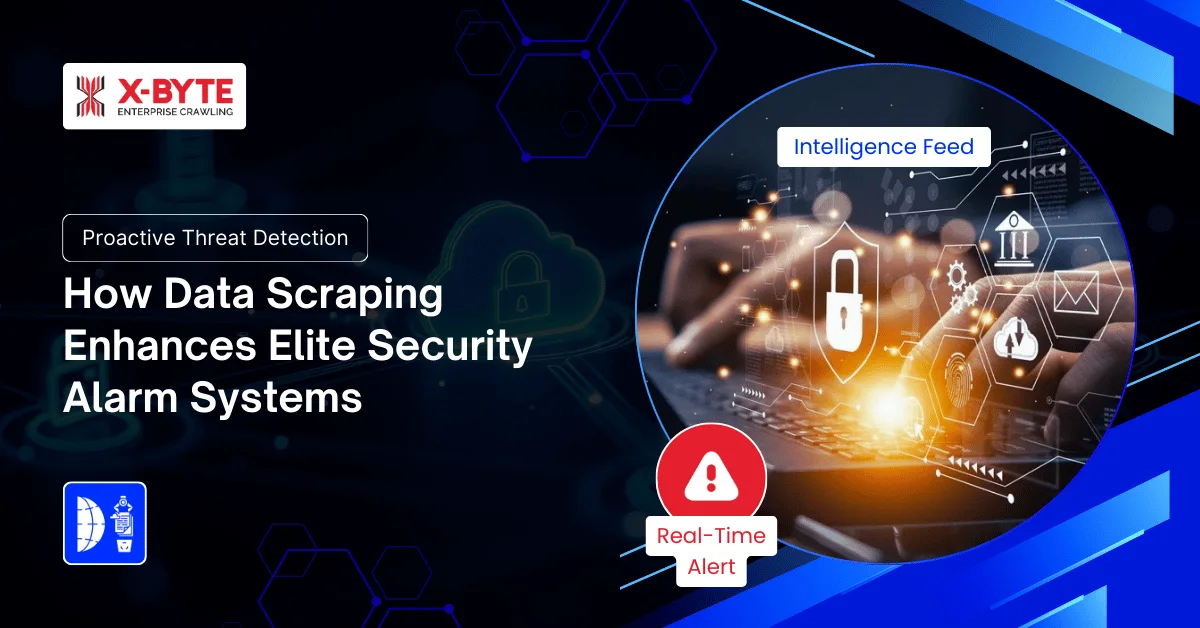
Threat detection is one of the issues that are becoming urgent demands in contemporary security alarm systems. Due to the increasing complexity of security threats, it is no longer possible to rely on the use of traditional reactive alarms. Houses and commercial premises have become targets to a large number of risks, such as bodily intrusion, computer-based assaults, and organized security assault. To keep in the lead of these threats, security systems should go beyond the simple alerts and implement smarter and data-oriented methods.
The data scraping comes in handy here. Through persistent data extraction and mining of real-time data of various digital sources, data scraping enhances threat detection and allows quicker, more intelligent security reactions. Combined with the current security alarm systems, it turns them into offensive defense systems. An integration of real-time data, automation, and insights of predicting enables the organization to make early warnings of potential threats and act before they cause harm.
What is Data Scraping and How Can It be Used to enhance Security?
The automated process of extracting large amounts of data on-line, in databases, sensors, and digital platforms is called data scraping. Such data is then organized and processed to derive data that is informative. In security contexts, data scraping can assist the systems to remain aware of any new threat, suspicious behaviors, and anomaly.
In the case of security alarm systems, data scraping would improve the detection of threats by feeding real time intelligence into monitoring systems. Rather than triggering a sensor when an incident happens, systems have the ability to process external and internal data streams in real time. This can be used to identify the potential threats early.
The major advantages of data scraping in the security sphere are in the form of real-time data gathering, constant surveillance, and the timely detection of threats. Security systems can be more responsive and dynamic by collecting information twenty-four hours a day. This proactive method gets a long way to prevent security breakdowns and false alarm.
The enhancement of Proactive Threat Detection with the Help of Data Scraping
Real-time threat intelligence can be considered one of the largest benefits of data scraping. The security systems have the ability to process data provided by several different sources in the form of network logs, publicly available threat databases, surveillance feeds and online activity. Such an overall view of data will enable the systems to identify any irregularities that could be an imminent threat.
Predictive analytics also reinforces the proactive threat detection. An analysis of historical and real-time data provides scraped information that can aid in predicting trends that usually make up the antecedents of security incidents. Such learnings enable systems to anticipate any possible threats and proactively prevent an alarm event before it happens.
The other imperative advantage is that it has a low response time. Delays that arise due to manual monitoring are removed through automated data scraping. Security systems are able to analyze new data immediately and send alerts in case there is a predefined risk threshold. This is necessary to have a quick response capacity that can avert the escalation and cause less damage.
The use of data scraping to enhance protection is successful in several security alarm systems already. These systems have shortened the response time, enhanced the detection capability and increased the overall security posture through the incorporation of automated intelligence feeds.
Major Characteristics of Elite Security Alarm Systems Data Scraping
Superior monitoring is one characteristic of current security alarm systems upgraded with data scraping. To make sure the systems have the latest threat intelligence, continuous data collection is required. This enables alarm systems to be able to adjust to new risks without requiring manual reconfiguration.
Another significant strength is automated alerts. In case of scraped data, suspicious behavior or a new threat is detected, the system automatically produces proactive alerts. Such alerts enable the security teams or home owners to take action at any specific time as opposed to responding to the breach incident once it happens.
It is also essential that there should be seamless integration. The data scraping technology may be installed on the existing security systems without interfering with operations. It integrates with sensors, cameras and access control system to form a single and smart security environment.
In the middle of this evolving security landscape, advanced home security systems demonstrate how real-time data, automation, and intelligent monitoring can work together to deliver stronger and more reliable protection. These systems combine physical security with data-driven insights to stay ahead of modern threats.
The Reasons CTOs and CEOs Need to Focus on Active Threat Detection
The threat detection will no longer be an option to business leaders. Threat detection at an early stage will help avoid the expensive damage, downtime and negative publicity. Data scraping helps organizations to identify vulnerabilities before they are exploited, which lead to enormous saving of costs in the long run.
Another important strength is scalability. Security requirements of organizations increase with their size. There is also easy scaling of data scraping solutions and the growth in volumes of data can be handled without affecting the performance. This ensures they are good in businesses that have a long run growth.
Better decision-making is also a significant advantage of CTOs and CEOs. Live-time and data-driven information will give leadership teams a clear picture of security threats. This enables quicker and more informed decision making, to match the security plans with the business agenda.
The Decision of An Appropriate Security System with Data Scraping
The choice of the security system should be evaluated. Organizations must seek vendors that are integrated with data scraping, provide real time threat monitoring and automated alerts. It is imperative to have a keen emphasis on data-driven security solutions.
Best practices involve deploying data scraping in stages with the high-risk areas being the initial, as well as, continuously enhancing the threat detection rules. Frequent updates and performance reviews make the system efficient in relation to a changing threat.
The decision-makers are expected to compare the quality of the data sources, automation, scaling, and the support services available when ranking the vendors. A security system that appropriately incorporates the concept of data scraping will be able to offer greater security and value in the long run.
Conclusion
Advanced Data Scraping Solutions should be considered by organizations that aim to improve their security position. X-Byte has customized security systems consultations that target different business requirements. Using the data scraping capabilities of X-Byte, organizations are able to both increase real-time threat detection, automate threat detection mechanisms and overall heighten security resiliency.
Contact X-Byte today to see how a data-driven approach to security can change your approach to detecting threats.
Frequently Asked Questions
 ✯ Alpesh Khunt ✯

Related Blogs
The Role of Data Annotation in Large Language Model Training and Performance
How Web Scraping Is Used to Extract eCommerce Data From eBay