

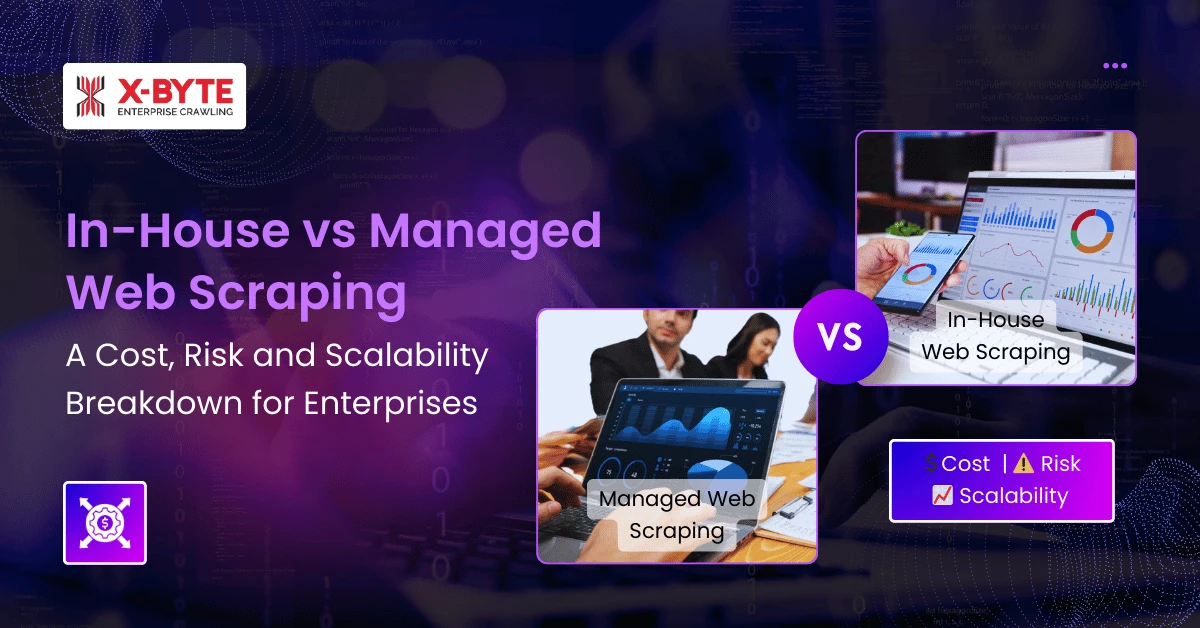
Enterprise leaders face a critical decision when implementing data extraction strategies: build an in-house web scraping infrastructure or partner with a managed service provider. This choice impacts your budget, operational risk, and ability to scale data operations. Therefore, understanding the trade-offs between in-house vs managed web scraping becomes essential for CTOs, CFOs, and data leaders.
What Is Web Scraping and Why Do Enterprises Need It?
Web scraping is the automated process of extracting structured data from websites at scale. Enterprises use web scraping to gather competitive intelligence, monitor pricing across markets, track brand sentiment, and aggregate market data.
However, successful web scraping requires more than basic tools. You need robust infrastructure, legal compliance expertise, and continuous maintenance. Consequently, many organizations struggle to decide whether to build internal capabilities or outsource to specialists like X-Byte Enterprise Crawling.
What Are the Key Benefits of Enterprise Web Scraping?
Enterprises leverage web scraping for several strategic purposes:
- Competitive Intelligence: Monitor competitor pricing, product launches, and marketing strategies in real-time.
- Dynamic Pricing: Track market prices across thousands of products to optimize your pricing strategy.
- Market Research: Aggregate customer reviews, social media sentiment, and industry trends.
- Lead Generation: Extract contact information and business data from public directories.
- Brand Protection: Monitor unauthorized product listings and trademark violations across e-commerce platforms.
According to industry research, 67% of enterprises use web scraping for competitive analysis, while 54% rely on it for pricing intelligence. Moreover, companies that implement data-driven strategies achieve 5-6% higher productivity than competitors.
In-House Web Scraping: What Are the Advantages and Limitations?
What Benefits Does In-House Web Scraping Offer?
Building an internal web scraping infrastructure provides several advantages. First, you maintain complete control over your data pipeline and scraping logic. Second, you can customize tools to match specific business requirements. Third, you keep sensitive data within your organization’s security perimeter.
Additionally, in-house solutions work well for small-scale projects with limited data requirements. For instance, if you need to monitor 50 competitor websites monthly, a small internal team might handle this efficiently.
What Are the Main Challenges of In-House Web Scraping?
Despite these benefits, in-house web scraping presents significant challenges. The upfront investment is substantial. You need to hire specialized developers, invest in infrastructure, and purchase proxy services and CAPTCHA-solving tools.
- Talent Acquisition Costs: A senior web scraping engineer costs between $120,000-$180,000 annually in the United States. Meanwhile, you’ll likely need 2-3 engineers plus DevOps support.
- Infrastructure Expenses: Cloud computing, proxy networks, and storage can exceed $3,000-$10,000 monthly for enterprise-scale operations.
- Maintenance Burden: Websites change their structure regularly. Your team will spend 40-60% of their time maintaining existing scrapers rather than building new capabilities.
Furthermore, in-house teams often lack expertise in legal compliance. Web scraping regulations vary by jurisdiction, and violations can result in lawsuits or IP bans. Without specialized knowledge, your organization faces significant legal risk.
When Does In-House Web Scraping Make Sense?
In-house web scraping works best under specific conditions. Consider this approach if you have highly sensitive data requirements that prohibit external access. Similarly, if your use case is extremely unique and requires constant iteration, internal control might justify the investment.
However, even large tech companies increasingly use managed services for non-core scraping needs. This allows their engineering teams to focus on product development rather than data infrastructure.
Managed Web Scraping: How Does It Compare?
What Advantages Do Managed Web Scraping Services Provide?
Managed web scraping services like X-Byte Enterprise Crawling handle the entire data extraction process for you. This approach offers several compelling benefits.
- Rapid Deployment: Managed services can launch scraping projects within days rather than months. Therefore, you access critical data faster.
- Expert Management: Specialized teams bring years of experience across industries and use cases. They know how to handle anti-scraping measures, rotating proxies, and browser fingerprinting.
- Compliance Protection: Reputable providers understand web scraping laws and terms of service restrictions. They implement best practices to minimize legal risk.
- Predictable Costs: You pay a fixed monthly fee rather than managing variable infrastructure costs and salaries.
- Scalability: Managed services scale effortlessly from thousands to millions of pages without requiring additional hiring or infrastructure planning.
What Are the Potential Drawbacks?
Managed web scraping isn’t without limitations. You’ll pay ongoing subscription fees that might exceed in-house costs for very small projects. Additionally, you rely on an external vendor’s reliability and data security practices.
Some organizations worry about losing control over the scraping process. However, quality providers like X-Byte Enterprise Crawling offer transparent reporting, custom SLAs, and collaborative workflows that maintain client oversight.
Real-World Example: How Managed Scraping Transformed a Retail Enterprise
A Fortune 500 retailer needed to monitor pricing across 50,000 products from 200 competitors daily. Initially, they built an in-house solution with three engineers over eight months.
Within six months, the system required constant maintenance. Website structure changes broke scrapers weekly. The team spent all their time fixing issues rather than expanding coverage.
After switching to X-Byte Enterprise Crawling, they achieved 99.5% uptime with comprehensive coverage. The managed service cost 60% less than their in-house operation while delivering higher data quality. Moreover, their engineering team refocused on revenue-generating projects.
How Do Costs Compare Between In-House and Managed Web Scraping?
What Does In-House Web Scraping Actually Cost?
Calculating the true cost of in-house web scraping requires accounting for multiple factors:
- Personnel Costs: Two senior engineers at $150,000 each, plus one DevOps engineer at $130,000, totals $430,000 annually in salaries alone. Add benefits, and this reaches $550,000-$600,000.
- Infrastructure: Cloud computing, proxy networks, and CAPTCHA-solving services cost $5,000-$15,000 monthly, or $60,000-$180,000 annually.
- Tools and Software: Web scraping frameworks, monitoring tools, and data storage solutions add another $10,000-$30,000 yearly.
- Opportunity Cost: Your engineers could build products that generate revenue instead of maintaining scrapers.
Therefore, the first-year cost for in-house web scraping typically ranges from $650,000 to $850,000. Subsequent years cost $500,000-$700,000 as infrastructure stabilizes.
What Do Managed Web Scraping Services Cost?
Managed web scraping services use subscription-based pricing that varies by data volume and complexity. Entry-level enterprise plans start around $3,000-$5,000 monthly for moderate data needs.
For the retail example mentioned earlier (50,000 products, 200 sources, daily updates), X-Byte Enterprise Crawling charges approximately $15,000-$25,000 monthly. This totals $180,000-$300,000 annually.
Compared to $650,000+ for in-house solutions, managed services deliver 60-70% cost savings. Furthermore, these savings increase over time as in-house systems require ongoing maintenance and upgrades.
Which Approach Offers Better ROI for Enterprises?
For most enterprises, managed web scraping delivers superior ROI. The cost advantage is clear, but the benefits extend beyond direct expenses.
Managed services provide faster time-to-value. You access data within weeks instead of months. Additionally, you avoid the risk of failed implementations that waste six months of engineering time.
However, if you’re a technology company with existing infrastructure and specialized talent, in-house solutions might make sense for core strategic data that requires continuous customization.
What Risk Factors Should Enterprises Consider?
What Risks Does In-House Web Scraping Create?
In-house web scraping introduces several categories of risk:
- Legal and Compliance Risks: Web scraping operates in a complex legal landscape. The Computer Fraud and Abuse Act (CFAA) in the United States, GDPR in Europe, and various terms of service restrictions create compliance challenges. Without specialized expertise, enterprises risk violating these regulations.
- Data Quality Issues: Maintaining consistent data quality requires constant monitoring. Website changes can silently break scrapers, causing you to make business decisions based on incomplete data.
- Technical Debt: Quick fixes and patches accumulate over time. Eventually, your scraping infrastructure becomes unmaintainable, requiring expensive rewrites.
- Operational Disruption: When scrapers break, your business processes stop. If pricing decisions depend on competitor data, scraper failures directly impact revenue.
- Resource Allocation: Your best engineers spend time fighting anti-scraping measures instead of building products that differentiate your business.
What Risks Come With Managed Web Scraping?
Managed services introduce different risks that require mitigation:
Vendor Dependency: You rely on your provider’s reliability and business continuity. Therefore, selecting an established vendor with proven uptime is critical.
Data Security: Your provider accesses scraped data, which might include sensitive competitive intelligence. Ensure your vendor implements enterprise-grade security, encryption, and access controls.
Cost Predictability: Some providers charge based on data volume, which can create budget surprises. Look for transparent pricing models and clear SLAs.
How Can You Mitigate These Risks?
Risk mitigation starts with thorough vendor evaluation. For managed services, examine the provider’s track record, client testimonials, and security certifications.
Implement these best practices:
- Service Level Agreements: Negotiate SLAs that guarantee uptime, data accuracy, and response times. X-Byte Enterprise Crawling offers customizable SLAs that align with your business requirements.
- Compliance Documentation: Request documentation of your provider’s compliance practices, including their approach to robots.txt files, rate limiting, and terms of service adherence.
- Data Validation: Implement your own data quality checks, even with managed services. Monitor for anomalies and validate against secondary sources.
- Dual-Source Strategy: For mission-critical data, consider using two providers or maintaining limited in-house capabilities as backup.
- Regular Audits: Conduct quarterly reviews of your scraping operations, costs, and data quality regardless of your chosen approach.
Why Is Managed Web Scraping More Scalable for Enterprises?
How Does Scalability Differ Between In-House and Managed Solutions?
Scalability represents one of the most significant advantages of managed web scraping. When your data needs grow, in-house solutions require proportional increases in infrastructure and personnel.
For example, doubling your scraping targets from 100 to 200 websites often requires hiring additional engineers. Tripling your data volume might necessitate infrastructure redesign. Consequently, scaling becomes a multi-month project.
Managed services scale differently. Providers like X-Byte Enterprise Crawling maintain excess capacity and distributed infrastructure. Adding new data sources or increasing volume requires minimal lead time. Your costs increase proportionally, but you avoid hiring, training, and infrastructure planning.
What Enables Managed Services to Scale So Effectively?
Managed providers achieve scalability through several mechanisms:
- Shared Infrastructure: Multiple clients use the same proxy networks, cloud resources, and scraping frameworks. This creates economies of scale impossible for individual enterprises to achieve.
- Specialized Expertise: Managed teams develop best practices across hundreds of client projects. They’ve already solved the anti-scraping challenges you’ll encounter.
- Automation: Providers invest heavily in automated scraper maintenance, anomaly detection, and self-healing systems. This automation distributes fixed costs across many clients.
- Geographic Distribution: Enterprise managed services operate globally, with data centers and proxies in multiple regions. This enables efficient scraping of region-specific websites.
Real-World Scalability Example
A financial services firm needed to expand their web scraping from 500 to 5,000 data sources over six months to support a new product launch. Their in-house team estimated this would require nine months and four additional engineers.
By partnering with X-Byte Enterprise Crawling, they achieved this expansion in six weeks. The managed service scaled seamlessly while maintaining 99.7% uptime. Moreover, the cost increase was only 40% despite a 10x increase in data sources.
Which Approach Is Right for Your Enterprise?
What Factors Should Influence Your Decision?
Choosing between in-house and managed web scraping depends on several factors:
- Data Volume and Complexity: High-volume, complex scraping favors managed services. If you need data from thousands of sources with varying formats, specialist providers deliver better results.
- Budget Constraints: Managed services typically cost 60-70% less than in-house solutions for equivalent capabilities. However, very small projects might favor internal development.
- Timeline Requirements: Managed services deliver faster results. If time-to-market matters, outsourcing accelerates your data strategy.
- Internal Capabilities: Do you have experienced web scraping engineers? Can you attract and retain this specialized talent? If not, managed services make sense.
- Compliance Requirements: Industries with strict regulatory requirements benefit from providers who specialize in compliant data extraction.
- Core vs. Non-Core Activity: If web scraping is central to your business model (you’re a data company), in-house might be justified. For most enterprises, it’s a supporting function better handled externally.
Decision Framework for CTOs and CFOs
Use this framework to evaluate your specific situation:
Choose In-House If:
- Web scraping is your core competitive advantage
- You have extremely unique requirements that change constantly
- Data sensitivity absolutely prohibits external access
- You already employ specialized scraping talent
- Your scale is very small (fewer than 50 sources)
Choose Managed Services If:
- You need to scale quickly or handle high data volumes
- Cost efficiency and predictability matter
- You lack specialized in-house expertise
- Compliance and legal risk are concerns
- You want your engineering team focused on product development
- You need reliable uptime and quality guarantees
For most enterprises, managed web scraping delivers superior results. The combination of lower costs, reduced risk, and better scalability makes it the pragmatic choice.
Conclusion: Making the Strategic Choice for Your Enterprise
The decision between in-house and managed web scraping ultimately depends on your organization’s specific needs, resources, and strategic priorities. However, the data clearly favors managed services for most enterprise use cases.
Managed web scraping offers 60-70% cost savings, faster deployment, better scalability, and reduced operational risk. These advantages become more pronounced as your data requirements grow. Meanwhile, in-house solutions make sense only for organizations where web scraping represents a core competency or where data sensitivity demands internal control.
X-Byte Enterprise Crawling provides enterprise-grade managed web scraping services with proven reliability, compliance expertise, and transparent pricing. Our platform handles everything from small monitoring projects to large-scale data operations across thousands of sources.
Ready to explore how managed web scraping can transform your data strategy? Contact X-Byte’s web scraping experts today for a free consultation and operational audit. We’ll analyze your specific requirements and demonstrate how our managed services can deliver better data at lower cost with reduced risk.
Frequently Asked Questions
 ✯ Alpesh Khunt ✯

Related Blogs
The Role of Data Annotation in Large Language Model Training and Performance
How Web Scraping Is Used to Extract eCommerce Data From eBay