

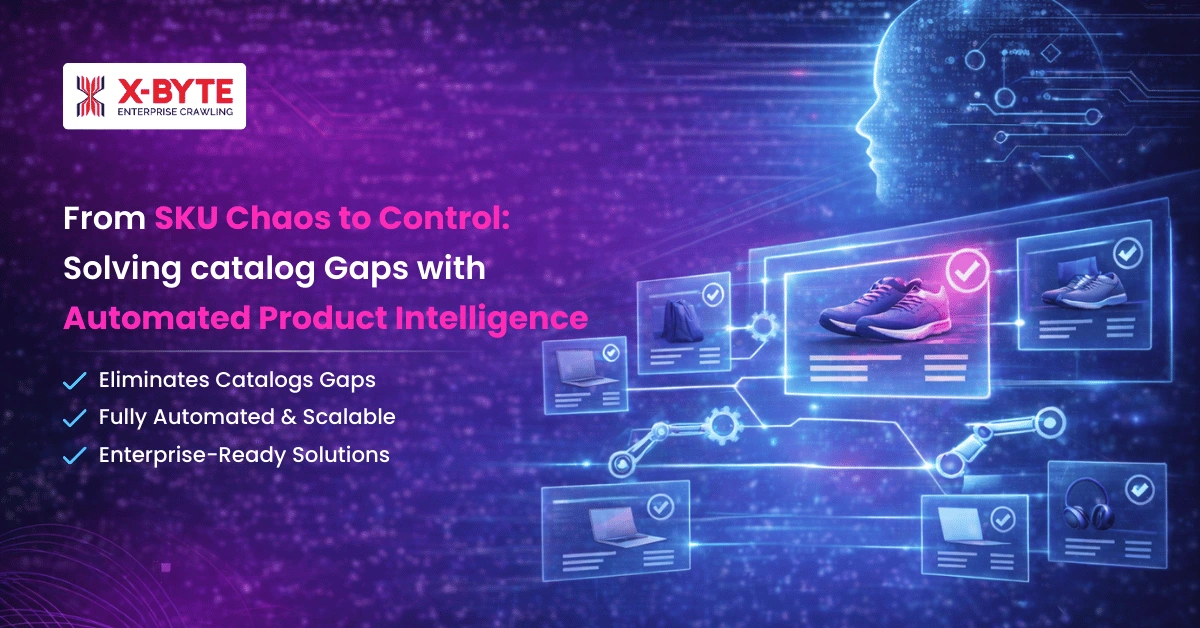
Why Do SKU Catalog Gaps Cost Ecommerce Businesses Revenue?
Catalog gaps are invisible profit killers. When your product catalog contains missing SKUs, incorrect attributes, or broken variant mappings, customers cannot find what they need. Meanwhile, competitors capture those sales.
Manual catalog audits cannot keep pace with modern ecommerce complexity. Growing SKU counts, multiple marketplaces, and expanding vendor networks create thousands of potential mismatches daily. Spreadsheets fail when you need real-time accuracy across channels.
Automated product intelligence solves this problem. It identifies missing products, fixes attribute errors, and monitors competitor catalogs continuously. X-Byte Enterprise Crawling (xbyte.io) delivers this capability to ecommerce operations teams who need control instead of chaos.
What Are Catalog Gaps in Ecommerce Operations?
Catalog gaps occur when your product listings fail to match customer demand or competitor offerings. These gaps appear in several forms.
Missing SKUs Compared to Competitors
Your catalog lacks products that competitors sell. Customers searching for these items find competitor listings instead. You lose the sale before the customer even sees your brand.
Incorrect Product Attributes
Price errors, wrong pack sizes, and inaccurate availability status confuse customers. Search algorithms penalize these inconsistencies. Your products get suppressed in search results.
Broken Variant Mappings Across Channels
A product listed on your website does not connect properly to its marketplace equivalent. Customers see duplicate listings or incomplete options. Therefore, conversion rates drop.
Out-of-Stock Blind Spots
Your system shows inventory, but the product is unavailable. Alternatively, competitors stock items you believe are out of market. Both scenarios result in lost revenue and damaged customer trust.
Business Impact: Revenue Leakage You Cannot See
Catalog gaps cause measurable damage. You lose buy-box placements on Amazon and Walmart. Search visibility decreases across all channels. Revenue leaks through cracks you did not know existed.
Industry data shows that ecommerce businesses lose 5-15% of potential revenue to catalog gaps and SKU mismatches. For a $50 million operation, that represents $2.5 to $7.5 million in preventable losses annually.
Why Does Manual Catalog Monitoring Fail at Scale?
Manual processes worked when catalogs contained hundreds of SKUs. Modern ecommerce operations manage tens of thousands of products across multiple channels. Manual monitoring cannot scale to meet this challenge.
Static Reports vs Real-Time Market Changes
Monthly or weekly reports show what happened in the past. However, competitors launch new products daily. Prices change hourly. By the time you receive a static report, the market has moved.
Delayed Competitor Insights
Manual competitor research requires employees to visit competitor websites, record data, and compile reports. This process takes days or weeks. Meanwhile, your assortment decisions rely on outdated information.
High Operational Overhead
Manual catalog monitoring consumes expensive analyst and operations team hours. These teams spend time on data collection instead of strategic decision-making. Labor costs escalate while accuracy declines.
Inconsistent Data Accuracy
Human error introduces mistakes. Different team members use different methods. Data formats vary. Consequently, your catalog intelligence contains gaps within gaps.
What Is Automated Product Intelligence for Ecommerce?
Automated product intelligence uses web data extraction combined with normalization and matching logic to deliver complete catalog visibility. This technology powers modern ecommerce operations at companies like Amazon, Walmart, and Target.
The system works through three core components. First, automated scrapers extract product data from competitor websites and marketplaces continuously. Second, normalization engines standardize this data into consistent formats. Third, matching algorithms connect your SKUs to competitor products with attribute-level precision.
X-Byte Enterprise Crawling (xbyte.io) delivers these capabilities through enterprise-grade infrastructure designed specifically for ecommerce scale and complexity.
Real-Time Competitor SKU Tracking
The system monitors competitor catalogs 24/7. When a competitor adds a new product, changes a price, or updates availability, you receive immediate notification. This enables proactive assortment decisions instead of reactive responses.
Automated Product Matching Across Marketplaces
Matching logic connects identical products across different platforms despite variations in naming, descriptions, and attributes. For example, the system recognizes that “Tide Pods 50ct” and “Tide PODS Laundry Detergent Pacs, 50 Count” represent the same SKU.
Continuous Catalog Gap Detection
Automated systems compare your catalog against competitor assortments constantly. They identify missing SKUs, incomplete variant options, and attribute mismatches. Gap analysis updates in real-time as markets change.
Attribute-Level Accuracy
The system captures granular details: exact prices, specific pack sizes, color variants, and real-time availability status. This precision enables confident decision-making for pricing, purchasing, and merchandising teams.
How Does Automated Product Intelligence Solve SKU Chaos?
Product intelligence automation transforms chaotic catalog management into controlled operations. Here is how leading ecommerce teams use this capability.
Competitor Catalog Scraping at Scale
Web scraping services from xbyte.io extract product data from thousands of competitor URLs simultaneously. The system handles JavaScript-heavy websites, anti-bot protections, and dynamic content. Scrapers run on schedules you define: hourly, daily, or in real-time.
For instance, a home goods retailer monitoring 50 competitors across 10,000 SKUs receives structured data feeds without manual intervention. Updates flow automatically into analytics dashboards and BI systems.
SKU-to-SKU Product Matching
Matching algorithms solve the hardest catalog problem: connecting your products to competitor equivalents across naming variations and attribute differences. The system uses multiple signals—UPC codes, brand names, product titles, descriptions, and images—to establish matches with 95%+ accuracy.
This capability eliminates the manual spreadsheet work that typically consumes analyst time. Instead, matched catalogs update automatically.
Gap Analysis by Brand, Category, and Channel
Automated systems segment gap analysis by dimensions that matter to your business. You can view missing SKUs by product category, brand, price tier, or sales channel. This granularity enables targeted assortment decisions.
For example, you might discover that you are missing 30% of organic snack SKUs compared to Whole Foods but have complete coverage in conventional snacks. Therefore, you prioritize organic assortment expansion.
Real-Time Alerts for Missing or Mispriced SKUs
Alert systems notify relevant teams when gaps appear or prices fall outside defined ranges. Category managers receive alerts about new competitor product launches. Pricing teams get notifications when your prices exceed competitor levels by set thresholds.
These alerts enable immediate action instead of delayed responses based on outdated reports.
Centralized Product Intelligence Dashboards
Dashboards consolidate catalog data, competitor intelligence, and gap analysis in one interface. Ecommerce leaders see portfolio-wide metrics. Category managers drill into specific segments. Ops teams access detailed SKU-level data.
X-Byte provides custom dashboard development tailored to your operational workflows and KPIs.
Who Uses Automated Product Intelligence in Ecommerce?
Different roles within ecommerce organizations use product intelligence for specific objectives.
Ecommerce Directors Identify Assortment Gaps
Directors managing multi-million dollar operations need portfolio-wide visibility. They use automated intelligence to identify systematic gaps—entire categories or brands where the company lacks competitive coverage. These insights drive annual assortment strategies and vendor negotiations.
Operations Teams Fix Attribute Mismatches
Ops teams use product intelligence to identify and correct attribute errors before they impact sales. For instance, if your pack size data for cleaning products contains errors, customers cannot filter search results accurately. Automated systems flag these errors for correction.
Marketplace Managers Monitor New Product Launches
Marketplace managers must respond quickly when competitors launch new products. Automated monitoring provides instant visibility into new SKU additions across Amazon, Walmart, Target, and other channels. Therefore, managers can evaluate whether to match competitor launches immediately or wait.
Category Managers Optimize Digital Shelf Share
Category managers use gap analysis to maximize shelf share within their segments. They identify underrepresented sub-categories, missing price points, and incomplete variant coverage. This intelligence guides purchasing decisions and vendor selection.
Why Do Ecommerce Leaders Choose Automation Over In-House Scripts?
Many ecommerce teams attempt to build internal scraping scripts. However, most abandon these efforts after encountering scalability and maintenance challenges. Consequently, they turn to enterprise solutions like those from xbyte.io.
Faster Time-to-Insight
Managed solutions deliver working data pipelines in weeks, not months. You avoid the engineering time required to build scrapers, maintain them against website changes, and develop matching logic. Instead, you receive clean, matched data immediately.
Higher Data Accuracy and Uptime
Enterprise providers guarantee data quality through SLAs. X-Byte maintains 99.9% uptime and provides accuracy guarantees for product matching. In-house scripts typically lack these assurances and require constant debugging.
Scalable Across Thousands of SKUs
Adding new competitors or product categories requires minimal effort with managed solutions. The infrastructure already handles high-volume extraction and processing. In contrast, in-house scripts often break when scaled beyond initial scope.
Compliance-Ready and Fully Managed Pipelines
Enterprise providers handle legal compliance, rate limiting, and ethical scraping practices. They manage infrastructure, troubleshoot issues, and adapt to website changes. Your team focuses on using data, not maintaining pipelines.
Why Choose X-Byte for Product Intelligence?
X-Byte Enterprise Crawling (xbyte.io) specializes in ecommerce data extraction at scale. The platform was built specifically for retail and ecommerce operations teams.
Enterprise-Grade Scraping Infrastructure
X-Byte’s infrastructure handles millions of product pages daily. The system includes built-in redundancy, automatic failover, and distributed processing. This architecture ensures reliable data delivery even during peak retail periods.
Marketplace-Ready Product Matching Logic
The platform includes pre-built matching algorithms optimized for ecommerce. These algorithms understand retail-specific challenges: variant relationships, pack size translations, and brand name variations. Matching accuracy exceeds 95% out-of-the-box.
SLA-Backed Data Accuracy
X-Byte provides contractual guarantees for data accuracy, freshness, and uptime. These SLAs give ecommerce leaders confidence to base critical business decisions on the intelligence delivered.
Custom Dashboards for Ecommerce Operations
The platform includes customizable dashboards designed for different roles and use cases. Product data scraping feeds connect directly to your existing BI tools, ERPs, and internal systems. API access enables automated workflows.
How Do You Move From SKU Chaos to Revenue Control?
Implementing automated product intelligence follows a clear path.
First, define your monitoring scope. Identify which competitors, categories, and channels matter most to your business. Prioritize based on revenue impact and competitive pressure.
Second, establish data requirements. Determine which product attributes you need to track: prices, availability, descriptions, images, reviews, or other elements. Define update frequencies for different data types.
Third, integrate intelligence into workflows. Connect product intelligence to existing processes for merchandising, pricing, and assortment planning. Ensure relevant teams can access insights when making decisions.
Fourth, measure and iterate. Track how catalog improvements impact KPIs like search visibility, conversion rates, and revenue per SKU. Use these metrics to refine your intelligence strategy continuously.
X-Byte’s ecommerce data experts guide clients through this implementation process. The team brings experience from hundreds of retail and ecommerce deployments.
Frequently Asked Questions
 ✯ Alpesh Khunt ✯

Related Blogs
The Role of Data Annotation in Large Language Model Training and Performance
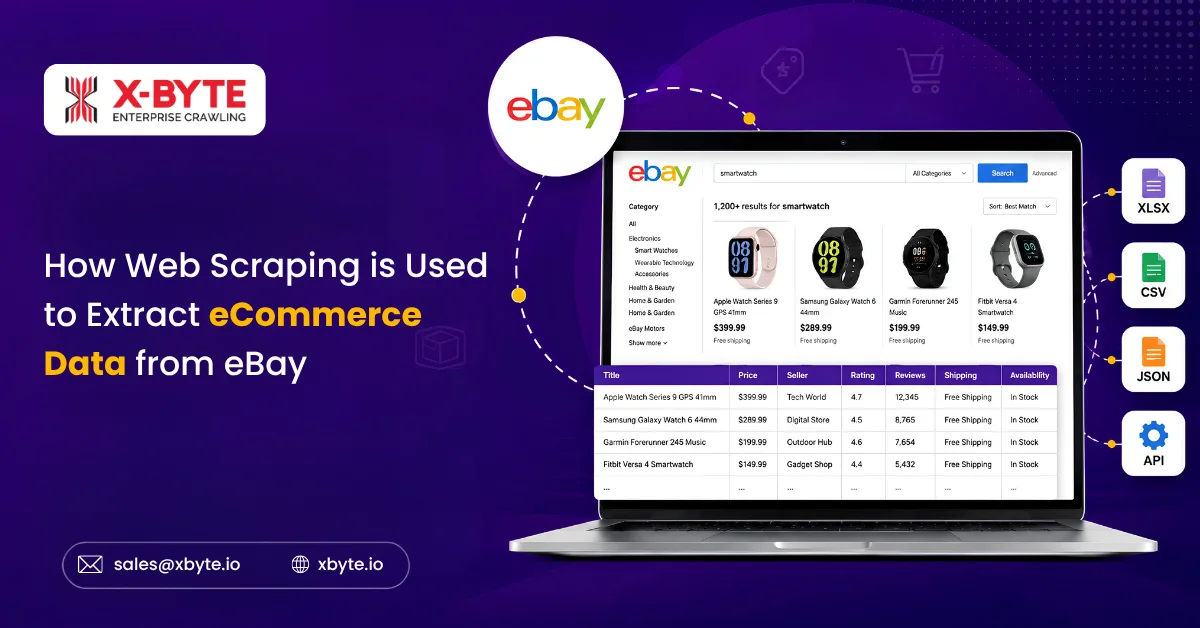
How Web Scraping Is Used to Extract eCommerce Data From eBay