
Introduction
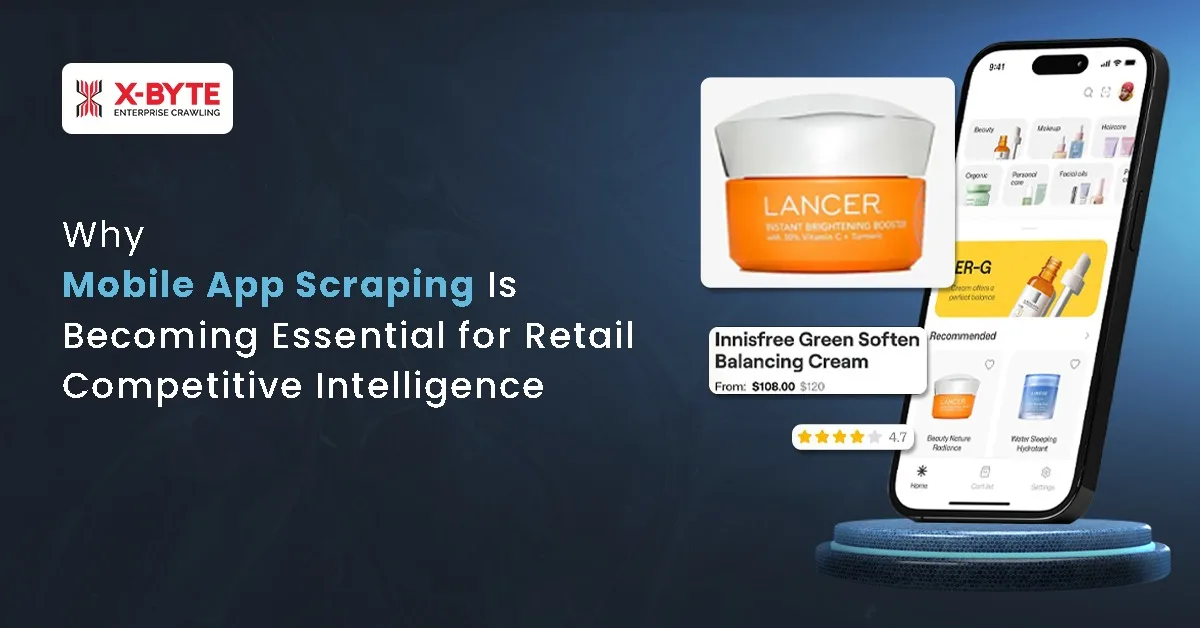
Mobile shopping has quietly become the main event in retail, and most brands are still watching the wrong screen. While teams obsess over their desktop dashboards, the real purchase decisions are happening inside apps that sit invisible to traditional data tools. This is exactly the blind spot that mobile app scraping is built to fix. In this guide, you will learn what mobile app scraping is, why retail data inside apps is so hard to capture, how X-Byte solves the problem with AI, and what all of this means for your pricing, assortment, and digital shelf strategy. By the end, you will have a clear, practical picture of how retail data extraction is shifting from websites to mobile screens, and why that shift matters for your bottom line.
Why Mobile App Scraping Matters?
Mobile commerce is no longer a side channel. As of 2025, mobile commerce is expected to account for 59% of total retail e-commerce sales worldwide, and that number keeps climbing every year. In the United States, the pull is just as strong. More than three out of four adults shop using their smartphones, which translates to over 200 million mobile shoppers nationwide. The story gets sharper when you look at apps specifically. Approximately 70% of mobile purchases in the U.S. take place through e-commerce apps rather than mobile browsers.
Here is the problem in simple terms. A growing share of pricing, promotions, and product information now lives only inside mobile apps. Some retailers show app-only prices. Others run app-exclusive deals or change their assortment based on the device. If your price monitoring only watches websites, you are missing a large and fast-growing slice of the market. That gap is where competitors quietly win.
This is why mobile app scraping for retail has moved from a nice-to-have to a core requirement. Brands and retailers need to see the same prices, offers, and listings that real shoppers see on their phones. Without that view, your competitive intelligence is incomplete, and your decisions rest on partial data.
For a deeper look at how scraping powers modern retail teams, explore X-Byte’s web scraping services and related data extraction solutions.
What Makes App Data So Hard to Capture?
Scraping a website is fairly well understood. Scraping a mobile app is a different challenge altogether, and the difficulty depends entirely on how the app shares its data. There are two main paths, and they could not be more different.
Scenario 1: Open composite APIs. Some large retailers, such as Amazon, expose composite APIs that are relatively open. In these cases, the setup is light, and the data scraping process does not differ much from standard website scraping. The data is accessible with the right approach.
Scenario 2: Encrypted composite APIs. This is where things get hard. Many retailers, including names like HEB, Dollar General, Stop & Shop, and Target, encrypt their composite APIs. You cannot simply request the data. Instead, you have to capture what appears on the screen, which calls for specialized mobile device scraping, OCR (optical character recognition), and a stack of machine learning techniques.
This second path is the real test of any app scraping provider. It is also where most generic tools fail, because reading pixels off a screen and turning them into clean, structured retail data is genuinely difficult. The frame can hold many products at once. Prices sit next to images. Text overlaps. A weak system produces messy, mismatched output that no pricing team can trust.
Ready to capture app-level retail data?
Talk to the data team at X-Byte about a custom mobile app scraping and price monitoring solution built for your category.
How X-Byte’s Mobile App Scraping Works?
X-Byte built a five-step pipeline to handle the hard case, the encrypted apps, with accuracy that holds up at scale. Here is how the method works, explained in simple language.
The process begins by recording a mobile session, where special visual navigation scrapers move through the app the way a real user would. To make this scalable, the system uses a real device cloud and emulates a cluster of devices through a smart proxy network. Once the session is captured, the engine identifies the region of interest, or ROI, for each product. Because a single screen often shows many products, the system uses an object detection model, a custom-tuned version of YoloV5, to find each product separately and avoid mismatched data. A deduplication stage then removes repeated frames so the data stays clean and processing stays fast.
Then, component identification takes place, where a second instance of YoloV5 identifies exactly what the components of each listing are, such as price, product information, and product image. Then, a custom-trained OCR framework is used to extract the actual text from these components. Finally, the system produces the final output. The extracted text and metadata are stored, unit tested, quality checked, and converted to the format required by the client, ready to be sent through an API.
This layered approach is what separates real mobile app scraping from a simple screen grab. Each stage feeds the next, and quality checks guard the output before it reaches you.
The Business Benefits for Retailers and Brands
Technology is only useful when it moves the numbers that matter. Here is what reliable app data extraction unlocks for retail teams:
- Accurate competitive pricing. See the exact prices shoppers see in apps, including app-only deals, so your dynamic pricing stays sharp.
- Stronger digital shelf performance. Track how your products rank, appear, and read inside the apps where most buying now happens.
- Smarter assortment planning. Spot gaps and overlaps in your product assortment against competitors across mobile channels.
- Faster promotion tracking. Catch flash sales and app-exclusive offers as they go live, not days later.
- Reliable MAP monitoring. Protect your brand by catching minimum advertised price violations hiding inside apps.
The common thread is visibility. When you can see the full picture, including the mobile-only data that used to be invisible, your retail analytics finally reflect reality. That is the difference between guessing and knowing.
Beyond apps, X-Byte has even extended its scraping technology to the metaverse, covering retail stores on platforms like Roblox, Meta, Decentraland, and Sandbox. It signals where retail data is heading next, and smart teams are preparing now.
Key Facts About Mobile App Scraping
- Mobile dominates online sales. Mobile commerce is estimated to account for 59% of total online retail sales as of 2025.
- Apps drive the purchases. Around 70% of U.S. mobile purchases happen through e-commerce apps.
- Encrypted apps need AI. Reading data from encrypted apps requires OCR and machine learning, not simple requests.
- Object detection comes first. YoloV5 isolates each product so prices never get mismatched.
- Quality checks are built in. Output passes unit tests before it ever reaches the client.
Conclusion
Retail is moving off the desktop and onto the phone, and the data is moving with it. As shopping shifts toward apps, social commerce, and even the metaverse, the brands that win will be the ones who can see clearly across every channel, not just the easy ones. Mobile app scraping is how that visibility gets built, turning encrypted, screen-locked app data into clean, structured insight your team can act on. X-Byte has shown what a serious, AI-driven approach looks like, and the lesson is clear for everyone in retail: the data you cannot see is the data your competitors are already using.
If you want to turn mobile and app data into a real advantage, the team at X-Byte Enterprise Crawling can help you build a retail data extraction and price monitoring solution tailored to your market.
Frequently Asked Questions
 ✯ Alpesh Khunt ✯

Related Blogs
How to Measure Data Extraction Quality at Scale: Accuracy, Coverage and Freshness
E-Commerce Product Data Management: Best Practices for Retailers