
As all companies, business sectors, and major and minor industries around the globe strive to develop AI/ML models for workflow automation, customer experience, and other use cases, the need for collecting data for machine learning models has increased manifold. From content generation and image recognition to training models for fraud detection and predictive analytics, machine learning models need quality datasets. In fact, a machine learning model’s accuracy and speed depend on data quality and relevance.
Businesses must learn the right ways to collect data for machine learning to train their AI/ML models effectively and accurately. Poor data collection practices, slow data extraction, and non-compliant data scraping can put a strain on your ML models. Therefore, using the best data collection methods for ML models’ training is extremely important.
This article details the right ways and methods to collect high-quality data for machine learning models.
Role of Quality Data in Machine Learning
Businesses now understand the power of personalized recommendations in online shopping and are deploying image recognition to provide superior retail shopping experiences. They know how AI chatbots can decrease their employees’ workloads and handle customer queries 24/7. No doubt the AI market will hit US$1.01 1.01tn by 2031. These AI models have machine learning algorithms trained on either text data or tabular datasets.
Like a multi-storey building needs a strong foundation, ML models need strong datasets that are error-free. ML models and data share a simple relationship – better data leads to better model performance.
Bad, unreliable, inaccurate, and duplicate data can wreck your ML projects in several ways:
- Unreliable models: Data with missing values, inconsistencies, and errors creates biased models that miss true patterns.
- Impaired decision-making: Poor data leads to wrong decisions that hurt businesses.
- Technical debt: Teams end up building complex ML models that are useless.
- Poor Pattern Recognition: Poor quality data hurts a model’s ability to recognize patterns. Models trained on poor data might learn noise instead of patterns and fail when used in ground scenarios.
- Flawed Model: Data quality issues can block a model’s decision-making process, making it harder to trust and validate results.
| Generally, companies have data engineers and data scientists who clean data that is to be used for ML model training. However, it is a waste of resources and time. Instead, it is prudent to use a proper data collection model to collect high-quality datasets that require minimal cleaning or validation. |
Types of Data You Can Collect for Machine Learning
Success in machine learning projects depends on collecting the right type of data as per the needs of your ML model. Below are the major types of data used for ML training.
1. Structured vs Unstructured vs Semi-Structured Data
Machine learning models deal with three main types of data structures. Each type has its own unique features:
| Structured data
● Follows a clear format with predefined schemas ● Stored in tables with rows and columns. ● Example: Sales records, customer details, and financial transactions in databases or spreadsheets |
Unstructured data
● Has no predefined format or model ● About 90% of business data falls into this category ● Examples include: Text files, images, videos, audio recordings, and social media posts |
Semi-structured data
● Doesn’t use a strict schema but relies on tags or metadata to mark specific features. ● Stored in JSON and XML file formats ● Examples include Email messages with structured headers and unstructured content, along with tagged digital photos. |
Note: Structured data makes up less than 20% of all data.
2. Qualitative, Quantitative, and Time-Series Data
Machine learning projects work with several types of data representations:
| Qualitative (categorical) data
● Uses labels or categories without numerical meaning ● Blood types and gender are qualitative data categories |
Quantitative (numerical) data
● Uses measurable values that you can average or sort. ● Examples include discrete data like student counts and continuous data such as temperature or weight measurements. |
Time-series data
● Shows data points at specific time intervals. ● Unlike regular numbers, time-series data needs clear start and end points. ● Examples include Stock prices, power usage readings, and website traffic. |
Choosing the right data type for your ML goal
Your machine learning goals should guide your choice of data types:
- ML models for predictive analytics are trained best on structured data
- Computer vision model training for object recognition, image recognition (for automated checkouts, etc.) needs unstructured data like images. Sentiment analysis works with unstructured text that has qualitative traits.
- Forecasting applications thrive on time-series data. For instance, stock movement prediction algorithms need time-series datasets.
Quality Datasets, when matched with the optimal storage space, processing power, and the ML algorithms, help develop robust ML models.
Data Sources for High-Quality Data for Machine Learning:
The right data sources are primarily requisite for training models. However, businesses may worry about where to access these datasets.
Below are some top sources of these datasets:
1. Internal Data Sources
Internal data flows from inside your organization. Examples include sales records, POS billing records, customer info, financial data, logistics data, warehouse numbers, stock data, vendor forms, employee records, connected devices (internal sensors, IoT connected machine data, network data), etc.
2. External Data Sources
External data comes from outside your company. External data comes in three forms:
- Open data (freely available)
- Paid data (purchased from vendors)
- API accessed data
- Shared data (exchanged between partners)
Expert Methods to Collect Data for Machine Learning
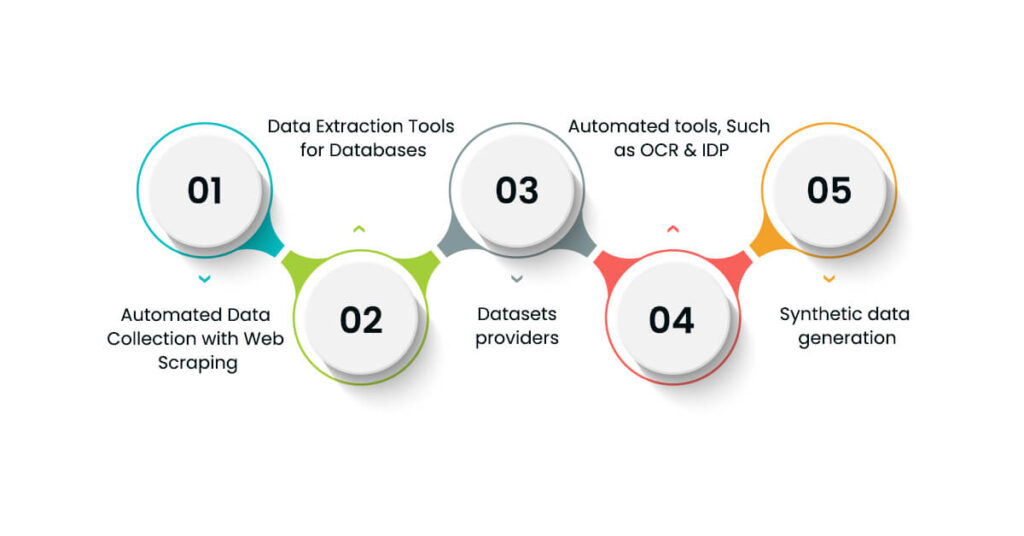
Expert data collection techniques can turn your machine learning projects from simple to outstanding. These methods will give your models the strongest possible training foundation.
1. Automated Data Collection with Web Scraping
Web scraping is the most powerful, easiest, and cost-effective way to collect machine learning data at scale. In web scraping, custom scripts are designed for accessing data from target websites and online platforms (listing sites, databases, delivery platforms, e-commerce sites, competitor websites, etc.).
Major LLMs are trained by web scraping freely available public data. You can retrieve huge amounts of data that might not be available anywhere else. On top of that, it gives you access to rich and varied data sources.
| Need expert help with data collection for your ML projects?
Explore X-Byte’s AI-powered web scraping services! |
2. Data Extraction Tools for Databases
Data extraction tools extract data from databases, APIs, files, and websites. From structured sources like databases, data warehouses, spreadsheets, to unstructured sources like media files, scattered docs, etc, all types of data available within your organization or procured databases can be extracted using data extraction tools. Use these datasets to train your machine learning models.
3. Datasets providers
Various services provide ready-made datasets to train your models. For instance, you need datasets of all major retail store chains like Walmart, Target, Kroger, etc., to train a model that can generate product descriptions for retail products based on the quality descriptions it analyzes from top retail platforms. There are companies that provide such real-time datasets.
4. Automated tools, Such as OCR and IDP
Intelligent Document Processing (IDP) is an advanced system that extracts, classifies, confirms, and merges data for business processes. IDP uses AI technologies like natural language processing, computer vision, and machine learning to process documents smartly. Optical Character Recognition (OCR) turns printed text into a machine-readable format.
5. Synthetic data generation
Synthetic data generation refers to artificial data that matches real-life data’s statistical properties. Using data augmentation, testing, validation, and data balancing techniques, businesses can generate synthetic data to train their models. This is generally done when data sources are limited or restricted and you don’t have data at scale. In such cases, training ML models with fewer datasets is not possible, and this is where you go for synthetic data generation. However, the ML models trained on synthetic data are not as effective as those trained on real-life data.
5 Factors for Ensuring Data Quality and Readiness
Quality is just as important as quantity when you prepare data for machine learning.
1. The Right Data Volume
Data volume requirements are complex and depend on your problem’s complexity and chosen algorithm. Simple machine learning applications typically need:
- At least hundreds of examples
- Tens or thousands for average problems work best
- Millions of examples when tackling complex challenges like deep learning
2. Data cleaning
Data cleaning involves managing missing values through imputation, deletion, or modeling, and removing duplicates that could disturb the final results. Data cleaning also fixes the format issues and brings all data into a proper standardized data format.
3. Data Validation
Data validation checks your dataset to confirm it is both accurate and dependable. It includes steps to verify things like data types, ranges, and distributions. These steps help find unusual values or outliers that might harm how your model works. Using cross-validation methods helps to confirm the dataset’s quality.
4. Avoiding bias and ensuring balance
Machine learning models often fail to make accurate predictions for underrepresented groups in training data.
You should:
- Check training data for implicit bias
- Use datasets that represent all groups fairly
- Give special attention to datasets where one class dominates others
4. Data storage and repository options
Your machine learning data collection needs strong storage as it grows. Cloud storage provides high performance and flexibility that suits AI/ML workloads perfectly. Check for scalability up to exabytes, high throughput (up to 1 TB/s with planning), etc.
How Web Scraping is the Most Preferred Way to Collect Data for ML Models?
Web scraping is the best way to collect machine learning training data in all kinds of industries.
Web scraping’s versatility makes it a powerful tool. You can target exactly the kind of data needed for your ML model. This includes text for NLP projects, images for computer vision, or numbers for predictive analytics.
The practical benefits are clear. Web scraping provides economical solutions compared to buying commercial datasets or creating data from scratch. Small organizations and individual researchers with tight budgets can access the data they need with web scraping.
X-Byte Enterprise Crawling offers specialized AI-powered web scraping services designed specifically for machine learning applications. Our advanced solutions help businesses build robust ML models through high-quality data collection:
Our services include:
- AI-enabled scrapers that extract structured, well-labeled data crucial for accurate ML model training
- Clean and diverse training datasets that help AI recognize patterns effectively.
- Automated data collection for ML/NLP applications
- Customizable & scalable data extraction to obtain industry-specific training data.
- High-quality training datasets that improve AI’s ability to make precise predictions.
- Extract real-time data from multiple online sources simultaneously (e-commerce, social media, financial markets, news portals)
- Handle large-scale data extraction accurately, even from complex websites
- X-Byte maintains 99% data quality standards and 100% compliance and security.
Conclusion
Smart data collection methods can take your ML projects to new heights. Web scraping, automated data extraction tools, synthetic data generation, ready-made commercial datasets, etc., offer powerful ways to get the training data your models need.
These methods help solve common problems like a lack of data and imbalance.
Data quality is just as important as quantity.
You need to clean and preprocess your data and ensure it’s balanced before training any model. Even the most sophisticated algorithms will give you wrong or biased results without proper preparation. It is prudent to hire a web scraping services provider to ensure the data quality and process steps, such as data cleaning and validation.
Need expert help with data collection for your ML projects?
X-Byte.io’s AI-Powered Web Scraping Services for Machine Learning Datasets
 ✯ Alpesh Khunt ✯

Related Blogs

Best Web Scraping Services in the USA: A CTO’s Guide to Choosing the Right Data Partner