

In the context of today’s rapidly evolving business landscape, organizations are creating unprecedented volumes of data, the vast majority of which remains untapped.
The gap between data insights and actionable outcomes, where revenue losses are happening, is exactly where opportunities lie in AI image transformation and mobile app scraping.
AI Image transformation and mobile app scraping are redefining how businesses engage, qualify, and convert leads, profoundly and positively impacting the intelligence, speed, and depth of real consumer behavior-based marketing.
As data-driven decision-making becomes less of a competitive advantage and more of a normative baseline expectation, the ability to understand how to effectively utilize these technologies becomes imperative.
AI Image Transformation and Its Importance to Lead Generation
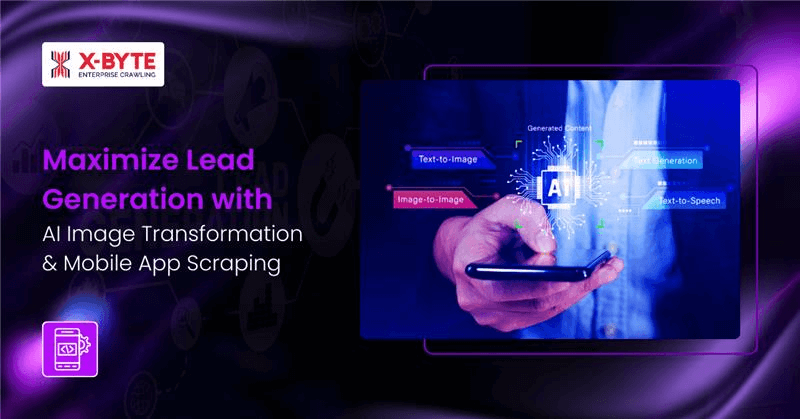
AI image transformation is defined by the autonomous enhancement, modification, reconstruction, or creation of visual content through the use of machine learning technologies to produce images at scale.
For marketing and ecommerce teams, operational use cases include the restoration of product images with low resolution, autonomous background modification or replacement, image adaptation for various channels and markets, and the creation of new visual assets for targeted audience segments.
The starting point for lead generation for AI image transformation is the understanding that visuals facilitate purchase decisions before copy. It has been demonstrated that on a product page, users examine visuals first before doing anything else, and 25% of product pages lack images that are satisfying enough to zoom. 56% of users do this.
(n x ) It is a problem that leads to lost potential, and a loss of leads is a failure of lead generation. 28% of product pages do not have a size reference to product images and 42% of users try to estimate the size of a product from the image. These issues are not minor and represent a failure of UX. These are revenue leakers that can be closed with AI image transformation.
AI has the ability to tailor images to a specific audience. This can be in the form of various images that are optimized for each audience. AI can also change the background and lighting for specific geo markets/ particular seasons. In the form of generating new brand assets, AI can also change brand consistency.
Personalized visuals and imagery for ad campaigns can increase CTR and achieve better results in terms of conversions. The reason for this is that personalization decreases the gap that exists to the product in the imagery. This is the reason why personalized visuals always lead to better results.
For teams focusing on quick iterations, image to image features enable marketers to alter existing hero images by creating new variations in different lighting, scenarios, and compositions, while maintaining product geometry and color fidelity to commercial standards.
Tools like the Higgsfield AI Image Generator make this process even faster by transforming existing images into high-quality marketing visuals from simple prompts, helping brands produce multiple creative variations without expensive photoshoots.
This technique significantly reduces the creative cycle by substituting several weeks of production with a few hours of guided AI output review.
The Benefits of Mobile App Scraping in Lead Generation
Mobile app scraping involves the systematic collection of data from mobile applications and their associated APIs to obtain insights that remain inaccessible through conventional web scraping.
This encompasses competitive app pricing data, product listings and stock availability, user review sentiment, promotional activity, and real-time market activity across various sectors. The worth of lead generation is in its ability to provide data with pin point accuracy.
Knowing what each competitor provides, what each customer responds to, and what real time gaps exist in the market, allow businesses to streamline their messaging, position themselves, and create what is needed to meet with the market demand.
Data is how predictor analytics improve, and with the ability to be both live and ongoing, not just simply data that is stale. Marketing strategies will not just be data driven and because of it will be the active need, in the best way.
How AI Image Transformation and Mobile App Scraping Work Together?
The real potential is realized when these two functions are integrated into a cohesive lead generation ecosystem. While mobile app scraping provides the market intelligence, audience preferences, competitive displays, emerging trends, and AI image transformation provides the means to convert that intelligence into visual action. Creative assets are designed to attract and convert.
To illustrate, let’s consider a case. A consumer electronics retailer employs mobile app scraping to analyze competitor offerings on three leading retail apps. The analysis identified a competitor’s bundled offering that was gaining traction, particularly among value-conscious buyers aged 25 to 35.
At the same time, app reviews sentiment analysis indicated that this demographic is highly influenced by product images that show real-world use as opposed to clean studio shots.
With this information, the marketing team applies AI image changes to create a new set of images of the same SKUs but recontextualized in realistic home and office environments, using background replacement and contextually repositioned in-scale proxies that specifically target the fit-and-proportion anxiety that the scraping data identified.
Advantages of AI and Mobile App Lead Generation Scraping
The combination of these two technologies produces profound effects on the quality and economics of lead generation.
The clearest benefit is improved personalization. AI image transformation enables businesses to create economized visual variants tailored to specific segments, markets, and moments. Mobile scraping data enables personalization based on actual behavior as opposed to pure speculation.
Faster insights and shorter creative cycles compound each other. Scraping provides real-time competitive and consumer insights, and AI-powered image generation tools create marketing materials based on those insights within a matter of hours.
The lag between market information and marketing response, which could take weeks or months in traditional methods, is reduced to days.
Targeting and reduced waste go hand in hand. When creativity is built from behavioral and competitive realities (not internal assumptions), campaigns are able to reach those with stronger intent.
This is seen by higher click-through rates and lower cost per qualified lead. This means those marketing dollars get focused on the areas that are most likely to generate pipeline.
Implementing AI Image Transformation and Mobile App Scraping in Your Business
It is best to prioritize phased pilots over full scale implementation on day one. A structured 90 day plan provides the right combination of tempo and structure to support this.
The first two weeks should be devoted to baselining. This means establishing the current state of cross over rates, average order values, returns, and page performance metrics (especially Largest Contentful Paint and Cumulative Layout Shift).
For the first stage, mobile app scraping should be performed on relevant class competitor apps to focus on 2-3 product categories that provide the most revenue and where the visual quality of the offerings is likely to influence purchase decisions the most.
Week 3 through 5 will improve capturing and delivery of images. Process current hero images using super-resolution and color normalization. Change image delivery to AVIF with fallback to WebP and JPEG. AVIF typically achieves > 50% size reduction compared to JPEG which will improve page speed.
A/B test enhanced images against original images while real user monitoring is active. Limit any releases to p75 LCP under 2.5 seconds.
In weeks 6 to 8 improve background control and provenance. Use segmentation to create clean backgrounds consistent with branding for priority SKUs.
As the EU AI Act’s synthetic media transparency enforcement commences in Aug 2026, implement C2PA signing for content provenance. Ensure all output has WCAG-compliant alt text.
Weeks 9 to 12 will incorporate mobile scraping intelligence into the creative process. Use the behavioral and competitive intelligence from the first two months to drive the new and creative context. Modify setting, lighting, and framing to match audience preferences based on scraping data.
Conclusion
Within the next three years, businesses that excel within specific categories will be the first to align their market execution with operational intelligence. Deploying AI to improve image quality and scraping data from mobile applications are not just technical innovations; they are becoming the operational backbone for market insight driven lead generation.
Improved image quality results in lower abandonment rates. Backgrounds that are distracting are removed to lower cognitive friction. Closing the demand and supply gap between what customers want to see and what brands are showing them is achieved by changing the creatives based on actual behavioral data.
Frequently Asked Questions
 ✯ Alpesh Khunt ✯

Related Blogs
How Web Scraping Is Used to Extract eCommerce Data From eBay
How to Extract UPC & ASIN Data for Better E-commerce Product Insights