Prices impact customer behaviors, competitor strategies, financials, and even brand equity. How you set prices for your products and services is a key factor that determines whether you will get a tactical and strategic advantage over your peers or not. In hyper-competitive markets, where consumers can compare options with a few clicks, pricing errors can be costly for businesses.
This is where price impact analysis takes the center stage. Price impact analysis is the study of prices and their impact on various entities–shoppers, sellers, competitors, marketers, and brand perception. It also takes into account a company’s financials and how they are affected due to price impact factors.
Want to stop scenarios such as eroded margins or missed sales opportunities? Want to stop scenarios where even newbie competitors snatch away market share from you due to better pricing strategies? Price impact analysis is your way to go.
What is Price Impact Analysis? Why is it Important?
According to an EY study, a 1% improvement in pricing can result in an 8.7% increase in operating profits for the average company, making pricing potentially the most powerful profit lever available to businesses.
Price Impact Analysis is a structured approach to assess how price changes in products, commodities, and services affect areas like revenue, profit margins, market share, customer decisions, and competition. It turns pricing into a science that relies on data instead of just guesswork.
Your pricing strategy’s setup plays a big role in market success. A smart, data-based price plan can improve even average products, but a weak approach to pricing can hurt even the best ones.
The importance of Price Impact Analysis extends far beyond simple profit calculations.

- Financial Impact: Directly affects revenue, profit margins, and cash flow
- Market Positioning: Influences how customers perceive your value proposition
- Competitive Dynamics: Determines your standing relative to alternatives
- Customer Behavior: Shapes purchase frequency, loyalty, and lifetime value
- Operational Efficiency: Impacts inventory turnover, production scheduling, and resource allocation
| “Pricing is the moment of truth – all of marketing comes to focus on the pricing decision. Yet too many companies treat pricing as an afterthought rather than the strategic weapon it can be.”
—Robert J. Dolan Harvard Business School Professor |
Who Benefits from Price Impact Analysis?
The primary beneficiaries of Price Impact Analysis include:
| Organization Type | Key Benefits | Critical Applications |
| Startups & Scale-ups | Validates pricing models before significant market entry | Product-market fit validation, funding pitch support |
| Mid-Market Companies | Optimizes pricing for sustainable growth | Market expansion, competitive positioning |
| Enterprise Organizations | Fine-tunes complex pricing structures across product lines | Portfolio management, global pricing strategy |
| Retailers | Balances margin and volume across thousands of SKUs | Promotional planning, category management |
| SaaS Companies | Optimizes subscription tiers and feature pricing | Conversion optimization, churn reduction |
| Manufacturing | Aligns pricing with cost structures and value perception | Channel pricing, value-based selling |
| Service Providers | Quantifies intangible value delivery | Service packaging, premium tier justification |
Functional Beneficiaries
Price Impact Analysis benefits various departments, segregated by their functions:
- Finance Teams
- Marketing Teams
- Product Teams
- Sales Teams
Those who catch up early on advanced pricing analytics stay relevant, profitable, and scale faster than competitors relying on outdated approaches.
Types of Price Impact Analysis
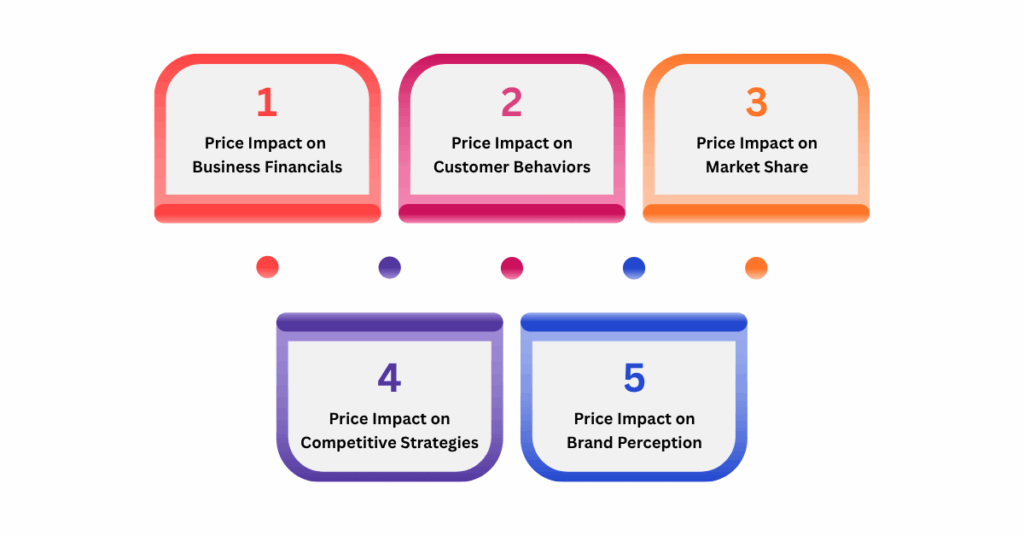
#1 Price Impact on Business Financials
Price impact in the business domain examines how prices affect financials like revenue, margins, profits, and financial ratios. The study is based on collecting data about product prices over time and relating how changes in prices have been affecting key financial aspects for businesses. For instance, a price rise of 10% for a flagship product resulted in 7% fewer sales in the third quarter. This type of analysis is based on price impact analysis on business financials.
#2 Price Impact on Customer Behaviors
It also helps in understanding how customers react to the market’s price changes. This analysis focuses on how customer behaviors change with prices and how companies can use optimal price points to impact shopping behaviors. It evaluates how pricing influences purchase decisions, loyalty, and lifetime value. Whether customers can switch to other brands or online platforms for better prices or not. It also answers key questions like whether prices affect purchase frequency, cart size, or ultimate checkouts.
#3 Price Impact on Market Share
Price impact analysis on market share evaluates how pricing decisions directly influence a company’s slice of the total market. This analysis tracks the correlation between prices and the percentage of sales a business captures within its industry. For instance, when a smartphone manufacturer reduced their mid-range model pricing by 15%, it witnessed a market share increase from 12% to 18% within two quarters. The analysis reveals critical thresholds where price reductions translate to proportional market share gains or vice versa.
#4 Price Impact on Competitive Strategies
Competitive reaction is another use case of price impact analysis. It is about adjustments of prices as per competitors’ price changes. In e-commerce and retail businesses, prices of similar products with similar specifications and variants can be a pivot for competition. So, if your competitor is selling the same for $35, you can lag if you sell that for $38. You can beat the competition only when you price it at $33 or provide an added benefit if your price is also $35. Real-time price monitoring of competitor product listings and their prices to change yours is what constitutes price impact on competitive strategies.
#5 Price Impact on Brand Perception
This area of price impact looks at how brands use pricing strategies to affect what customers think about their value, quality, and place in the market. It explores how pricing psychology plays a role in shaping brand equity. Suppose a luxury skincare brand kept its prices higher even when competitors had slashed them. This brand created an image of exclusivity by doing it, and it appealed more to the luxury skincare brand buyers. Understanding how pricing affects brand perception helps businesses figure out the tricky balance between being accessible and staying exclusive.
Methods of Price Impact Analysis
Pricing decisions can no longer rely on intuition alone. Forward-thinking organizations use sophisticated price impact analysis methodologies that power their pricing strategy and deliver measurable financial outcomes.
A. Conjoint Analysis: Understanding How Customers See Value
Conjoint analysis helps businesses measure how much customers value different parts of a product or service. This method mimics real-world decisions by showing customers different product options combined with various prices. Through these comparisons, companies figure out how much a particular feature matters compared to its cost. The strength of conjoint analysis lies in uncovering unnoticed pricing chances.
B. Price Elasticity: Understanding How Customers React to Changes
Price elasticity helps predict the way demand shifts when prices change. It is shown as the ratio between how much the quantity demanded changes compared to the percentage change in price. These numbers show how much customers react to price differences. For this, you will need a large amount of historical pricing and sales data to build accurate elasticity numbers.
C. A/B Testing: Testing Pricing in Real Life
Unlike methods that predict results, A/B testing proves them by running controlled experiments in actual market conditions. In this process, you split your customers into groups, expose each group to different prices, and then analyze how they respond to find more effective pricing plans.
The power of A/B testing comes from how it turns guesses into clear results through facts.
D. Psychological Price Analysis: Understanding Buyer Perceptions
Psychological price analysis looks at customer perception instead of just focusing on economics. It studies how price setups and how prices are shown can shape buying choices. This approach understands that people don’t always decide. Instead, they react to pricing signals in ways that are often expected but can sometimes be surprising. This method includes several tricks tied to how people think about prices. These include using charm pricing with $9.99 instead of $10.
For all the above analyses, you will need price data.
| Need Real-time competitor price monitoring across all major marketplaces?
Connect with X-Byte for Price Intelligence Services! |
Industry-Specific Use Cases of Price Impact Analysis

#1 E-commerce and Retail
Retailers face the challenge of balancing promotional sales with keeping steady profit margins. One large electronics store used dynamic pricing analysis to find the best discount limits for different product types. This led to a 12% boost in gross profit and helped them stay competitive against online-only shops.
Key Applications:
- Seasonal price changes
- Adjusting prices to manage demand
- Optimizing personalized deals
- Pricing strategies based on product roles
#2 Software and SaaS
Creating a great product is one part of succeeding in SaaS. Companies also need to focus on how they monetize it. How can this be applied? Suppose a project management SaaS company used conjoint analysis to measure how users saw the value of features. They found that users rated timeline visualization three times higher than reporting tools. This finding led to a smart tier-based pricing update, which boosted conversion rates by 23 percent.
Ways this approach is applied:
- Measuring feature importance
- Analyzing how much different user groups will pay
- Improving steps that drive sign-ups
- Reducing churn by matching pricing to user needs
#3 Manufacturing and Industrial
Dealing with security issues remains a constant struggle in industrial pricing because price changes and competitive pricing cuts put profit margins at risk. Suppose one manufacturing company used value-based pricing analysis to measure often-ignored features like quicker delivery times and better technical support. This helped them raise their prices by 7%. Customers accepted the change without pushing back, which brought direct growth in earnings.
Main Uses:
- Using value-based pricing
- Improving how prices are set across distribution channels
- Crafting specific pricing for individual customers
- Managing changes in material costs
#4 Healthcare and Pharmaceuticals
According to a JAMA Network Open study, price transparency initiatives in healthcare drove a 7.3% reduction in hospital charges for services. This highlights how pricing analysis can influence outcomes in controlled industries like healthcare.
Key Uses:
- Setting prices based on the value of medical innovations
- Improving how insurance pays for reimbursement
- Pricing services as bundles
- Creating clear pricing strategies
#5 Hospitality and Travel
Hotels dread this kind of problem the most: expensive rooms staying vacant while cheap rooms lose revenue. Now, consider this hypothetical scenario: One high-end resort used a smart price analysis system to adjust room rates based on 17 different demand factors. They saw big changes. Revenue per available room climbed by 22% during busy seasons, with occupancy rising 15% during less-busy times. Guest satisfaction levels stayed steady, too.
Some key uses:
- Adjusting prices in real time based on demand
- Optimizing value for loyalty program tiers
- Pricing strategies for extra services
- Setting competitive rates by season or location
How to Collect Data for Price Impact Analysis?
Before you set out for price impact analysis using various methods like conjoint analysis, price elasticity analysis, A/B testing, etc., you need price data in hand. This may include data of your own product listings, competitor product listings, data from Google shopping pages, e-commerce websites, price comparison sites, and many more. Again, you need this data in a tabulated format that is easy to analyze. How do you get this data in a structured format? Web Scraping via automated tools or using APIs for platform-specific scraping is the best way to collect the data for price impact analysis.
Data Collection for Price Impact Analysis: Web Scraping and APIs
Web Scraping for Price Data
The beauty of web scraping lies in having a plethora of data points from across the market at your disposal. This flexibility allows you to monitor competitive positioning depending on your specific analysis needs.
Implementation Approaches:
- Custom Python-based scrapers using BeautifulSoup or Scrapy for tailored price data collection
- Headless browser automation with Selenium for rendering JavaScript-heavy sites
- Commercial scraping platforms like X-Byte, Scrapin Intelligence, Web Screen Scraping, etc., are for non-technical users
API Integration for Real-Time Price Data
For those looking to grow their pricing intelligence capabilities, API integration provides an ideal opportunity to access structured data sources without the complexity of scraping.
Key API Sources:
- E-commerce marketplace APIs (Amazon, eBay, Walmart)
- APIs for Price comparison platforms like Google Shopping
- APIs built by professional data scraping companies like X-Byte
Conclusion
In the online business world, pricing is a strategic conversation between businesses and their customers. If organizations are not able to change this conversation as per the prevalent mood of the market (competitors, customers, macros) or changing market trends, they are vulnerable to being beaten by those who do it. Price impact analysis is the way by which businesses can learn to adapt their prices according to market conditions. While most companies still operate with reactionary pricing models, forward-thinking organizations are already building price impact analysis into their operational DNA.
Remember that pricing excellence isn’t achieved through analysis alone, but through relevant data on which the analysis is based.
If you need price data from your competitors in a structured format, X-Byte can help. With our advanced scraping solutions, we can help you build a pricing ecosystem that autonomously identifies opportunities before your competitors even recognize them.
Stop losing market share to better-priced competitors. Schedule your personalized pricing intelligence consultation today!
 ✯ Alpesh Khunt ✯

Related Blogs

Best Web Scraping Services in the USA: A CTO’s Guide to Choosing the Right Data Partner