

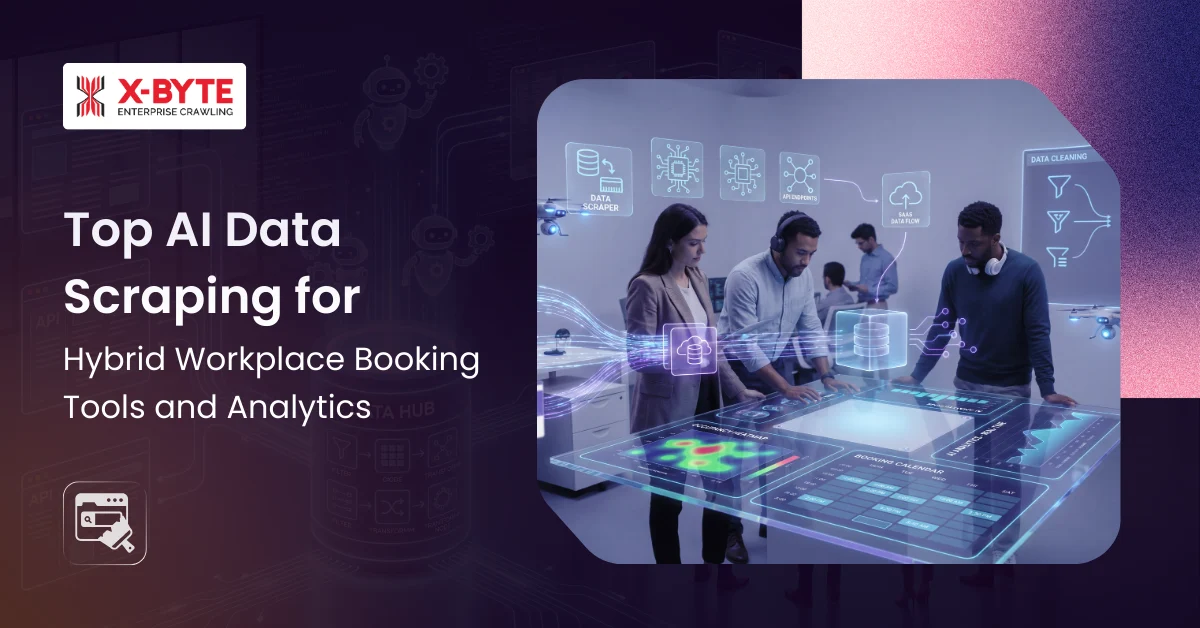
AI Data Scraping for Workplace Analytics in Hybrid Offices
Data scraping built by AI retrieves structured booking and occupancy data based on the workplace management platform, converting disjointed records of operations into analytics-scalable datasets. In the absence of automated extraction pipelines, that data remains confined within the native interface of each platform. This information is automatically gathered through AI scraping infrastructure without manually exporting, using restricted access to the API, or using a built-in reporting method.
Key data points collected through workplace scraping include:
- Desk reservations and utilization rates by floor and zone
- Meeting room usage and availability windows by capacity and type
- Parking space bookings by zone, including EV and accessible spots
- Employee attendance patterns across sites and departments
- Peak office occupancy hours by day, floor, and building
- Department-wise space usage and demand trends over time
- Location-level utilization across multi-site and multi-country portfolios
This information drives analytical software used in the workplace that enables the facilities teams to identify the appropriate office size, optimize resources, and design evidence-based plans of hybrid work. AI pipelines are more consistent and structured than manual processes when large-scale occupancy data of the workplace is required by companies.
Why Workplace Booking Platforms Alone Are Not Enough?
The default reports provided by the reservation systems are not designed to provide profound business understanding, but rather daily operational tasks. The inbuilt dashboards become too basic too fast in many companies where they have multiple sites, departments or they have used multiple booking tools.
Common problems with native platform analytics:
- Limited reporting capabilities with no ability to customize metrics or dimensions beyond what the vendor provides
- No cross-platform analytics when teams use more than one booking tool across locations or business units
- Exportation of raw data to be processed downstream or long term storage is not possible.
- The BI tools such as PowerBI, Tableau, or Looker are not integrated or poorly integrated.
- No past booking patterns and attendance patterns can give any predictive information into the workplace.
Platforms like Ronspot, Robin, and Condeco each offer useful built-in reporting, but none of them can aggregate data across each other. In situations where a real-estate team prefers that all sites and all tools be seen as having one view of utilization, the default dashboards do not give it.
These gaps are filled in through AI data scraping. It extracts raw booking data of each platform and enters them into a central data warehouse. This gives analytics and real estate teams a single source of truth for hybrid workplace utilization data analysis across every tool, site, and team in their portfolio.
Key Hybrid Workplace Tools Companies Track with Data Scraping
Understanding how to collect desk booking data from workplace tools starts with knowing what each platform captures and how its data can be extracted. Here are the key platforms enterprises commonly track.
1. Ronspot
The best all-purpose choice is Ronspot in situations when you have to deal with the problem of parking shortage with enforceable fairness, but not only with the first-come, first-served reservation.
When comparing sites to deploy one application to encompass desks, rooms and parking, consider the calendar sync, overbooking prevention and equity on peak days of each site. One useful method of ascertaining fit is to launch a small pilot with real zones, caps, and waitlists and compare the rate of double-booking and user reviews across teams through Ronspot.
Ronspot pros
- It is possible to reserve desks, rooms, and parking. Admins are able to manage credits, establish booking schedules, restrict usage, manage waitlists, and establish regulations concerning who is allowed to book.
- Teams and Microsoft 365 keep each other informed to prevent the occurrence of double bookings. Single Sign-On is operational, the system complies with ISO 27001:2022 standards of security, and the EU data hosting is optional.
- There are no ambiguous prices on individual spaces or a 7-day personal trial. Floors and parking lots are presented on maps. Add-on access-control can be added on.
Ronspot cons
- Add-ons for sensors, access-control tablets, and ANPR (automatic number plate recognition) are priced separately, so scope them early
- Per-space licensing can be cost-sensitive for tiny “micro-resources,” so define what truly needs to be bookable
2. Envoy
Envoy is the most natural pick when your front desk and arrivals already run on Envoy Visitors.
Envoy pros
- Native Parking tied to desks, rooms, and visitors, with rotations, release of unused spots, and interactive maps
- Clear analytics across resources, strong mobile UX, and admin-friendly controls for multi-site policies
Envoy cons
- Best value comes from using multiple Envoy modules, while partial rollouts can split reporting and governance
- Parking policies need careful design, or you can create friction on peak days
3. Skedda
Skedda is ideal when you need a flexible “book anything” model that still stays manageable for admins.
Skedda pros
- “Book anything” approach with interactive maps, strong rules and roles, SAML (Security Assertion Markup Language) SSO, and fast setup
- Clean reporting and straightforward packaging that supports campus-style rollouts
Skedda cons
- Flexibility requires conventions for naming, tags, and zones, or wayfinding becomes messy
- Advanced analytics and automations may require add-ons or integrations
4. Condeco (Eptura)
Condeco is built for enterprise governance where global consistency matters more than minimal setup.
Condeco pros
- Enterprise-grade booking across desks, meeting rooms, lockers, and parking, with Outlook and Teams add-ins
- Governance features and change-management support, with expansion paths into other Eptura modules for assets and work orders
Condeco cons
- Depth can extend timelines, so plan a phased pilot and lock your data model early
- UI consistency can vary across legacy components, so training and comms matter
5. Robin
Robin is a strong choice when UX and map clarity drive adoption across diverse teams.
Robin pros
- Modern maps and user-friendly desk and room booking, with parking and lockers supported as resource types
- Good fit for organizations replacing legacy tools without heavy change management
Robin cons
- Parking capabilities vary by plan and rollout stage, so confirm scope for your lot types
- Advanced policy controls may require tighter admin process or custom workflows
Enterprise Use Cases of AI Data Scraping for Workplace Booking Data
1. Office Space Utilization Optimization
Facilities and real estate teams use scraped booking data to identify and act on inefficiency across their portfolios. Companies analyze underused office locations that may be candidates for consolidation or repurposing, meeting room demand patterns that reveal mismatches between room sizes and actual group attendance, and hybrid attendance patterns that show which days and sites experience peak versus low utilization. Platforms like Ronspot and Robin generate the raw booking records that make this analysis possible when extracted and aggregated at scale.
2. Corporate Real Estate Cost Reduction
Scraped analytics-supported real estate decisions are more justifiable and accurate. Information assists companies in consolidating their office space where usage is continually lower than the limits, reducing lease expenses by matching the contracted space to the observed usage as opposed to projecting headcount, and reengineering floor plans to show actual usage of the office by teams. In the case of organizations that deploy Condeco or OfficeSpace in multiple markets, scraped utilization information is commonly the evidence base used to decide on lease renewal or termination.
3. Workforce Planning and Hybrid Policies
Workplace booking data provides a behavioral signal that HR and operations teams can use to shape hybrid policy. Scraped data reveals employee office attendance trends by team, role, and location, team collaboration schedules that show whether anchor days are actually driving co-presence, and peak workday patterns that inform decisions about space allocation, catering, and facilities staffing. Tools like Envoy and YAROOMS generate attendance check-in data that, when extracted and analyzed, gives workforce planners a ground-truth view of hybrid behavior.
4. Parking and Facility Optimization
Parking is one of the most friction-heavy parts of the employee arrival experience, and one of the hardest to optimize without data. Through desk room parking booking analytics, companies can track parking demand by zone and day across platforms like Ronspot and Envoy, monitor employee arrival patterns to identify congestion windows, and improve parking space allocation efficiency by matching supply to actual usage rather than historical assumptions. For organizations managing EV charging spots, accessible spaces, and tiered priority zones, scraped parking data enables the granular analysis that makes fairness enforcement practical.
How AI Data Scraping Powers Workplace Analytics Dashboards?
The value of scraped workplace data depends entirely on the pipeline that processes and delivers it. A well-architected workplace management data pipeline automation workflow transforms raw booking records from platforms like Ronspot, Robin, Skedda, and Condeco into dashboard-ready intelligence.
Data pipeline workflow:
- Platform identification – mapping each workplace tool, its data structure, and its access method across the enterprise stack
- AI web scraping infrastructure – deploying adaptive scrapers that handle authentication, session management, and dynamic content rendering across each platform
- Data normalization – standardizing field names, date formats, and schemas across platforms so records from Robin, Envoy, and Condeco can be joined and compared in a single dataset
- Data warehouse storage – loading clean, structured records into a central repository for historical analysis and trend modeling
- BI dashboard integration – connecting the warehouse to visualization and reporting tools used by workplace, real estate, and HR teams
This pipeline integrates directly with enterprise analytics platforms, including Power BI, Tableau, and Looker for visualization, and Snowflake and BigQuery for scalable warehouse storage and querying. Once live, workplace leaders gain a continuously updated view of how their entire office portfolio is actually being used, across every platform and every site.
Key Data Fields Extracted from Workplace Booking Platforms
A well-structured workplace booking dataset enables both operational reporting and advanced predictive modeling. Whether data is extracted from Ronspot, Envoy, Skedda, Robin, or Condeco, the normalized output follows a consistent schema that supports cross-platform analysis.
The typical dataset produced by AI scraping pipelines includes:
- Desk ID – unique identifier for each bookable desk or workstation
- Room ID – identifier for each meeting room or bookable space, including capacity and amenities
- Parking Slot ID – identifier for each parking space, including zone, type (EV, accessible, general), and floor
- Booking timestamp – date and time the reservation was created and last modified
- Employee department – team or business unit associated with the booking for segmentation analysis
- Booking duration – length of the reservation in hours or half-days
- Office location – building, floor, or campus associated with the booking for multi-site comparison
- Attendance check-in status – whether the employee checked in, no-showed, or cancelled, and at what time
These datasets power advanced workplace analytics, including utilization reporting, no-show rate analysis, demand forecasting by space type, and long-term capacity planning. With clean, normalized records aggregated from multiple platforms, analytics teams can answer questions that no single tool’s native dashboard can address on its own.
Challenges in Scraping Workplace Booking Platforms
Workplace booking data scraping is technically demanding. Enterprise SaaS platforms are built with security and access controls that make automated extraction a significant engineering challenge.
Anti-bot protections are standard across tools like Condeco, Envoy, and Robin. These platforms use login authentication that requires persistent session handling, API restrictions that limit programmatic access without approved credentials, and rate limiting that throttles high-frequency requests and can trigger temporary or permanent access blocks.
Dynamic dashboards add another layer of complexity. Most modern workplace platforms rely on JavaScript rendering, where booking data is loaded client-side after page load rather than served in static HTML. Others use API-based interfaces where data is only accessible through authenticated endpoints, not through traditional scraping paths. Skedda and Robin both use dynamic front ends that require headless browser infrastructure to extract reliably.
Why Enterprises Use Managed AI Data Scraping Services
The effort of constructing and maintaining our own scrapers to SaaS workplace tools of large firms is heavy. It can be difficult when the platform interfaces and APIs are modified without notice and teams have to deal with the process of logging in with session tokens, rotating passwords and multi-factor authentication and ensure that data pipelines continue running successfully with new anti-bot rules being added by the likes of Condeco, Robin and Envoy.
All that work is removed by managed AI scraping services. They provide businesses with a pre-developed scraping system developed to work with SaaS tools. Their proxy networks are able to pull voluminous data reliably. They include monitoring which automatically identifies and corrects breakages and they straighten cleaned information into the business-intelligence tools or straight into the company data warehouse.
When your team is working on workplace strategy rather than data engineering, managed services will enable you to have a reliable, scalable, and easy-to-maintain analytics foundation.
Why Choose X-Byte for AI Workplace Data Scraping?
X-Byte provides an excellent means of extracting data of work place software to the businesses. It is designed to work with large and complicated office configurations with applications such as Ronspot, Envoy, Skedda, and Condeco.
- The system brings in AI to scrape data which is capable of performing quite a number of jobs across numerous sites simultaneously. It does not lose reliability.
- X-Byte is very successful using SaaS in the workplace. It employs intelligent parsing, session management and is able to cope with dynamic content. It is also optimized towards the most popular booking tools.
- The tool establishes automatic data pipelines which provide clean, well structured and standardized records. This may be operational in real time or scheduled to work on analytics of the workplace.
- It integrates with BI dashboards and data warehouses including Power BI, Tableau, Snowflake, and Big Query. This provides fast analytics outcomes.
- X-Byte adheres to information governance and compliance regulations in the enterprise. It has written data handling procedures, which fulfill security and privacy requirements.
Since X-Byte has vast experience in creating web data systems for companies, their customers receive pipes that can survive interfaces. The scrapers do not fragment whenever the UI changes.
Future of Hybrid Workplace Analytics with AI Data Pipelines
The examples of the current workplace analytics are not the limit of what organized booking information can accomplish. With more AI data-collection tools becoming better and longer-term data sets becoming increasingly available on the sites like Ronspot, Envoy, and Condeco, firms will acquire the skills that extend much further than what the present reports can provide.
Some of the features already in development include predictive office utilization models that forecast use, ahead of time, so that facilities teams can prepare, artificial intelligence applications that adjust resources in accordance with real-time booking cues and dashboards that display operations executives the particulars of any site and type of space in real time.
Firms establishing data pipelines in the workplace today will have an advantage. All predictions are based on clean old data, which presently anyone beginning to gather and organize in Ronspot, Robin, Skedda, and Envoy will be way ahead of the curve when such new tools are normalized.
Conclusion
Booking tools provide a substantial amount of operation data generated on a daily basis by hybrid workplaces. Platforms such as Ronspot, Envoy, Skedda, and Condeco make records of desks, rooms, parking spaces, and events related to check-in, which when compiled and viewed can demonstrate precisely how office space is being utilized against the manner it was designed to be utilized. With the help of AI data scraping, firms will be able to convert disjointed booking data on individual websites into powerful, practical insights on the workplace. In the case of large companies that have a number of offices and teams in different locations, AI workplace analytics is rapidly becoming a strategic competence, rather than an assistive tool. Those companies that establish co-ordinated data pipelines today will be making smarter and faster decisions regarding real estate and staffing tomorrow.
Frequently Asked Questions
 ✯ Alpesh Khunt ✯

Related Blogs
How to Measure Data Extraction Quality at Scale: Accuracy, Coverage and Freshness
E-Commerce Product Data Management: Best Practices for Retailers