
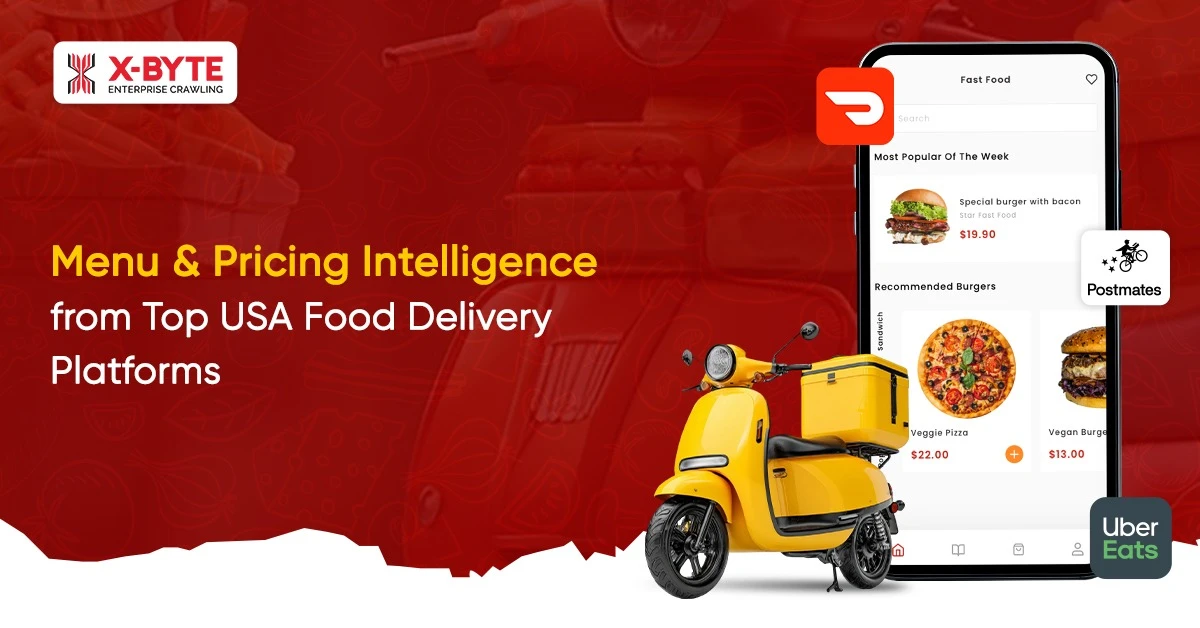
The U.S. food delivery market has become highly competitive, with restaurants constantly adjusting menu prices, discounts, delivery fees, and promotional offers to attract customers. Keeping track of these changes manually across platforms like DoorDash, Uber Eats, and Grubhub is nearly impossible, especially for brands operating in multiple cities. This is where menu and pricing intelligence powered by food delivery data scraping gives businesses a competitive advantage.
By collecting publicly available restaurant menu data, pricing information, promotional offers, customer ratings, and delivery charges, businesses can monitor competitors in real time and make smarter pricing decisions. Instead of relying on guesswork, restaurant chains, cloud kitchens, food delivery aggregators, and market research firms use structured data to benchmark prices, optimize menus, identify regional pricing trends, and respond quickly to changing market conditions.
In this blog, we will learn what menu and pricing intelligence is, how food delivery data scraping works, the insights businesses can collect from leading U.S. food delivery platforms, and how these insights help improve pricing strategies, profitability, and competitive positioning.
What is Menu and Pricing Intelligence?
Menu and pricing intelligence is the process of collecting and analyzing publicly available restaurant menu data, prices, promotions, delivery fees, and customer ratings from food delivery platforms such as DoorDash, Uber Eats, and Grubhub. Businesses use this information to monitor competitors, optimize pricing strategies, identify market trends, and improve profitability.
Why Menu & Pricing Intelligence Matters for Restaurants?
The money involved here is hard to ignore. U.S. food delivery is already worth well over USD 100 billion a year, and it keeps climbing. At that scale, even a small pricing mistake can quietly chip away at your margins across a full month of orders.
U.S. Food Delivery Market at a Glance
- Market Size: USD 100+ Billion
- DoorDash Market Share: 56%
- Uber Eats: 23%
- Grubhub: 16%
- Restaurant Commission: 10–30%
- Average Delivery Fees: Vary by city
The greater challenge is that prices rarely stay fixed. A single menu item can carry one price in the downtown core, and a different price a few miles away, and it may change again by the lunch rush. Since menus and prices, as well as promotions, vary by geography and distribution method, a chain operating a dozen locations cannot realistically monitor all of it manually. Doing so would require checking hundreds of pages daily, and overnight changes would still slip through. This is precisely the gap that automated restaurant menu tracking and competitor pricing intelligence are built to close.
What Is Food Delivery Data Scraping?
Food Delivery Data Scraping gathers publicly listed menu and pricing details from delivery apps and restaurant pages, all through automation. The tools behind it, known as scrapers, move through each page the way a browsing customer would and extract the fields that matter into a usable structure, whether that ends up as a spreadsheet, a JSON feed, or a live dashboard.
In practice, the process follows a defined sequence. A business first specifies what it needs, after which the tools crawl the target platforms, clean the results, and deliver the finished dataset. Most projects move through four stages:
- Defining the scope: The project begins by settling on which platforms to cover, the specific cities or ZIP codes that matter, and the exact fields worth pulling.
- Crawling the pages: Modern scrapers then work through dynamic content and applied filters, reading how each page structures its menu items and prices.
- Cleaning the results: The raw output is rarely good enough, so we remove duplicate listings, standardize item names, and match the same restaurant across platforms.
- Delivering the dataset: Finished data reaches the business through whatever fits its systems, whether a REST API, a JSON feed, cloud storage, or a live dashboard.
An important point important to note is that all of this information is already public. We can collect data such as restaurant names, menus, item prices, reviews, ratings, delivery times, and offers, all available publicly. No hidden access or private breach is involved at any stage. The value lies not in obtaining the data, but in organizing information that already is publicly available into something a business can actually use.
Top Business Use Cases of Menu & Pricing Intelligence
The real value shows up in daily decisions. Restaurants and chains use scraped pricing intelligence to price smarter, bundle better, and defend their turf. Here are the most common plays.
Pricing Benchmarks: Comparing your prices against the strongest competitors in the same area removes the guesswork from every menu decision. You see exactly where you sit before you set a number.
Regional Pricing: Menu pricing can vary substantially based on local economy or demand. A dish that sells well downtown may need a different price in the suburbs, so brands tune each market to what it will actually pay.
Dynamic Pricing: Timing drives a lot of value here. Since a lunch menu rarely matches a dinner menu, data helps you set the right price for each daypart instead of running one flat number all day.
Finding Value Gaps: The data reveals weak spots. Teams can cut the overpriced items and get rid of combos people keep ignoring, then rebuild the menu around what really sells.
Defense and Trend Spotting: A competitor’s new bundle or delivery deal is a warning shot. Early data buys you time to test a response before customers reset their expectations and drift elsewhere.
DoorDash Vs Uber Eats Vs Grubhub: Cost Comparison
Pricing intelligence is not just about menu items. It also covers the fees that eat into every order. These fees shape how a restaurant prices its food in the first place. The table below compares the major USA food delivery platforms based on public 2026 figures.
| Platform | U.S. Market Share | Restaurant Commission (Delivery) | Pickup Commission | Notable Detail |
| DoorDash | 56% | 15%–30% by plan tier | 6% | Basic 15%, Plus 25%, Premier 30% |
| Uber Eats | 23% | 15%–30% by plan tier | Lower self-delivery tiers | Plans mirror Basic, Plus, Premium |
| Grubhub | 16% | 10%–20% base | Varies | Free Grubhub+ for Amazon Prime members |
DoorDash’s marketplace delivery commission ranges from 15% on Basic to 30% on Premier; pickup is listed separately at 6%. Uber Eats sits in a similar band, since Uber Eats charges restaurants 15-30% commission per delivery order depending on plan tier. Grubhub often runs a touch cheaper, as Grubhub typically charges between 10% and 20% in commission.
The hidden cost climbs even higher once you add extras. Third-party delivery commissions typically range from 15% to 30%, but real costs often reach 30% to 40% per order once additional fees are included. That is why tracking fees across platforms is just as important as tracking menu prices.
Industries That Benefit from Food Delivery Pricing Intelligence
This tool is not just for giant chains. Food delivery data scraping is used by all sorts of businesses to sharpen their edge. The main users include:
- Cloud kitchens with a few outlets that need live competitor pricing.
- Regional QSR brands that benchmark menus across many stores.
- Market research firms that build sector reports on pricing and consumer behavior.
- Digital marketing agencies that advise food clients with real data, not speculation.
- Platforms that compare prices of app menus and delivery charges
Food delivery data scraping is not a technical luxury reserved for large chains. A small brand with three locations can gain the same clarity as a national player. The common thread is simple: better data leads to better revenue.
Need Real-Time Menu & Pricing Data?
Custom scraping solutions for menu and pricing data, aligned with your business goals.
Best Practices for Implementing Menu & Pricing Intelligence
Getting value from menu and pricing intelligence does not require a huge tech team. It does require a clear plan. Follow these simple steps to begin:
- Pick your targets: Start with the platforms and cities that carry the most weight for your business, rather than trying to cover everything at once.
- List your fields: Be specific about what you need pulled, whether that is item prices, fees, promotions, reviews, or some mix of them.
- Set a frequency: Some businesses need fresh numbers every day, others manage fine with a weekly pull or a real-time feed. Pick the cadence that fits what you are trying to achieve.
- Clean and match: Normalized data is what makes comparison honest, so line up items and restaurants correctly before you draw any conclusions.
- Act on insights: The numbers only pay off once you use them, whether that means adjusting prices, testing new combos, or sharpening a promotion.
Most teams do not want to build and maintain scrapers on their own, and they rarely need to. A capable data partner takes on the crawling, cleaning, and delivery, which frees your staff to spend their time on strategy rather than technical upkeep.
Conclusion
The food delivery race in the USA rewards speed and clarity. Menus shift, fees climb, and competitors launch new deals every week. Guessing your way through this market is a slow path to lost profit. Menu and pricing intelligence replaces that guessing with facts, giving you a clear view of prices, promotions, and trends across every major platform.
The numbers make the case on their own. With a market heading toward USD 130 billion and three platforms holding nearly all the power, every pricing decision carries weight. Businesses that track competitor pricing, benchmark menus, and read the data early will keep winning. Those that stay blindfolded will keep guessing.
 ✯ Alpesh Khunt ✯

Related Blogs
Web Data Extraction API vs. Custom Data Extraction: Which Approach Fits Your Project?
Build vs. Buy: Should Your Business Build a Data Extraction Pipeline or Outsource It?