
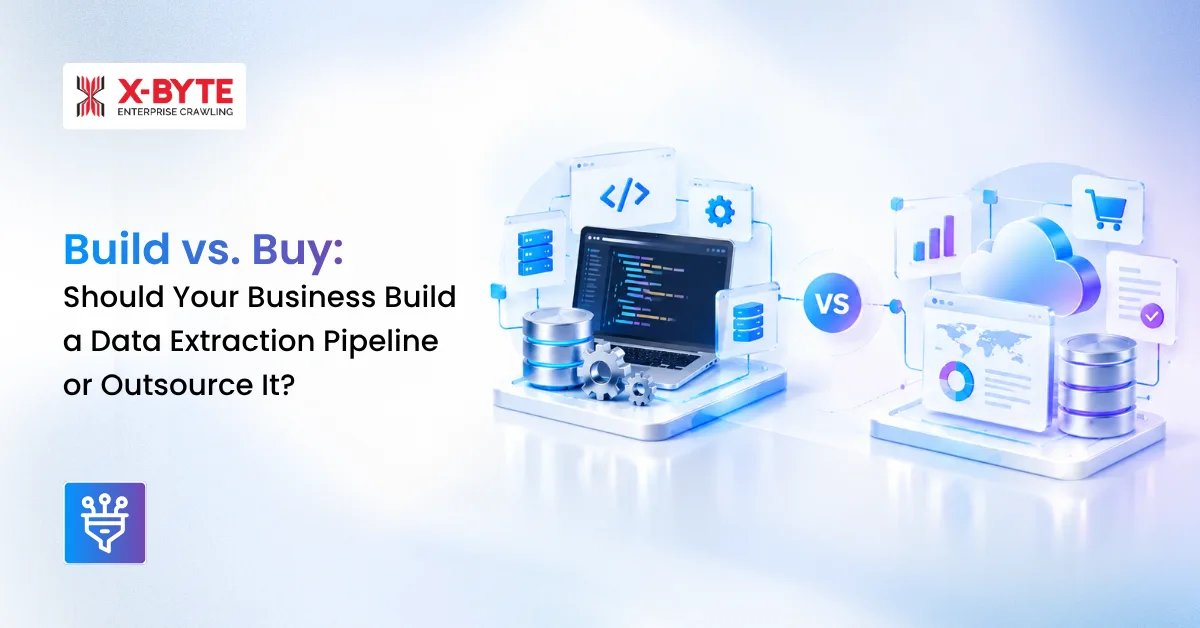
Businesses that rely on web data must decide whether to build and maintain their own data extraction pipeline or outsource the work to a managed provider. An in-house solution offers greater control over infrastructure and data workflows, but it also requires engineering resources, ongoing maintenance, and investment in scaling and data quality. Managed data extraction services can reduce that operational burden, although the right choice depends on your data volume, source complexity, budget, and internal expertise.
This guide compares both approaches, including their first-year costs, maintenance requirements, scalability, and time to launch. You will also find a practical decision checklist and the key factors to assess before choosing a solution. By the end, you will have a clearer framework for deciding whether to build an internal pipeline or work with an external data extraction provider.
What Is a Data Extraction Pipeline?
A data pipeline for extraction is the full system that pulls raw information from websites, apps, and APIs, then cleans, structures, and delivers it where your team needs it. Web scraping sits at the front, while parsing, validation, storage, and scheduling make up everything behind it. Without that back half, you end up with messy files nobody trusts, which defeats the purpose of data extraction in the first place. A healthy pipeline runs on a schedule, adapts when target sites change their layout, and flags errors before bad records reach your dashboards. Because websites update constantly, this is never a build-it-once project, and that single truth shapes most of the debate that follows.
Key Components of a Data Extraction Pipeline
Technical depth matters here, because the hidden work lives inside components most buyers never see. A production-grade data collection infrastructure usually includes the following layers:
- Crawlers and fetchers, which request pages while rotating proxies and handling CAPTCHAs so target sites do not block the traffic.
- Parsers and extractors, which turn raw HTML or JSON into structured fields, and which break the moment a site changes its markup.
- Job queues and schedulers, which control how often each source runs and keep large jobs from colliding.
- A validation layer, which flags records that look wrong, come back empty, or have gone stale, so weak data gets caught before it ever reaches your reports.
- Retry and failure recovery, which re-run failed tasks automatically instead of silently dropping data.
- Storage and delivery, which push clean output into a warehouse, a file drop, or an outsourced web scraping API for your apps.
- Monitoring and alerting, which watch for coverage gaps, latency spikes, and sudden drops in record counts.
In flow terms, the path runs: source sites → fetcher with proxy rotation → parser → validation → queue and retry → storage → delivery → monitoring. Every one of those boxes needs an owner, and that ownership question is the heart of the build-versus-buy call.
When Should You Build a Data Extraction Pipeline In-House?
Building your own system gives you total control, yet that control carries responsibilities many teams underestimate. Here is what an in-house build genuinely demands:
- Engineering time upfront: Skilled developers must design crawlers, manage proxies, and write parsers for every site you target, which pulls them off your core product.
- Ongoing maintenance cost: Sites change structure often, so repairing broken scrapers becomes a weekly chore, and the maintenance cost rarely appears in the first budget.
- Infrastructure and tooling: Servers, rotating proxies, anti-bot handling, and storage all carry monthly bills that grow with your data volume.
- Quality assurance: Someone on your side must verify accuracy and freshness, since nobody else is checking the data quality for you.
- Scalability planning: Adding ten new sources or a new country usually means more servers and more people, so scalability turns into its own project.
When Should You Outsource Data Extraction?
Outsourcing flips the model, because a specialist already owns the infrastructure, the expertise, and the monitoring that an internal team would build from zero. The appeal usually comes down to a few practical gains:
- Predictable budgeting: Since the maintenance cost of broken scrapers, proxy rotation, and site changes is bundled into one agreed fee rather than a string of surprise invoices.
- Faster time to value: Because a managed extraction platform is largely pre-built, and your first structured dataset can land in days rather than the weeks a from-scratch build often needs.
- Built-in scalability: As a mature provider can expand across thousands of pages and new regions without you hiring a single extra engineer.
- Dependable output: A good provider ties its accuracy to an SLA. When a feed breaks, fixing it is their job, not yours.
- Fewer legal gray areas: Serious providers stick to public data and track the rules as they shift, which an overloaded internal team rarely has time to do.
In-House vs. Outsourced Data Extraction: Cost Comparison
Numbers tell the story better than adjectives, so the first table maps the two routes across the factors that usually decide the outcome. The second table puts rough dollar ranges on a 12-month horizon.
| Factor | Build (In-House) | Buy (Managed Data Extraction Services) |
| Upfront cost | High (hiring, tooling, setup) | Low to moderate (onboarding fee) |
| Maintenance cost | Continuous and unpredictable | Included in the service fee |
| Time to launch | Weeks to months | Days to a couple of weeks |
| Scalability | Limited by servers and staff | Elastic and on-demand |
| Data quality ownership | Fully yours to monitor | Backed by provider SLAs |
| Best fit | Large teams with niche, long-term needs | Most businesses wanting speed and reliability |
The next table shows illustrative first-year ranges in U.S. dollars. Treat these as planning estimates, since real figures shift with data volume, site difficulty, and location.
| Cost item (12 months) | Build (In-House) | Buy (Outsourced) |
| Engineers (1–2) | $120,000 – $200,000 | Included |
| Proxies and anti-bot | $6,000 – $24,000 | Included |
| Servers and cloud | $3,600 – $18,000 | Included |
| Maintenance hours | Part of engineer time | Included |
| Provider/onboarding fee | — | $12,000 – $60,000 |
| Estimated Year 1 total | $140,000 – $250,000+ | $15,000 – $70,000 |
The pattern is clear once the true maintenance cost and scalability limits enter the picture. Building can pay off for very large organizations with highly specific, permanent needs, while buying wins for the majority that value speed, predictable spend, and dependable output.
Dealing With Broken Scrapers and Blocked Requests?
Custom data scraping solutions that handle blocks, errors, and maintenance for your business needs.
Build vs. Buy: How to Choose the Right Approach
Rather than guessing, run your situation through these honest questions:
- Is web scraping central to your product, or support for other goals? Central needs may justify a build, while support needs rarely do.
- Do you have engineers who can own a custom data pipeline full-time, for years? If not, outsourcing removes a real staffing risk.
- How fast do you need the first dataset? Urgent timelines almost always favor a managed partner.
- Can your budget absorb unpredictable maintenance cost spikes when target sites change overnight?
- Will your needs grow across new sources and regions? Heavy scalability demands are far easier for a specialist to handle.
If most answers lean toward speed, savings, and reliability, the in-house vs. outsourced data collection question has quietly answered itself.
Data Extraction Market Trends in 2026
Market context strengthens the case for treating data extraction as a serious, specialized discipline, though analysts size it differently, so the ranges are worth noting. According to Research and Markets, the web scraping market was valued at about $1.34 billion in 2025 and is projected to grow from roughly $1.56 billion in 2026 to $3.49 billion by 2031, a compound annual growth rate near 17.4%. The Business Research Company reports a more conservative figure, with the market rising from about $0.99 billion in 2025 to $1.17 billion in 2026 at a CAGR of 18.5%.
On the technology side, AI-assisted scraping is reported to deliver roughly 30–40% faster extraction than older methods, while the alternative data market that scrapes the feeds is compounding at nearly 28% a year. The totals differ by source, yet every estimate points in the same direction: steep, sustained demand that is hard to match with a thinly staffed internal build.
How We Evaluated In-House and Outsourced Data Extraction?
Experience shapes this guidance, not theory alone. X-Byte.io has operated as an enterprise web scraping and data extraction provider since 2012, which is more than thirteen years of running pipelines through site redesigns, anti-bot shifts, and scaling spikes.
The company reports a team of 200+ specialists across India, the United States, the United Kingdom, and Germany, with 2,000+ clients served and 4,500+ projects delivered. Its platform pushes 1,500+ data feeds every day at a stated 99% data quality rate, which is the kind of reliability bar an internal team must recreate from scratch. In one documented engagement, a major e-commerce retailer needed real-time Buy Box insights it could not generate alone, and a managed approach supplied that live data stream for pricing decisions. Results like that are the practical reason the build-versus-buy math so often favors a specialist.
Conclusion: So, Should You Build or Buy?
The build-versus-buy decision is really a trade between control and convenience, and for most companies convenience wins on the merits. A self-built data collection infrastructure suits a small number of large teams with niche, long-running requirements, while managed data extraction services deliver faster launches, steadier data quality, and far gentler maintenance costs for everyone else. If your goal is reliable web scraping output without the headaches of hiring, servers, and constant repairs, outsourcing is the practical answer to the in-house vs. outsourced data collection question. To see how a managed approach handles your volume and your sources, explore the data extraction services and enterprise web crawling solutions from X-Byte Enterprise Crawling, and let the specialists carry the technical load.
Frequently Asked Questions
 ✯ Alpesh Khunt ✯

Related Blogs
Build vs. Buy: Should Your Business Build a Data Extraction Pipeline or Outsource It?
How to Measure Data Extraction Quality at Scale: Accuracy, Coverage and Freshness