

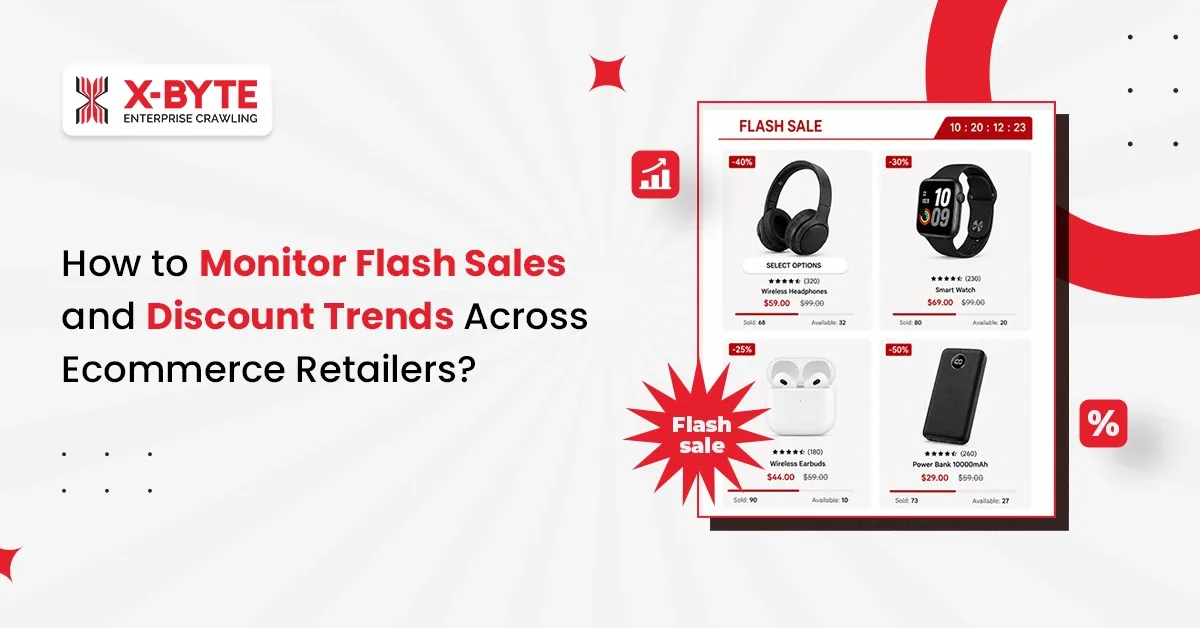
In today’s eCommerce market, prices can change within minutes. Retailers launch flash sales, limited-time discounts, and promotional campaigns without warning, making it difficult for competitors to keep up through manual monitoring. Missing even a short-lived price drop can lead to lost sales, reduced margins, and missed market opportunities.
That’s why businesses are increasingly investing in flash sale monitoring and discount trend analysis to track competitor pricing in real time and make faster, data-driven decisions. Whether you’re managing hundreds of products or monitoring multiple online stores, having accurate pricing intelligence helps you respond strategically instead of reactively.
In this blog, you will learn how to monitor flash sales, identify meaningful discount trends, choose the right price monitoring approach, and transform pricing data into a competitive advantage.
What Is Flash Sale Monitoring?
Flash sale monitoring is the process of continuously tracking temporary price reductions, limited-time promotions, and special offers across eCommerce websites. Instead of manually checking competitor websites, businesses use automated tools or web scraping solutions to detect price changes as they happen. This enables retailers to react quickly, protect profit margins, and understand competitors’ promotional strategies before opportunities disappear.
Unlike general price monitoring, flash sale monitoring focuses on short-duration discounts that may last only a few hours, making real-time tracking essential for businesses operating in competitive markets.
Why Does Flash Sale Monitoring Matter So Much Today?
The online shopping world moves at lightning speed. Major retailers adjust millions of prices every single day, and a flash sale can appear and vanish within a few hours. If your team refreshes a page too late, the deal is already gone, and so is the insight you needed.
Here is the reality in plain numbers. The global eCommerce market is forecast to reach $6.88 trillion in 2026, representing 21.1% of all retail sales worldwide. That is a massive amount of money changing hands, and pricing is at the center of every sale. Meanwhile, the dynamic pricing software market will grow from $3.49 billion in 2025 to $4 billion in 2026 at a compound annual growth rate (CAGR) of 14.7%. Businesses are clearly investing in price monitoring because it works.
When you track flash sales and discount trends the right way, you gain three real advantages:
- Speed: You catch a price drop while it is still fresh, often before your own shoppers spot it.
- Margin protection: You stop cutting prices out of panic and only match competitors when the numbers say you should.
- Timing intelligence: Over a few weeks, you start to see exactly when competitors push their heaviest promotions.
Today’s shoppers compare prices across multiple online stores before making a purchase. Businesses that fail to identify competitor promotions in real time often lose customers to brands offering better value at the right moment. Monitoring flash sales helps companies stay competitive while making informed pricing decisions based on market data rather than assumptions.
What Is Discount Trend Analysis?
While flash sales provide immediate opportunities, discount trend analysis helps businesses understand long-term pricing behavior. By analyzing historical discounts, promotional frequency, seasonal campaigns, and pricing patterns, retailers can predict future promotions and optimize their own pricing strategies.
Instead of reacting to every competitor discount, businesses gain insights into recurring promotional cycles, helping them plan campaigns, protect margins, and maximize revenue throughout the year.
What Exactly Should You Track Across Ecommerce Retailers?
Before you pick a tool, you need to know what data actually matters. Watching a single price tag tells you almost nothing on its own. Real competitor price tracking looks at the full picture around every product.
Here are the core data points worth watching:
- Price changes: Track the full cycle, not just the drop. When a price returns to normal often says more than the discount itself.
- Discount depth: A 40% cut sounds great until you learn the price was quietly raised last week. Measure the real markdown against a genuine baseline.
- Stock availability: Pair every price with its stock status. A deal on an item that is already sold out is not a threat you need to answer.
- Sale duration: Some deals last an hour, others a full weekend. Logging how long each one runs helps you predict the next wave.
- Promotional copy: The banners, hero images, and coupon codes on a page reveal how a competitor thinks about its customers.
- Shipping and delivery terms: Price is only part of the offer. Free or faster shipping can win a shopper even at a higher sticker price.
Price changes are more meaningful when evaluated against historical pricing, availability, and promotional context. Knowing that a product is “on sale” means nothing without context. A tool that shows price history lets you judge whether a discount is real or just clever staging. This is where genuine discount trend analysis begins, and it separates guessing from knowing.
Benefits of Automated Price Monitoring
Manual competitor monitoring quickly becomes inefficient as product catalogs grow. Automated price monitoring solutions continuously collect pricing data across multiple online stores, enabling businesses to make faster and more accurate decisions.
Some of the key benefits include:
- Real-time competitor price tracking
- Instant alerts for flash sales
- Reduced manual effort
- Better pricing intelligence
- Historical pricing insights
- Improved promotional planning
- Higher profit margin protection
- Scalable monitoring across thousands of products
How Do You Choose the Right Price Monitoring Tool?
The market is full of tools, and they do not all do the same job. Some are built for individual shoppers who want a deal alert. Others are built for retail teams that need serious competitor monitoring across hundreds of products. Choosing the wrong one wastes both time and money.
To make this easier, here is a comparison of the main approaches you will find when you start shopping for a price tracking tool.
| Monitoring Approach | Best For | Check Frequency | Key Strength | Main Limitation |
| Browser extension trackers | Individual shoppers | On-page visit | Free and simple to use | Limited to saved items |
| URL-based monitoring tools | Small retail teams | Up to 8 times per day | Tracks any product page | Manual setup per URL |
| Screenshot comparison tools | Visual change tracking | 5 to 15 minutes | Catches layout and banner shifts | Shows a region changed, not what |
| Dedicated pricing platforms | Mid-market brands | Multiple times daily | Deep analytics and MAP alerts | Higher cost, sales call needed |
| Custom web scraping services | Enterprise and data teams | Real-time or scheduled | Full control over data and scale | Requires technical resources |
When you compare options, weigh three factors above all else. First is alert speed, because the difference between a 5-minute check and a 24-hour check matters when a flash sale lasts only a few hours. Second is retailer coverage, since some tools only track Amazon while others watch any URL. Third is price history depth, which powers your long-term discount trend reports.
A quick warning worth repeating. Check frequency is 12 hours on Starter, meaning flash sales that start and end in a single afternoon will not be caught. Always match your check frequency to how fast your market moves.
Which Methods Work Best for Real-Time Flash Sale Tracking?
Now let us get practical. There are a few proven methods for catching flash sales as they happen, and the best strategy usually blends more than one. Manual checking simply does not work anymore, because a deal can expire before you hit refresh.
Here is a straightforward setup process that many teams follow:
- Pick your target pages. Choose the competitor product URLs that matter most to your revenue.
- Set a tight check frequency. For flash sales and high-demand products, choose 5 to 15 minutes.
- Select the price region only. Watching just the price area means the tool ignores unrelated changes like ad banners.
- Enable instant alerts. Route notifications to email, Slack, or your dashboard so nobody misses a drop.
- Log the history. Store every change so you can build discount trend analysis over weeks and months.
For teams that need heavy coverage, web scraping and data extraction offer the most flexibility. This approach pulls pricing data directly from any public page, at any scale, on your own schedule. It is the method that powers most enterprise pricing intelligence systems, and it is exactly the kind of work a professional data extraction partner handles well.
If you want to build a custom pricing intelligence pipeline, you can explore professional web scraping services that gather clean, structured price data from thousands of ecommerce retailers.
How Web Scraping Powers Flash Sale Monitoring?
For businesses tracking hundreds or thousands of products across multiple retailers, automated web scraping provides the flexibility and scalability that traditional monitoring tools often lack. Custom web scraping solutions can collect real-time pricing, product availability, promotional banners, coupon information, and historical pricing data from virtually any public eCommerce website.
The extracted data can be integrated into pricing dashboards, analytics platforms, or business intelligence tools, enabling retailers to monitor competitor activity, identify pricing opportunities, and automate strategic decision-making at scale.
Get Real-Time Pricing and Discount Data
Custom web scraping solutions for flash sales and pricing trends, built for your business.
How Do You Turn Pricing Data Into Real Strategy?
Collecting data is only half the job. The real value comes from what you do with it. Smart teams turn raw price feeds into decisions that grow revenue and protect margins.
The numbers make the case clearly. According to McKinsey benchmarks, dynamic pricing tends to deliver about 2–5% sales growth and 5–10% margin improvement when implemented against a tested, pilot-category approach. That is a serious return for something driven entirely by better data.
Here is how leading brands convert monitoring into action:
- Spot patterns: Watch closely, and you will notice competitors favor certain days and hours for their deepest discounts. That rhythm is gold.
- Time your own sales: Once you know when competitors go quiet, you can launch your promotions into a clear field and grab far more attention.
- Avoid price wars: Not every cut deserves a response. When a competitor’s discount is short-lived or sits on a sold-out item, holding your price is the smarter move.
- Protect trust: Steady pricing builds loyalty. Research shows 80% of shoppers see brands that keep prices stable as more trustworthy, and that trust is hard to win back once it is gone.
One caution worth keeping in mind. Dynamic pricing can feel unfair to shoppers, and 68% of US consumers report feeling “taken advantage of” when brands use dynamic pricing. Use your data to compete smartly, not to punish loyal buyers. Good discount trend analysis helps you find the balance between winning the sale and keeping the relationship.
Industries That Benefit from Flash Sale Monitoring
Flash sale monitoring delivers value across a wide range of industries, including:
- eCommerce retailers
- Consumer electronics
- Grocery and supermarkets
- Fashion and apparel
- Home furnishing brands
- Beauty and cosmetics
- Travel and hospitality
- Online marketplaces
- Pharmaceutical retailers
Each industry benefits from understanding competitor pricing trends, promotional strategies, and customer purchasing behavior.
What Common Mistakes Should You Avoid?
Even good teams stumble when they start monitoring flash sales. A few simple errors can quietly ruin your data quality and waste your budget. Watch out for these.
- Checking too slowly: A once-a-day scan will miss most flash sales, because many of them open and close within a single afternoon.
- Ignoring price history: Without a record of past prices, every discount looks equal. Only history reveals whether a markdown is genuine.
- Tracking too few competitors: With only two or three competitors in view, your read on the market is bound to be skewed. Widen the set of stores you follow and the real picture comes through.
- Overreacting to noise: Prices move constantly, and most of that movement means nothing. Answer every twitch, and you will drain your budget while inviting a price war nobody wanted.
- Skipping stock data: An out-of-stock item on sale can look threatening, yet it rarely is. Read price and stock together before you decide it matters.
Avoiding these traps keeps your competitor price tracking honest and useful. The goal is clean, reliable data that you can actually trust when you make a pricing call.
Conclusion: Turn Flash Sale Monitoring Into a Real Advantage
Flash sales are not slowing down, and discount trends shift faster each year. The retailers that come out ahead are not always the ones with the lowest prices. They are the ones paying attention, moving quickly, and letting reliable data settle the close calls. This guide has covered the essentials: what data actually matters, how to pick a price monitoring tool that fits your needs, why check frequency makes or breaks your results, and how to convert raw pricing feeds into decisions worth making.
The difference between guessing and knowing comes down to data. When you build a reliable price tracking system, you stop reacting late and start acting early. That shift protects your margins, sharpens your timing, and keeps your customers trusting your brand.
If you are ready to build a serious pricing intelligence pipeline powered by accurate, large-scale data extraction, the team at X-Byte Enterprise Crawling can help you gather the clean price data you need to stay ahead of every flash sale across the web. Start monitoring smarter, and let the numbers work for you.
 ✯ Alpesh Khunt ✯

Related Blogs

Why Shopee Data Extraction Is the Secret Weapon for Modern Singaporean Retailers
What Are the Best Practices for Extracting Contact Information with Web Scraping?