
Did you know that more than 6 billion people use the internet? This creates an enormous and constantly changing stream of information every second. For AI agents, however, having access to this information is just as important as the ability to reason over it. Static training data and traditional knowledge bases can quickly become outdated as prices change, products go out of stock, competitors launch new offers, and fresh trends emerge.
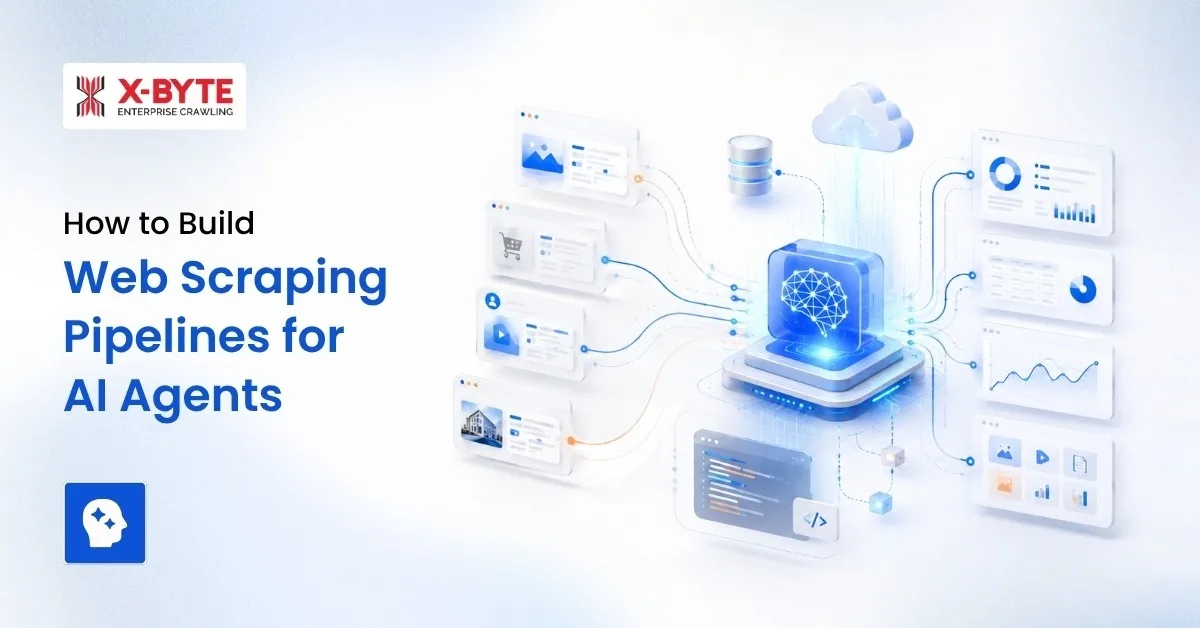
This is where web scraping pipelines play a key role in the AI stack. They continuously collect, clean, structure, and deliver dynamic web content in formats AI systems can understand and act on. Instead of depending solely on what an AI model learned during training, agents can draw from a continuously refreshed stream of external data to make more relevant, timely, and sound decisions.
In this guide, we will explore how to build web scraping pipelines for AI agents, including how to identify data sources, extract and transform web content, handle data quality, and deliver AI-ready datasets. We will also cover the key components, challenges, and best practices for building scalable pipelines that keep AI agents powered by fresh web intelligence.
Let’s begin by understanding the web scraping pipeline.
What is a Web Scraping Pipeline for AI Agents?
At their core, a web scraping pipeline for AI agents is a structured workflow that collects, processes, validates, and delivers web data to AI systems. Unlike conventional scrapers that follow rigid, hard-coded instructions, AI agents can “read” a page like a human. They can understand the semantic meaning of the content, allowing them to identify product descriptions, the pricing tiers, or the customer reviews, and other relevant information regardless of the underlying HTML structure.
AI agent web scraping generally refers to a two-stage process. The first stage involves collecting raw data from the web. This is where our services step in, handling the complications of proxy management, CAPTCHA solving, and reliable HTML/JSON retrieval. The next step involves passing this raw data to an LLM, which acts as the intelligent parsing engine. The LLM can then extract the desired fields and organize them according to a predefined schema, making the output ready for use in databases or applications.
Why Do AI Agents Need Web Scraping Pipelines?
AI agents need access to more than their training data because static knowledge can quickly become outdated. That’s where a web scraping pipeline becomes valuable: it continuously collects the latest information from external sources to AI agents by collecting relevant data from external websites and delivering it in a structured, machine-readable format. This enables agents to work with current information rather than relying entirely on historical knowledge.
Beyond data collection, a web scraping pipeline creates a bridge between the dynamic web and AI reasoning systems. It can automate data extraction, cleaning, validation, transformation, and delivery, ensuring agents receive relevant, usable information when they need it. For instance, an e-commerce AI agent can scrape recently changed product prices and availability to compare competitors, while a market research agent can monitor changing trends across multiple websites. By combining AI agents with continuously refreshed web data, scraping pipelines help make their outputs more timely, relevant, and actionable.
Key Components of an AI Web Scraping Pipeline
Building a reliable web scraping pipeline for AI agents involves much more than simply extracting information from websites. The pipeline must move data through various stages, from identifying the right sources and crawling relevant pages to extracting, cleaning, validating, structuring, and delivering information in a format that AI systems can process.
Each component performs an important role in assuring that AI agents receive data that is accurate, fresh, relevant, and usable.
Target Website Identification
The first step is identifying the websites and data sources that contain the information an AI agent needs. Depending on the use case, these may include e-commerce websites, marketplaces, news portals, review platforms, public databases, or other online sources. Before scraping, evaluate each source based on accessibility, page structure, information availability, update frequency, and applicable terms or restrictions. Also define the exact data fields required by the AI agent.
Web Crawling
Once the target sources are identified, the crawler navigates relevant pages, follows links, handles pagination, and collects the required data while controlling crawl frequency and scope to conserve resources and respect website rules.
Data Extraction
After discovering relevant pages, the extraction layer retrieves the required information using CSS selectors, XPath, structured data parsing, or other field-identification methods. For JavaScript-heavy websites, a headless browser may be needed to render dynamic content, while flexible extraction logic helps handle varying layouts and retain consistent data.
Data Cleaning and Transformation
Raw web data often contains HTML, duplicates, advertisements, irrelevant content, and inconsistent formats. The cleaning and transformation stage removes unnecessary elements, standardizes fields such as text, prices, currencies, dates, and units, and handles missing or incorrectly formatted data to create a consistent structure for AI agents.
Data Validation
Data validation ensures that extracted information meets predefined quality standards before reaching the AI agent. It checks required fields, expected values, formatting, completeness, freshness, and duplicate, or suspicious records. Automated checks also detect extraction errors caused by website changes or failed requests, preventing unreliable data from affecting AI outputs.
Power AI Agents with Real-Time Web Data
Build scalable web scraping pipelines that deliver reliable, structured data for smarter AI agents and business decisions.
Step-by-Step: How to Build a Web Scraping Pipeline for AI Agents
Here’s how to build a web scraping pipeline for AI agents:
Step 1: Data Extraction Through Web Scraping
The first step in an AI web scraping pipeline is collecting data from relevant websites. This involves identifying pages that contain the required information and selecting the appropriate extraction method. Depending on the website, this may include static HTML parsing or browser based scraping for JavaScript-heavy content. Scheduling extraction at intervals also helps keep datasets fresh.
AI can further enhance this process by automatically discovering relevant fields and patterns, adapting to changes in website layouts, and extracting contextual information. Together, these capabilities provide the raw web data needed to build a structured and reliable pipeline for AI agents.
Step 2: Parsing and Field Identification
Next, the pipeline needs to identify and isolate the relevant data fields from the collected web content. This involves removing unnecessary HTML tags, scripts, advertisements, and other irrelevant elements when identifying key information like product names, prices, dates, ratings, and reviews.
AI models are able to further enhance this process by comprehending the content’s semantic context and distinguishing significant data from noise. This step transforms messy, unstructured HTML into semi-structured data ready for further cleaning and processing.
Step 3: Data Cleaning and Normalization
Extracted website data often contains inconsistent formats, labels, missing values, and malformed entries, making it difficult for AI systems to process reliably. AI can assist with the cleaning process by standardizing dates, currencies, units, and other formats; removing duplicates and irrelevant information; and, where appropriate, helping resolve missing values using contextual or predictive methods. This ensures the resulting dataset is consistent, accurate, and reliable for downstream AI processing.
Step 4: Deduplication and Validation
Duplicate or inconsistent records can distort AI outputs and reduce the reliability of downstream analysis. An effective web scraping pipeline can use fuzzy matching, semantic similarity scoring, and cross-source verification to identify and resolve duplicate or conflicting entries.
Data validation helps maintain high-quality datasets, reduce potential bias, and improve the reliability of AI predictions. AI models can also detect unusual patterns and mark them for further review, supplying a layer of quality control to the pipeline.
Step 5: Structuring Data for AI Systems
After deduplication and validation, the collected data must be organized according to the AI model’s expected schema to enable consistent, productive processing. A standardized schema keeps data from different sources in the consistent structure, making it machine-readable and ready for AI analytics, model training, decision-making, and automated workflows.
Step 6: Enrichment and Feature Engineering
Once the data is structured, AI web scraping can add more detail to it with meaningful context and attributes to make it more useful for downstream applications. This may include categorizing products, content, or industries; generating sentiment and relevance scores; identifying entities such as brands, locations, and keywords; and creating derived features for predictive models.
By adding these layers of context, data enrichment can transform structured web data into actionable intelligence, helping AI models deliver more accurate results and supporting better, data-informed decision-making.
Step 7: Integration into AI Workflows
Finally, the processed and validated data can be delivered to AI systems and downstream applications based on the intended use case. It can support machine learning models for prediction and classification, NLP systems for processing text, RAG applications that require fresh external information, automation workflows that trigger actions, and dashboards that monitor trends and key metrics.
When properly integrated, the web scraping pipeline enables data to flow continuously and reliably from online sources to AI applications, helping businesses make faster and more informed decisions.
Final Thoughts
Web scraping pipelines give AI agents a reliable way to access fresh, structured, and actionable web data beyond their static knowledge. From crawling and extraction to cleaning, validation, and delivery, each stage helps ensure that AI systems receive the right information at the right time.
So, are you ready to power your AI agents with continuously refreshed web data? X-Byte Enterprise Crawling can help you build scalable web scraping and crawling solutions tailored to your data requirements. Get in touch with X-Byte Enterprise Crawling today and turn dynamic web data into AI-ready intelligence.
 ✯ Alpesh Khunt ✯

Related Blogs

E-Commerce Product Data Management: Best Practices for Retailers

Why Shopee Data Extraction Is the Secret Weapon for Modern Singaporean Retailers