

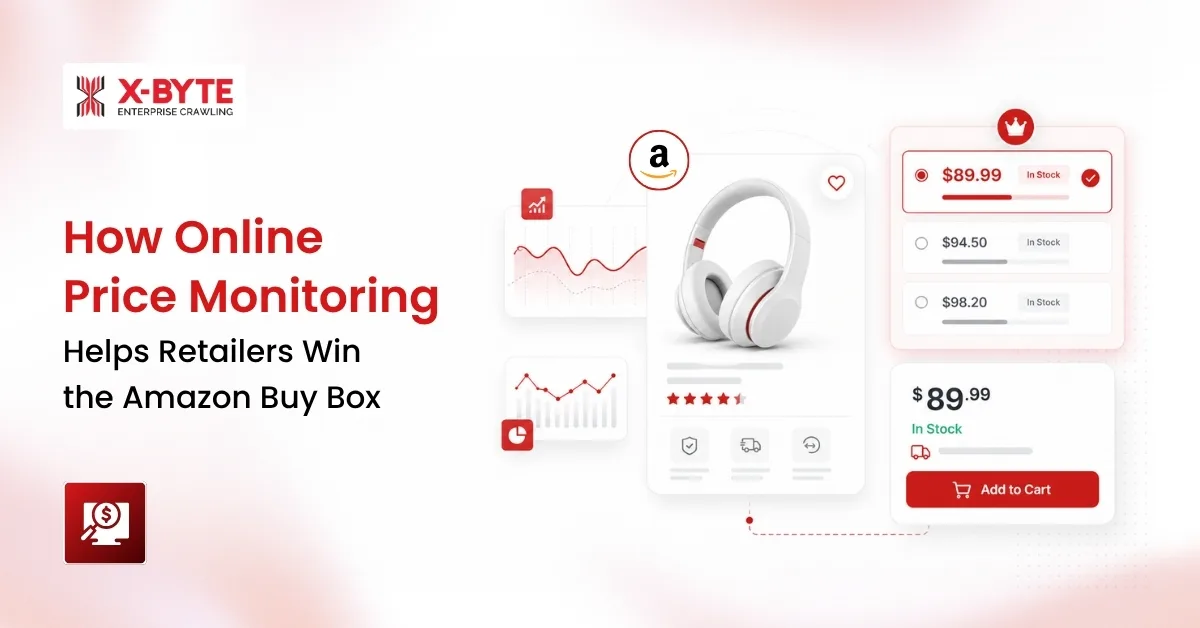
Competition on online marketplaces can change quickly. A competitor may lower a product’s price, introduce a promotion, or change availability, making your offer less competitive before you even notice. For Amazon sellers, these changes can directly affect their chances of winning the Buy Box, now known as the Featured Offer. This is where online price monitoring becomes valuable. By continuously tracking competitor prices, promotions, and other market signals, retailers can identify pricing changes faster and make informed decisions without relying on manual checks.
Competitive price intelligence also helps sellers understand market trends, protect profit margins, and maintain competitive landed prices. This guide explains how online price monitoring works, how it supports Buy Box strategies, where automated monitoring outperforms manual tracking, and what retailers should consider when choosing a price monitoring solution.
What Is the Amazon Buy Box and Why Does It Matter So Much?
The Buy Box, now officially called the Featured Offer, is the panel on a product page that powers the “Add to Cart” and “Buy Now” buttons. When several sellers list the same item, Amazon picks just one offer to feature at a time. The Featured Offer receives the most prominent placement on the product page and makes it easier for shoppers to purchase from the selected seller. For sellers competing for the same ASIN, earning this placement can have a significant impact on visibility and conversions.
The numbers here are hard to ignore. Industry estimates commonly place the share of purchases attributed to the Buy Box at around 80% or higher, although the exact percentage varies by source, category, and methodology. For mobile shoppers, that share climbs even higher. Losing the Buy Box therefore means losing most of your sales on that product, even if your listing looks identical to the winner.
There is another sharp edge to this. When the Featured Offer is suppressed, shoppers may see a “See All Buying Options” experience instead, creating additional friction and potentially reducing conversions. When no offer meets Amazon’s value expectations, shoppers see a “See All Buying Options” link instead of the friendly Add to Cart button, and most people simply do not click through.
How Does Price Influence the Amazon Buy Box Algorithm?
Price is important, but it is not the only factor Amazon considers when determining the Featured Offer. Seller performance, fulfillment method, inventory availability, shipping experience, and other eligibility signals can also influence the outcome. Price monitoring therefore works best as part of a broader Buy Box strategy rather than as a standalone tactic.
Amazon has never published its exact formula, but years of aggregated seller data reveal a consistent set of ranking signals. Price sits near the top, though it works in a smarter way than most people assume. The algorithm looks at the landed price, meaning the item price plus shipping, rather than the sticker price alone.
Here is why real-time price monitoring becomes essential rather than optional:
- The speed of change is staggering, since Marketplace prices can change thousands or even millions of times across large retail catalogs, depending on the number of sellers, products, and repricing activity involved. According to Profitero, Amazon marketplace pricing activity can reach more than 2.5 million price changes per day.
- Rotation frequency is relentless, because on highly competitive listings, the Buy Box can rotate among eligible sellers dozens of times per day, with Amazon’s algorithm re-evaluating ownership continuously, typically every few minutes.
- External benchmarks also count, as Amazon compares your pricing against outside retailers like Walmart, Target, and eBay under its Fair Pricing Policy, not just against other Amazon sellers.
A price you set in the morning can become uncompetitive by afternoon. Manual daily checks miss almost every competitive window, which is where automated competitor price tracking earns its keep.
What Exactly Is Online Price Monitoring?
Online price monitoring is the process of continuously tracking competitor prices, discounts, promotions, and product availability across marketplaces and retail websites. Instead of relying on occasional manual checks, retailers can collect pricing data at scheduled intervals and use it to identify competitive changes. Some businesses review this data a few times a day, while others track it by the minute. In both cases, the purpose holds firm: understand your position in the market before a customer makes their decision.
The process behind it involves several stages. It begins when crawling technology visits competitor product pages and collects the current price, any promotional messaging, and the item’s stock status. That raw data is rarely clean. Prices appear in different formats, product names seldom match across sites, and duplicate entries are common. The information is then standardized, organized into a consistent structure, and matched product by product until it becomes intelligence a pricing team can act on.
For retailers who want a deeper look at the mechanics, this guide from X-Byte Enterprise Crawling on how to use web scraping for price monitoring explains the workflow in detail.
Manual Pricing vs. Automated Price Monitoring: A Quick Comparison
There is a wide gap between checking prices by hand and letting software do it. The table below sets the two approaches side by side so the trade-offs are easy to weigh.
| Factor | Manual Price Checking | Automated Price Monitoring |
| How often prices refresh | A check or two a day, and often out of date by the time you act | Refreshes every few minutes, close to live |
| Products you can cover | A short list of SKUs before it gets overwhelming | Thousands of SKUs across many retailers at once |
| Competitive opportunities identified | Only a handful slip through in your favor | Identifies price changes throughout the day |
| Watching outside retailers | Rarely happens, since it takes too long | Runs continuously across Walmart, eBay, and others |
| Protecting your margin | Comes down to guesswork on your floor and ceiling | Guided by preset min and max rules |
| When a competitor sells out | You notice late, if at all | Price shifts the moment stock runs dry |
| Effort from your team | Heavy, every single day | Light once the setup is done |
The business case for the automated column is not just theory. X-Byte reports that one Fortune 500 retailer achieved a 4.2% margin improvement through competitor-informed dynamic pricing, contributing to $23 million in additional annual profit. Returns of that size are what move price monitoring from a cost line to a growth investment.
How Does Price Monitoring Directly Help You Win the Amazon Buy Box?
Price monitoring cannot guarantee Featured Offer placement because Amazon considers multiple eligibility and seller-performance factors. Its value is in helping retailers respond quickly when competitive pricing changes create a risk or opportunity.
- Live competitor data shows exactly where competitors have set their prices, so your landed price can sit inside the winning band without ever slipping under your profit floor.
- Reaction time is the quiet advantage. Automated feeds adjust within minutes, while a seller checking prices by hand only finds out they have lost ground after it happens.
- Minimum and maximum thresholds keep your margins protected, which matters most during price wars that would otherwise drag everyone to the bottom.
- Suppression is easier to avoid when your prices track external retailers, because Amazon’s main suppression trigger is pricing well above historical averages or outside price benchmarks.
- Stock levels can shape the strategy too. When inventory runs low, a small price increase slows sales; when you are heavily stocked before a demand spike, sharper pricing helps you capture more of it.
The payoff of getting this right is significant. According to Amazon’s own data cited by Repricer, early adopters of dynamic pricing tools have seen a 15% increase in Buy Box wins and a 20% increase in overall sales.
Win the Amazon Buy Box With Price Monitoring
Custom price tracking solutions for Amazon sellers, built around your business goals.
Which Retail Categories Benefit the Most?
Products do not all move at the same competitive speed, and that matters for how often you monitor. Some patterns worth noting:
Products do not all move at the same competitive speed, and that shapes how often you should be watching. A few patterns stand out:
- Electronics and other fast-moving categories are the clearest case. Prices shift constantly, the Buy Box changes hands throughout the day, and monitoring on a daily or even hourly basis is where the real payoff shows up.
- Niche items tell a different story. With fewer sellers and calmer pricing, a weekly check is usually enough to stay competitive.
- Sellers working across several channels have their own reason to invest here. Consistent pricing from one channel to the next earns shopper trust, yet the data still leaves room to tailor a strategy per channel.
As X-Byte Enterprise Crawling notes, virtually any retail category with competitive pressure benefits from systematic pricing intelligence. The key is matching your monitoring frequency to your category’s real-world volatility rather than treating every product the same.
What Should Retailers Look for in a Price Monitoring Solution?
The tool you select carries long-term consequences, so the decision warrants careful evaluation. What distinguishes a strong solution from a weak one usually comes down to whether it performs at scale, maintains accuracy, and operates reliably once configured. Several capabilities deserve particular attention:
- Access to both live prices and historical records. Can it track Amazon, Walmart, eBay, and the other retailers you actually compete against? Partial coverage leaves blind spots.
- Access to both live prices and historical records. One drives your decisions today. The other shows you where the market has been heading over the past several months.
- Rule-based repricing: The suggestions should follow parameters you set, not a generic default, so nothing recommended ever undercuts your margin goals.
- Alerts that reach you where you work, through email notifications tied to price changes, new pricing suggestions, or any custom trigger your team defines.
- Extraction that holds up on difficult sites. JavaScript-heavy pages and anti-bot defenses break weaker tools. X-Byte notes that its systems adjust to site changes automatically, using machine learning to locate new price positions when a competitor redesigns a page.
Those interested in these features can check out our pricing intelligence services, which include multi-currency tracking, bulk SKU support, and API integration with platforms like Shopify and Magento.
Conclusion
Winning the Amazon Buy Box requires more than simply offering the lowest price. Retailers need timely visibility into competitor pricing, promotions, availability, and broader market conditions to make informed pricing decisions. Online price monitoring provides this visibility by continuously collecting and organizing competitive pricing data, helping retailers respond faster while maintaining their target margins.
Automated monitoring can be particularly valuable for large catalogs and highly competitive categories where manual checks quickly become difficult to manage. However, price monitoring should be viewed as part of a broader Buy Box strategy rather than a guarantee of Featured Offer placement. By combining competitive price intelligence with pricing rules, inventory data, and regular analysis, retailers can build a more responsive and sustainable pricing strategy.
 ✯ Alpesh Khunt ✯

Related Blogs
E-Commerce Product Data Management: Best Practices for Retailers

Why Shopee Data Extraction Is the Secret Weapon for Modern Singaporean Retailers