

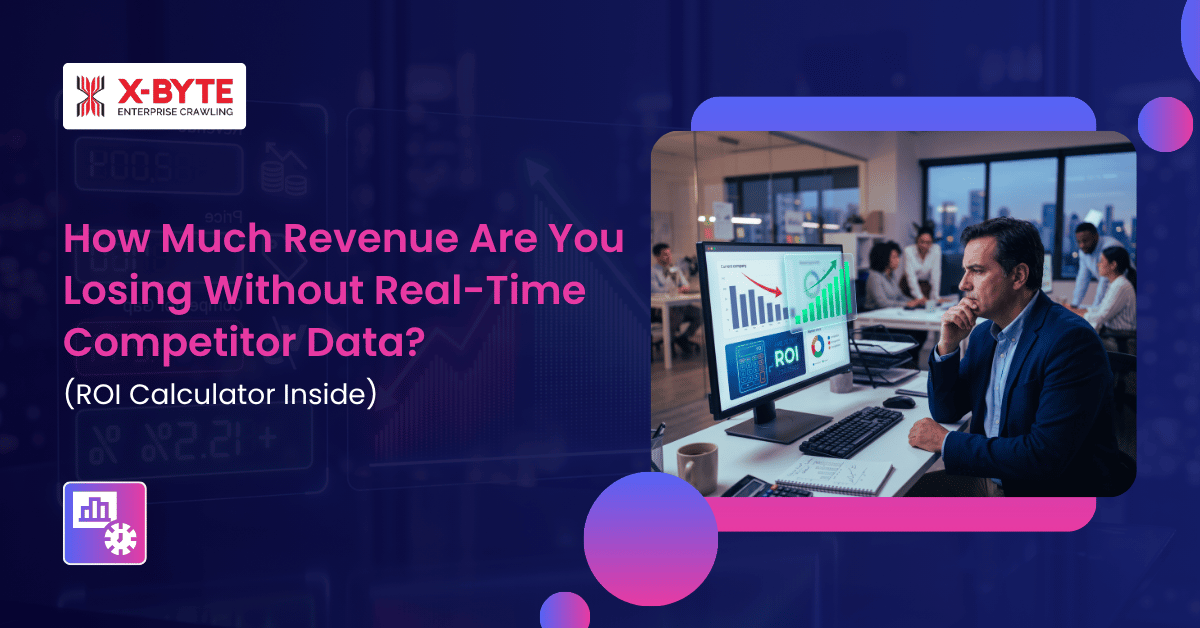
Introduction: The Hidden Revenue Leak You Can’t See
Most businesses believe they are pricing competitively. However, that assumption often hides a dangerous truth. Without real-time competitor data, companies operate with delayed or incomplete insights. As a result, pricing decisions become reactive instead of strategic.
In today’s fast-moving markets, even small pricing gaps can lead to major revenue loss. For instance, a product priced just 3% higher than competitors can reduce conversions significantly. Meanwhile, pricing too low can erode margins without increasing volume.
Therefore, the real question is not whether you need competitor pricing data. Instead, it is how much revenue you are already losing without it. This blog will help you quantify that loss and show how to fix it using competitor price monitoring strategies.
Why Real-Time Competitor Data Matters More Than Ever
Modern markets are driven by dynamic pricing. Prices change frequently across eCommerce platforms and retail stores. Therefore, relying on manual checks or outdated data creates a serious disadvantage.
Moreover, competitors are no longer static. They continuously adjust pricing based on demand, inventory, and promotions. Consequently, businesses without real-time pricing intelligence fall behind quickly.
Here’s what happens without competitor price tracking software:
- You miss competitor price drops
- You fail to react to discount campaigns
- You lose visibility into market trends
- You make decisions based on outdated assumptions
On the other hand, companies using competitor data scraping gain a clear advantage. They can respond instantly, optimize pricing, and protect their margins effectively.
The Real Cost of Not Tracking Competitor Pricing
Revenue loss is not always obvious. In fact, it happens silently over time. However, when you break it down, the impact becomes clear.
Let’s consider a simple example.
If your product is priced higher than competitors:
- Conversion rates drop
- Traffic does not convert into sales
- Customers choose cheaper alternatives
If your product is priced too low:
- You win sales but lose margin
- Profitability decreases
- Long-term growth suffers
Additionally, inconsistent pricing can damage brand perception. Customers may see your pricing as unreliable or uncompetitive. As a result, trust declines over time.
Even worse, these issues compound daily. Therefore, the longer you operate without real-time competitor data for ecommerce pricing, the greater the loss becomes.
ROI Calculator: Estimate Your Revenue Loss
Now, let’s quantify the impact.
You can estimate your revenue loss using this simple model:
Step 1: Identify Key Metrics
-
- Monthly website traffic
- Current conversion rate
- Average order value (AOV)
- Estimated price gap vs competitors (%)
Step 2: Apply the Formula
Potential Revenue Loss = Traffic × Conversion Drop × AOV
Example:
-
- Traffic: 50,000 visitors/month
- Conversion Rate: 2%
- AOV: $100
- Conversion Drop due to pricing gap: 20%
Loss = 50,000 × (2% × 20%) × $100
Loss = 50,000 × 0.003 × 100 = $20,000/month
That means you could be losing $240,000 annually due to poor dynamic pricing strategy data decisions.
Furthermore, this does not include lost opportunities from promotions or stock gaps. Therefore, the actual loss may be even higher.
How Leading Companies Eliminate Revenue Leakage
Top-performing companies do not rely on guesswork. Instead, they use pricing intelligence solutions powered by real-time data.
Here’s how they do it:
- Continuous Price Monitoring – They track competitor prices using price monitoring tools for ecommerce across multiple platforms. This ensures they stay aligned with market trends.
- Automated Alerts – They receive alerts when competitors change pricing. As a result, they can react instantly without manual effort.
- Dynamic Pricing Strategies – They adjust pricing based on demand and competition. Therefore, they maximize both sales and margins.
- Promotion Tracking – They monitor discounts and seasonal offers. Consequently, they can match or outperform competitor campaigns.
By implementing these strategies, businesses transform raw competitor pricing data into actionable insights.
Real-World Scenario: Retail Brand Revenue Recovery
Let’s look at a real-world scenario.
A mid-sized retail brand noticed declining sales despite steady traffic. Initially, they assumed it was due to market conditions. However, after applying ecommerce competitor analysis, they discovered a pricing gap.
Competitors were consistently pricing similar products 5–7% lower. As a result, customers were choosing alternatives.
After implementing real-time competitor data and competitor price monitoring:
- They adjusted pricing dynamically
- They aligned with competitor offers
- They optimized promotional campaigns
Within three months:
- Conversion rate increased by 18%
- Revenue grew by 22%
- Margin loss was reduced significantly
This example clearly shows how real-time pricing intelligence drives measurable results.
Key Signs You Are Losing Revenue Right Now
You may already be experiencing revenue leakage without realizing it. Here are some common signs:
- High traffic but low conversion rates
- Frequent price changes without strategy
- Competitors consistently undercutting your prices
- Declining margins despite stable sales
- Lack of visibility into competitor pricing data
If you notice any of these, it’s time to adopt competitor price tracking software immediately.
How to Get Started with Real-Time Competitor Data
Getting started does not have to be complex. However, it requires the right approach.
Step 1: Define Your Data Needs
Identify what data you need:
-
- Product pricing
- Stock availability
- Promotions
- Reviews and ratings
Step 2: Choose a Scalable Solution
Manual tracking is not sustainable. Therefore, you need automated competitor data scraping solutions.
Step 3: Integrate Data into Decision-Making
Data alone is not enough. You must use it to:
-
- Optimize pricing strategies
- Improve campaign performance
- Enhance product positioning
Step 4: Monitor and Optimize Continuously
Markets change constantly. Therefore, continuous monitoring is essential for long-term success.
Why Real-Time Data Is a Competitive Advantage?
Real-time data is not just a tool. Instead, it is a competitive advantage.
Companies that leverage real-time competitor data can:
- Respond faster than competitors
- Make data-driven decisions
- Optimize pricing in real time
- Increase both revenue and profitability
Meanwhile, companies without competitor price monitoring fall behind and miss critical opportunities.
Final Thoughts: Stop Guessing, Start Measuring
Revenue loss due to poor pricing is often invisible. However, with real-time competitor data, it becomes measurable and actionable.
Instead of guessing, you can:
- Identify pricing gaps
- Quantify revenue impact
- Improve ecommerce competitor analysis
- Optimize strategies in real time
The difference between data-driven companies and others is clear. One reacts, while the other leads.
🚀 Ready to Calculate Your Revenue Loss?
If you want to understand your exact revenue impact:
👉 Get a Custom ROI Analysis with Real-Time Competitor Data. – ROI Analysis Calculator
👉 Request Competitor Pricing Data for Your Industry Today. – Contact Us
Stop losing revenue silently. Start using real-time pricing intelligence solutions to stay ahead.
Frequently Asked Questions
 ✯ Alpesh Khunt ✯

Related Blogs
The Role of Data Annotation in Large Language Model Training and Performance
How Web Scraping Is Used to Extract eCommerce Data From eBay