

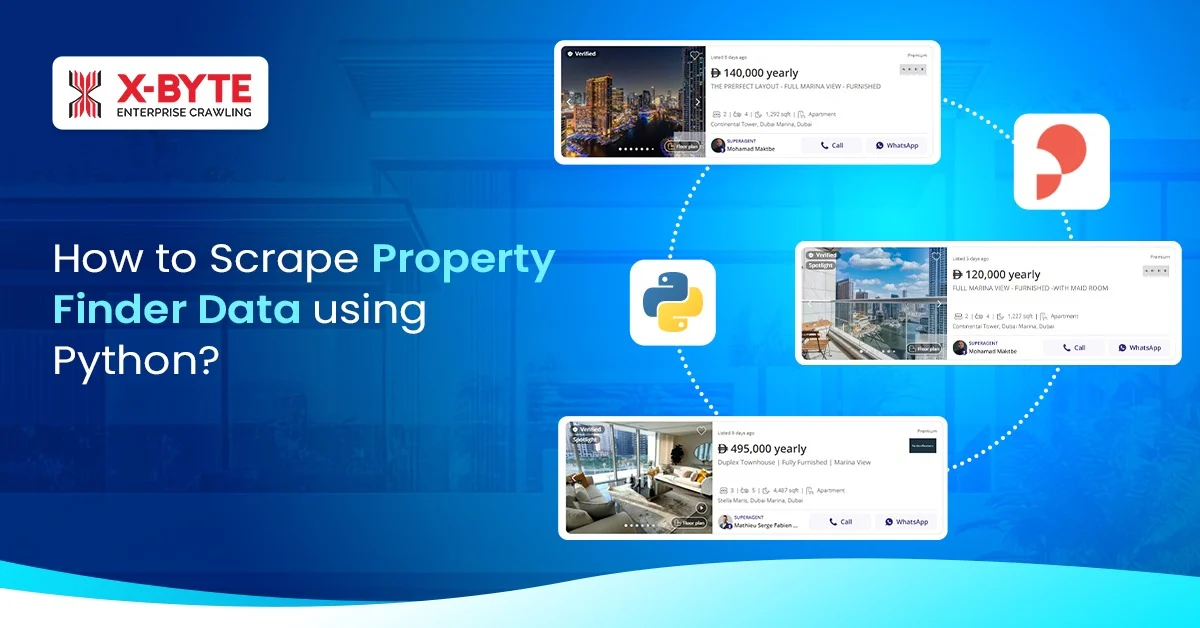
In today’s data-driven world, the real estate industry is changing the traditional way of development, ownership, and management of property. Analysts, investors, and real estate professionals use data as a primary source to drive innovation forward and capture new opportunities.
If you are looking to buy, sell, or rent any property, Property Finder is a leading real estate platform for buying, selling, and renting properties. However, manual data collection is a poor way to collect actionable data for making informed decisions because it increases the risk of errors.
So, the question is how to collect data from this type of real estate platform? The simple answer to this question is to use cutting-edge technologies and tools to scrape massive amounts of property data. This blog will help you understand how Python can help you achieve this goal.
What Is Property Finder Data Scraping?
Property Finder data scraping is the automated process of extracting publicly available property listings, prices, locations, agent information, property specifications, and market trends from Property Finder using Python libraries such as Requests, BeautifulSoup, and Selenium. X-Byte Data Scraping uses Python to write custom scripts. They utilize a CAPTCHA solver and Python libraries like BeautifulSoup, and Playwright to scrape Property Finder Data.
Why Scrape Real Estate Data?
Real estate has always been a data-heavy business, but the scale and speed requirements have changed dramatically. Consider the numbers: Property Finder lists over 500,000 properties, and Redfin publishes weekly market data that contains hyperlocal listing information that never appears on official portals.
For real estate professionals needing full market intelligence, this fragmented landscape is both an opportunity and a challenge. The data is out there, spread across dozens of platforms, each with its own structure, update schedule, and access rules. Scraping data is important because it provides the mechanism to pull this information together into actionable data sets.
Types of Property Data You Can Scrape
The public data available varies by source; common and unique data points are:
- Ownership Data: Owner names, history
- Parcel/Land Data: Plot boundaries, area
- Location Data: Locality, address, coordinates
- Transaction Data: purchase history, sales
- Utility Data: Water, gas, electricity
- Rental Data: occupancy status, rent
- Listing Data: Features, price, availability
- Maintenance Data: Inspection records, repairs
It doesn’t take a lot of imagination to take advantage of these important data points. With persistent tracking, we can also see how the listing changes through time.
Scraping Property Finder Data: Step-by-Step Method
Now let’s extract the data. Follow the steps below to seamlessly extract Property Finder data.
Step 1: Setting Up the Python Environment
You need to make some necessary arrangements. If we talk technically, you have to install Python libraries.
pip install requests beautifulsoup4
Step 2: Checking the HTML structure
The next immediate step is to press F12 in your browser and analyze the HTML structure of Property Finder. Take note of the structure and class names. Note HTML tags such as div and span.
Step 3: Implementing Proxies to Avoid Detection
In the third step, we will use headers and proxies to simulate human behavior.
import requests

proxies = {

"http": "http://proxy.example.com:8080",

"https": "http://proxy.example.com:8080",

}

response = requests.get(

"https://httpbin.org/ip",

proxies=proxies,

timeout=10

)

print(response.text)
Step 4: Extracting Real Estate Data
Extract data from Property Finder using Selenium. You might run into some JavaScript issues when you try to extract data. To get out of this issue, slow down requests or add realistic headers.
Step 5: Clean and Store Data
Now, it’s time to clean and store data in your desired formats. These formats can be JSON, XML, CSV, etc. Here, you need to leverage pandas (an open-source Python library) to structure and clean data.
import pandas as pd

# Sample scraped data

properties = [

{

"Title": " Luxury Apartment ",

"Price": "$350,000",

"Location": " New York, NY "

},

{

"Title": "Modern Villa",

"Price": "$750,000",

"Location": "Los Angeles, CA"

}

]

# Create DataFrame

df = pd.DataFrame(properties)

# Clean data

df["Title"] = df["Title"].str.strip()

df["Price"] = df["Price"].str.replace("$", "", regex=False).str.replace(",", "", regex=False)

df["Price"] = pd.to_numeric(df["Price"], errors="coerce")

df["Location"] = df["Location"].str.strip()

# Store cleaned data

df.to_csv("properties.csv", index=False)

print("Cleaned data saved to properties.csv")

print(df)
Use Cases of Property Finder Data Scraping
Let’s explore how scraping property listings data provides competitive advantages.
Listing Monitoring
One of the most common Property Finder data scraping use cases is tracking price, photos, listing status, rental rate, descriptions, and property attributes over time for changes.
This is essential for: investor analysts, brokerage research, rental monitoring, and market intelligence teams.
Real estate agents need to distinguish between allowed and prohibited portal scraping and source access. Many property listing site feeds operate under licenses that limit reuse, automated extraction, or reproduction. So change monitoring is useful for real estate businesses. But the path to doing it lawfully matters more than just monitoring it.
Public Record and Assessment Research
Ownership history, parcel data, deed records, and zoning references are often important for research. However, consider that if personal data is present, privacy and data-protection obligations can still apply depending on jurisdiction and usage.
Property Valuation
Property valuation helps buyers know the true cost of a property. It helps with home loans, scams, insurance, taxes, and rent. The valuation of a property is done taking into account different factors such as location, market trends, and amenities.
Track Housing Demand
Scrape property listing platforms to collect inventory signals and structured pricing—new listings, price reductions, days on market, and sold or pending status. Use time-stamped snapshots to spot market cycles and identify demand trends by neighborhood, city, and property type.
Market monitoring
Use real estate scraping to gather comparable listings across multiple platforms and analyze price changes over time. Extract square footage, amenities, and location context to benchmark similar properties and understand your buyer expectations by area.
Real Estate Scraping Tips
- The number one tip is to create your scraper from scratch. This is because every business has different data requirements.
- Always scrape publicly available data. Do not use data without the permission of the owner.
- Maintain transparency in web scraping by adhering to GDPR and CCPA data privacy laws.
- Check the detailed website property links by visiting /robots.txt.
- Add random delays between your requests. These requests can range from seconds to longer intervals to mimic natural browsing.
- Use a headless browser like Selenium or Puppeteer for JavaScript rendering. These tools help you access dynamic pages of Property Finder.
Challenges While Scraping Data
Scraping Property Finder presents several technical challenges that require careful handling.
IP Blocking
Websites always block your IP to prevent bots from scraping. Implement geographic diversity by distributing requests across different regions and countries. You must rotate IP addresses constantly to prevent pattern detection and long-term tracking.
JavaScript Rendering
The more websites load property listing pages using JavaScript, the more difficult it will be for you to scrape data. To resolve this issue, minimize Render-Blocking JavaScript. Sometimes improving runtime efficiency also works well to overcome JavaScript rendering issues.
Rate Limiting
Websites like Property Finder employ a rate-limiting strategy to limit network traffic. Here, you have to throttle the request speed to proceed.
Infinite Scroll
If you visit Property Finder, you may have to scroll infinitely. The website does this to reduce clicks. The most straightforward approach to tackle this issue is to make your scraper scroll the page like a human would, wait for property listings to load, then scrape.
Let Experts Solve Your Scraping Problems
Custom data scraping solutions that eliminate blocks, errors, and maintenance for your business needs.
Is It Legal to Scrape Property Finder Data?
There is no exact answer on whether scraping Property Finder data is legal or not. Many factors can influence the legality of scraping this platform’s data. While scraping Property Finder data offers important insights and opportunities for your business, there is a darker side if you do it unethically. The legality of data scraping depends totally depending on how you scrape, what data you scrape, how you use the scraped data, the platform’s Terms of Service, etc.
Conclusion
Now you know how to scrape real estate data. First of all analyze the Property Finder website. Define your data points. Then use the Python programming language and its libraries to collect data from property listings of your choice. Ensure to handle CAPTCHAs and website structure changes. To minimize the chances of getting blocked, rotate your IP address so that anti-bot measures think that you are a genuine user. Follow the steps mentioned in this blog to get information about pricing patterns, property trends, and demand for lead generation and market analysis. Talk to X-Byte data experts to scrape Property Finder data.
Frequently Asked Questions
 ✯ Alpesh Khunt ✯

Related Blogs

Build vs. Buy: Should Your Business Build a Data Extraction Pipeline or Outsource It?

How to Measure Data Extraction Quality at Scale: Accuracy, Coverage and Freshness