Black Friday and Cyber Monday bring some of the biggest price changes of the year, making it difficult for retailers to keep track of competitor discounts manually. Products can receive multiple price cuts, limited-time offers, and promotional updates within a single shopping day. Missing these changes can affect pricing decisions, sales opportunities, and competitive positioning.
Web scraping offers a practical way to monitor Black Friday and Cyber Monday discounts across e-commerce websites and online marketplaces. Retailers can automatically collect product prices, discount percentages, stock availability, coupon offers, and other promotional details at regular intervals. This data helps pricing teams compare competitor offers, identify pricing trends, and respond to market changes faster.
In this blog, you will learn how to track BFCM 2026 discounts using web scraping, structure the collected data, build a basic scraping workflow, and address the technical and compliance challenges involved in large-scale price monitoring.
Why Is Black Friday and Cyber Monday Price Tracking Important for Retailers?
Black Friday and Cyber Monday create a short period of intense pricing competition across e-commerce websites and online marketplaces. Retailers frequently adjust product prices, introduce limited-time promotions, and offer additional discounts to attract shoppers. Keeping track of these changes manually becomes difficult when competitors sell thousands of products across multiple channels.
Adobe Analytics reported that U.S. consumers spent $11.8 billion online on Black Friday 2025 and $14.25 billion on Cyber Monday. For the 2026 holiday season, Adobe forecasts $12.9 billion in Black Friday spending and $15.1 billion on Cyber Monday.
These figures highlight the scale of the shopping season, but the real challenge for retailers is understanding how competitors respond to changing demand.
Automated discount tracking helps businesses:
- Monitor competitor prices: Identify when competing retailers reduce or increase prices for the same products.
- Validate promotional offers: Compare advertised discounts with historical prices to understand actual price reductions.
- Track inventory changes: Identify products that become unavailable during high-demand periods.
- Identify pricing opportunities: Find products where competitors offer deeper discounts or better promotions.
- Improve repricing decisions: Use current market data to make informed pricing adjustments.
The goal is not simply to collect more pricing information. It is to understand market movements quickly enough to make better commercial decisions.
Table 1 — U.S. online sales: 2025 confirmed results vs. 2026 Adobe forecast
| Shopping event | 2025 result (actual) | 2026 outlook (forecast) | Projected YoY |
| Black Friday | $11.8B | $12.9B | +9.2% |
| Cyber Monday | $14.25B | $15.1B+ | +6.2% |
| Cyber Week (5 days) | $44.2B | $47.5B | +7.4% |
| Full season (Nov–Dec) | ~$257.9B* | $275.1B | +6.7% |
How Does Web Scraping Help Track Black Friday and Cyber Monday Deals?
Web scraping is an automated method of collecting publicly accessible information from websites and organizing it into structured datasets. For Black Friday and Cyber Monday monitoring, it allows retailers to gather product prices, discount percentages, stock availability, promotional offers, and seller information from selected e-commerce websites.
Instead of checking each competitor’s website manually, businesses can configure scraping workflows to collect product information at scheduled intervals. The collected records can then be stored in databases, compared against historical prices, and displayed through pricing dashboards.
For example, an electronics retailer tracking a competitor’s television listings might collect the following information:
- Original product price
- Current selling price
- Advertised discount percentage
- Available coupon codes
- Stock availability
- Delivery charges
- Seller information
- Date and time of collection
When these records are collected consistently, retailers can identify price changes, compare promotional strategies, and understand how competing stores position their products throughout the shopping season.
Which Data Fields Should You Capture During BFCM 2026?
Collecting everything on a page wastes crawl budget, so experienced teams agree on a schema before writing a single line of code. The pointers below name the signals that actually move a decision, and the schema table that follows shows how those same signals look once they are structured.
- Product-level pricing, meaning the list price, the sale price, and the precise percentage off on each SKU you follow.
- Stock availability and “out of stock” flags, which expose demand spikes and supply gaps as they happen.
- Competitor promotions like coupon codes, bundle offers, and flash sales that surface and disappear within hours.
- Shipping terms and delivery windows, often the quiet factor that decides a crowded checkout.
- Ratings and review counts, an early read on how shoppers judge a given deal as the day runs.
- Seller and marketplace context on Amazon, Walmart, and Target, where one item can wear several prices.
Table 2 — Sample data schema for a BFCM price record
| Field | Type | Example value | Why it matters |
| product_id | string | “B0CX1234” | Stable key for joining across crawls |
| list_price | float | 699.99 | Baseline for discount math |
| sale_price | float | 429.99 | The live BFCM offer |
| discount_pct | float | 38.6 | Lets you rank deals instantly |
| in_stock | boolean | true | Signals demand and urgency |
| seller | string | “ExampleStore” | Separates marketplace resellers |
| captured_at | timestamp | 2026-11-27T13:45:00Z | Anchors every row to a moment |
What Does the BFCM 2026 Tracking Workflow Look Like?
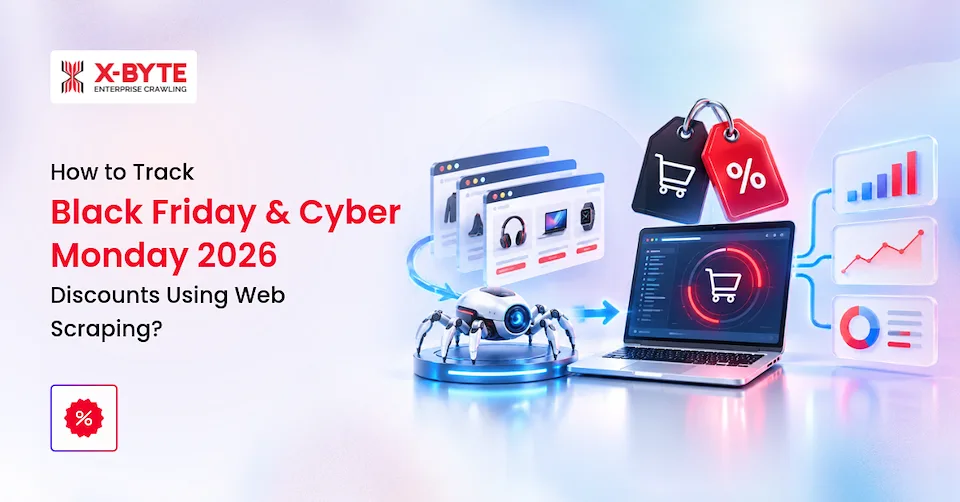
The infographic compresses the full pipeline into a single view, from target selection through to action. Each stage hands off to the next, and the whole loop repeats on a timer for as long as the sale runs.
How to Track Black Friday & Cyber Monday 2026 Discounts Using Web Scraping?
The method splits into six stages, and skipping any one of them tends to show up later as missing or messy records. Here is what each stage actually involves.
- Define your targets and SKU list. List the competitor sites, marketplaces, and specific products worth watching, because a tight scope keeps crawls quick and keeps noise out of your price data.
- Build or configure the scraper. Map each schema field, add rotating residential proxies, and cap request rates so the scraper resembles ordinary shopper traffic rather than a crawler under load.
- Schedule frequent crawls. Prices move within the hour on peak days, so a five-to-fifteen-minute cadence on top SKUs keeps your discount data genuinely current.
- Clean and structure the output. Strip the HTML clutter, normalize currencies and date formats, compute discount_pct, and reject any row that fails a sanity check.
- Store everything centrally. A single warehouse or time-series table holds historical pricing, which is what later powers trend lines and year-over-year comparisons.
- Visualize and act. Dashboards and threshold alerts convert raw rows into decisions, pinging your team the moment a rival cuts a price or a Cyber Monday deal goes live.
What Does a Practical Scraper Look Like in Code?
Theory only goes so far, so here is a trimmed, illustrative example. It uses Playwright because holiday pages often render prices through JavaScript, which a plain HTTP request would miss. The snippet loads a product page, reads a few fields, and returns one structured record that matches the schema in Table 2.
# Illustrative example — selectors differ per site
from playwright.sync_api import sync_playwright
import json, datetime
def scrape_price(url):
with sync_playwright() as p:
browser = p.chromium.launch(headless=True)
page = browser.new_page()
page.goto(url, wait_until="networkidle") # let JS prices load
list_price = float(page.locator(".list-price").inner_text().strip("$"))
sale_price = float(page.locator(".sale-price").inner_text().strip("$"))
record = {
"product_id": page.locator("[data-sku]").get_attribute("data-sku"),
"list_price": list_price,
"sale_price": sale_price,
"discount_pct": round((1 - sale_price / list_price) * 100, 1),
"in_stock": page.locator(".availability").inner_text() == "In Stock",
"captured_at": datetime.datetime.utcnow().isoformat() + "Z",
}
browser.close()
return record
print(json.dumps(scrape_price("https://example-store.com/p/123"), indent=2))
Run against a sample page, the output is a clean JSON record that is ready to validate and store:
{
"product_id": "B0CX1234",
"list_price": 699.99,
"sale_price": 429.99,
"discount_pct": 38.6,
"in_stock": true,
"captured_at": "2026-11-27T13:45:00Z"
}
Scaled to thousands of SKUs, teams usually wrap this core in a scheduler, a proxy pool, a retry layer, and validation rules. That engineering overhead is the main reason many brands route stages two through five to X-Byte’s eCommerce data scraping services rather than staffing it in-house right before the rush.
What Are the Legal and Compliance Considerations for Ecommerce Web Scraping?
Responsible collection is a process, not an afterthought, and a few habits keep a program on solid ground. U.S. courts have generally treated the scraping of publicly available data as permissible, with the hiQ Labs v. LinkedIn line of cases often cited on that point, while privacy laws such as GDPR and CCPA govern anything that counts as personal data. The guardrails below reflect how careful teams operate.
1. Review Website Terms and Access Policies
Check the terms of service and applicable website policies before collecting information. Understand any restrictions related to automated access, data reuse, and commercial applications.
2. Prioritize Publicly Accessible Product Information
Focus on product prices, publicly displayed promotions, product descriptions, and stock information. Avoid collecting personal information or accessing restricted areas without authorization.
3. Respect Robots.txt and Website Restrictions
Review robots.txt instructions and other applicable access policies. Do not assume that publicly accessible information is automatically unrestricted for automated collection.
4. Implement Responsible Request Management
Configure reasonable request intervals, caching, and error handling to avoid unnecessary server load. Stop collection when access restrictions or blocking mechanisms indicate that automated access is not permitted.
5. Consider Applicable Privacy and Data Protection Laws
Businesses operating across regions should understand relevant legal requirements, including GDPR in the European Union and applicable U.S. state privacy laws such as CCPA/CPRA.
6. Maintain Transparent Data Handling Practices
Document the information collected, its intended purpose, retention period, and internal access controls. Establish a process for reviewing compliance as scraping requirements change.
What Challenges Should You Expect When Scraping BFCM Data?
Peak season raises the difficulty in ways a quiet Tuesday never does, so knowing the hurdles early saves a frantic fix mid-sale. These four catch most teams off guard.
- Dynamic pricing — Half the time, the price you see is painted in by JavaScript after the page arrives. Fire a plain request too early, and you capture an empty slot, not the real sale figure.
- Anti-bot defenses — This is where peak season bites hardest. CAPTCHAs multiply, limits drop, and IP bans land faster, so rotating proxies and a calmer rhythm stop being optional.
- Traffic at scale — A few thousand SKUs, each refreshed every few minutes, adds up to serious load. Your setup has to stay upright on the one weekend it cannot afford to wobble.
- Data accuracy — A quiet layout tweak, a regional price, or a stray currency symbol can each throw the numbers off. Validation rules catch most of that, which is why they belong in from the start.
Which Best Practices Keep Your Scraping Clean and Reliable?
1. Prioritize High-Value Products
Focus on products that contribute significantly to sales or face strong competitor pricing pressure. This keeps monitoring resources concentrated on commercially important SKUs.
2. Maintain Historical Price Records
Store every validated price observation with its collection timestamp. Historical records help retailers identify discount patterns, compare promotional periods, and understand whether a sale price represents a genuine reduction.
3. Validate Product Matches
Compare product identifiers, specifications, brand names, sizes, and variants before calculating competitor price differences.
4. Monitor Data Freshness
Track when each product was last successfully collected. Set alerts for missing records, outdated prices, and repeated collection failures.
5. Build Automated Quality Checks
Validate price ranges, discount calculations, currency formats, stock status, and duplicate records before sending information to dashboards.
6. Review Significant Pricing Changes
Use human verification for major price adjustments and unusual competitor promotions. This prevents incorrect or incomplete records from influencing important pricing decisions.
Final Thoughts
Black Friday and Cyber Monday create significant pricing opportunities, but keeping track of competitor discounts across multiple ecommerce websites can be challenging. Web scraping helps retailers automate this process by collecting product prices, promotional offers, stock availability, and other important market signals.
With a structured monitoring workflow, businesses can compare competitor prices, identify discount trends, validate promotional offers, and make informed pricing decisions throughout the holiday shopping season. Reliable data collection, product matching, historical tracking, and regular validation are essential to maintaining accurate insights.
For businesses monitoring thousands of products across multiple platforms, managing the entire scraping infrastructure internally can require considerable technical resources. X-Byte Enterprise Crawling offers ecommerce data scraping services to help businesses collect and organize product information at scale. The right approach can help your team spend less time gathering data and more time acting on valuable pricing insights.