
E-commerce marketplaces generate enormous amounts of product, pricing, seller, review, and availability data every day. For brands, retailers, marketplace sellers, researchers, and analytics teams, this information can reveal market trends, competitor positioning, product demand, and pricing trends.
eBay is a valuable source of marketplace intelligence because of its global reach and extensive product catalog. As of June 30, 2026, eBay reported approximately 136 million active buyers worldwide, around 2.6 billion live listings, and $22.4 billion in gross merchandise volume (GMV) during Q2 2026. The company also reported approximately $15 billion in gross merchandise bought through mobile devices during the quarter.
With millions of listings changing over time, manually tracking eBay marketplace information can be difficult and time-consuming. eBay web scraping provides a way to collect publicly accessible marketplace data at scale and convert it into structured datasets for research, analytics, competitive intelligence, and business decision-making.
What Is eBay Web Scraping?
eBay web scraping is the automated process of collecting publicly available information from eBay pages and organizing it into a structured dataset.
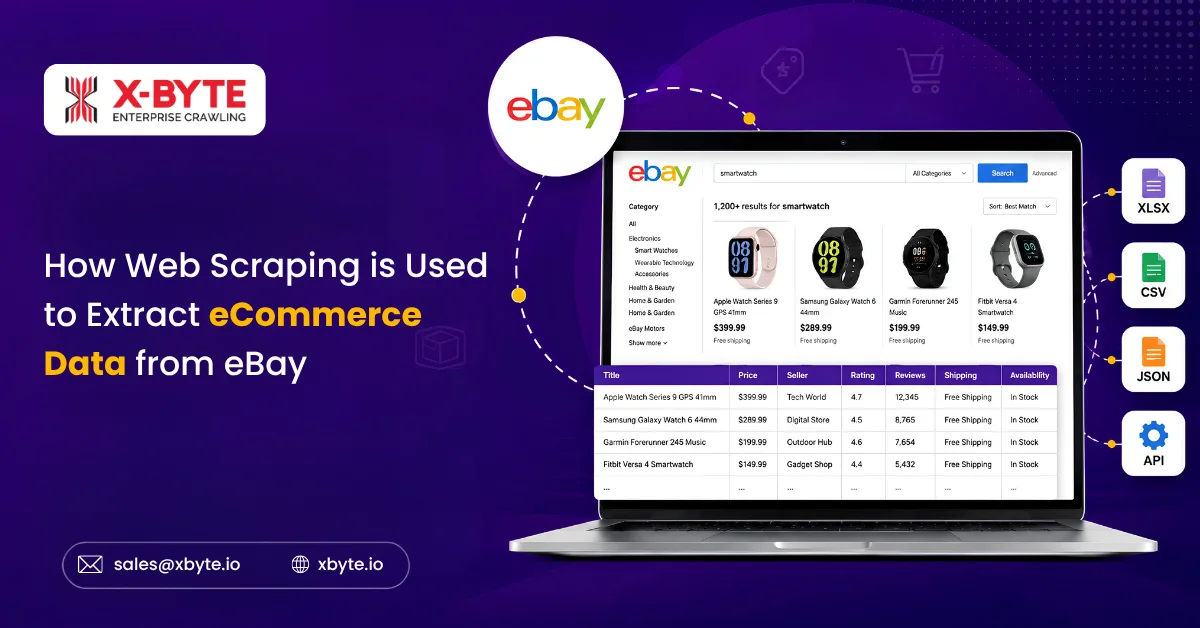
Depending on the project requirements, an eBay product data scraping solution can capture information from product listings, search results, seller pages, categories, and other publicly accessible marketplace pages.
Common data fields include:
- Product titles and descriptions
- Product URLs and item identifiers
- Categories and subcategories
- Product prices
- Seller information and seller ratings
- Product condition
- Availability information
- Shipping and delivery details
- Product images
- Ratings and reviews
- Listing formats
- Promotional or offer information
- Search-result positions
- Product attributes and specifications
The extracted information can be delivered in formats such as CSV, Excel, JSON, or database-ready structures, depending on the business requirement.
Why Extract eBay Marketplace Data?
eBay’s large and continuously changing marketplace creates opportunities for businesses that need more than occasional manual research.
A structured eBay dataset can help organizations:
- Track product and pricing trends
- Compare competing sellers
- Research new product opportunities
- Analyze marketplace supply
- Monitor seller activity
- Study customer feedback
- Evaluate product assortment
- Build historical marketplace datasets
- Support pricing and merchandising decisions
- Feed marketplace data into analytics platforms
Rather than analyzing individual listings one at a time, businesses can work with thousands or millions of structured records and identify patterns across products, categories, sellers, and time periods.
eBay Product Data Scraping for Product Intelligence
Product information is one of the most valuable datasets available from an e-commerce marketplace.
An eBay product dataset can provide a structured view of product titles, descriptions, categories, specifications, conditions, prices, images, seller information, and other publicly displayed listing attributes.
Businesses can use this information to:
- Compare product assortments
- Identify frequently listed products
- Analyze product attributes
- Research emerging categories
- Identify gaps in product offerings
- Evaluate product positioning
- Build internal product research databases
For example, a retailer researching a new category can collect product information across relevant eBay categories, organize the listings by product type and seller, and analyze pricing and assortment patterns before making purchasing or expansion decisions.
Monitor eBay Prices and Pricing Trends
Marketplace prices can change because of competition, promotions, product availability, demand, and seller strategies.
eBay price data scraping allows businesses to collect pricing information across selected products or categories and compare observations over time.
A historical pricing dataset can help identify:
- Average selling prices
- Price differences between sellers
- Frequent price changes
- Premium and discount positioning
- Promotional pricing patterns
- Pricing ranges within a category
- Products with significant price fluctuations
For ongoing monitoring, new snapshots can be compared with historical records to identify meaningful changes.
This makes price data useful for competitive pricing analysis, market research, and product strategy.
Analyze eBay Competitor and Seller Data
Competition on eBay involves more than price. Sellers may differentiate themselves through product assortment, seller ratings, shipping options, listing quality, availability, and other marketplace signals.
eBay competitor data scraping can help organizations create structured datasets for selected sellers and products.
Depending on the project scope, the dataset may contain:
- Seller names and profiles
- Product listings
- Product prices
- Seller ratings
- Review counts
- Product availability
- Shipping information
- Product assortment
- Category presence
- Listing activity
Analyzing these fields together can help businesses understand competitor positioning and identify areas where the market may be underserved.
Discover Product and Category Opportunities
eBay’s broad marketplace covers categories such as electronics, collectibles, automotive products, fashion, home goods, business equipment, and many other product segments.
Analyzing listings across these categories can reveal differences in supply, competition, pricing, and product availability.
A business can compare:
Product Demand → Seller Competition → Pricing → Availability → Market Opportunity
For example, a category with a growing number of product listings but relatively limited seller competition may warrant further research. Similarly, significant price variation among comparable products may indicate an opportunity for pricing analysis.
These insights can support:
- Product research
- Assortment planning
- Market expansion
- Product sourcing
- Category analysis
- Competitive research
Track eBay Seller and Listing Activity
Seller activity provides another useful layer of marketplace intelligence.
A structured eBay seller dataset can be used to monitor selected sellers and identify changes in their publicly available marketplace activity.
Historical snapshots can reveal:
- New product listings
- Products removed from a catalog
- Changes in product prices
- Changes in seller ratings
- Assortment expansion
- Category changes
- Listing availability changes
Rather than looking at a seller’s marketplace activity manually, businesses can maintain structured historical records and analyze how the seller’s assortment and positioning change over time.
Extract eBay Reviews and Ratings Data
Customer feedback can provide valuable insight into product quality, buyer expectations, and recurring issues.
eBay review data scraping can collect publicly available ratings and review information and organize it into a structured dataset for analysis.
Review data can support:
- Product quality analysis
- Customer sentiment research
- Common complaint identification
- Competitor comparison
- Product improvement research
- Brand and category monitoring
For example, analysts can group customer feedback by product category and identify recurring themes. When review information is combined with pricing and product attributes, businesses can develop a broader understanding of marketplace performance.
What eBay Data Can Be Extracted?
The exact fields collected depend on the project requirements and the publicly accessible information available at the time of extraction.
Product Data
Product titles, descriptions, URLs, item identifiers, categories, specifications, condition, images, and listing attributes.
Pricing Data
Current prices, sale prices, pricing observations, and price differences among comparable listings.
Seller Data
Seller names, seller ratings, feedback information, and publicly available seller-level listing information.
Review Data
Ratings, review counts, customer feedback, and other publicly visible review information.
Availability and Shipping Data
Listing availability, publicly displayed stock information, shipping details, delivery options, and related listing information.
Search and Category Data
Search-result positions, product visibility, category placement, and other publicly visible marketplace signals.
Combining these fields creates a richer dataset for product intelligence, competitive analysis, and marketplace research.
How eBay Data Scraping Supports Business Decisions
The value of web scraping goes beyond collecting individual pieces of information. The objective is to transform marketplace data into structured information that can support business decisions.
A typical workflow looks like this:
Public Marketplace Data
↓
Data Collection
↓
Cleaning & Standardization
↓
Structured eBay Dataset
↓
Analytics & Business Intelligence
↓
Actionable Market Insights
The resulting dataset can support pricing teams, retailers, brands, marketplace sellers, researchers, and strategy teams.
Building an eBay Product Data Pipeline
A scalable eBay data extraction project typically includes several stages.
1. Define Data Requirements
Start by identifying the products, categories, sellers, geographic markets, data fields, and collection frequency required for the project.
Defining the scope first helps reduce unnecessary data collection and keeps the final dataset focused on business objectives.
2. Collect Publicly Accessible Data
A scraping system can collect the required publicly accessible marketplace information according to the project’s technical requirements and applicable rules.
For larger projects, automated collection can be scheduled at defined intervals instead of relying on manual research.
3. Clean and Standardize the Data
Raw marketplace data may contain duplicate listings, missing values, inconsistent formats, or changing product attributes.
A data-processing layer can normalize fields, remove duplicates, validate records, and standardize values before the information reaches the final database or analytics environment.
4. Maintain Historical Records
For price monitoring and competitive intelligence, historical snapshots are particularly valuable.
Storing periodic datasets makes it possible to compare marketplace conditions and identify changes in pricing, listings, seller activity, and availability.
5. Analyze and Deliver the Data
The processed dataset can be delivered through CSV, Excel, JSON, APIs, databases, or other formats required by the organization.
It can then be connected to dashboards, business intelligence platforms, internal applications, or analytical workflows.
Technical Considerations for Scalable eBay Data Extraction
Large-scale marketplace data collection requires more than a basic scraper.
A production-oriented workflow may need to address:
- URL and product discovery
- Pagination and category navigation
- Duplicate detection
- Data validation
- Missing-field handling
- Change detection
- Request scheduling
- Error handling and retries
- Historical data storage
- Structured output generation
- Monitoring and maintenance
For recurring projects, the system should also be designed to accommodate changes in page structures and data availability.
The appropriate technical architecture depends on the volume, frequency, data fields, and delivery requirements of the project.
What Businesses Can Learn From eBay Marketplace Data
A well-designed eBay data collection project can provide insights across several business areas:
- Competitive pricing: Compare prices for similar products and identify pricing trends.
- Product intelligence: Analyze product catalogs, attributes, conditions, and assortment.
- Seller intelligence: Study publicly available seller and listing activity.
- Market research: Identify changes in product and category trends.
- Customer insights: Analyze ratings and publicly available customer feedback.
- Opportunity analysis: Discover potentially underserved product categories.
- Historical monitoring: Measure changes in prices, listings, and marketplace activity.
- Business intelligence: Combine marketplace data with internal sales and market datasets.
Scaling eBay Data Extraction for Ongoing Monitoring
A one-time dataset may be enough for a specific research project. Organizations that need continuous marketplace visibility can use recurring data collection workflows.
For example, selected eBay product information can be collected daily, weekly, or at another appropriate interval based on the business requirement.
Each new dataset can be compared with previous snapshots to identify changes in:
Prices + Listings + Availability + Seller Activity + Ratings = Marketplace Intelligence
This approach helps organizations move from static product research toward continuous marketplace monitoring.
Important Considerations for eBay Web Scraping
Before starting an eBay data extraction project, businesses should clearly define the intended use of the data, the required fields, and the collection scope.
Data collection should focus on publicly accessible information and should be performed in accordance with applicable laws, contractual obligations, website terms, and technical restrictions.
Businesses should also avoid collecting unnecessary personal or sensitive information. Data quality, request frequency, duplicate handling, error management, storage, and ongoing maintenance should be considered when designing a production scraping workflow.
Turn eBay Marketplace Data Into Actionable Insights
eBay’s scale makes its marketplace a valuable source of publicly available e-commerce information. With approximately 136 million active buyers, 2.6 billion live listings, and $22.4 billion in Q2 2026 GMV, eBay provides a large and continuously changing environment for product and market analysis.
Businesses can use structured eBay data to monitor prices, analyze competitors, research products, evaluate sellers, understand customer feedback, and identify potential marketplace opportunities.
At X-Byte Enterprise Crawling, we provide scalable eBay data scraping and e-commerce data extraction solutions tailored to specific business requirements. Our team can help define the required data fields, collection frequency, processing workflow, output format, and integration requirements.
Frequently Asked Questions
 ✯ Alpesh Khunt ✯

Related Blogs
How Web Scraping Is Used to Extract eCommerce Data From eBay
How to Extract UPC & ASIN Data for Better E-commerce Product Insights