
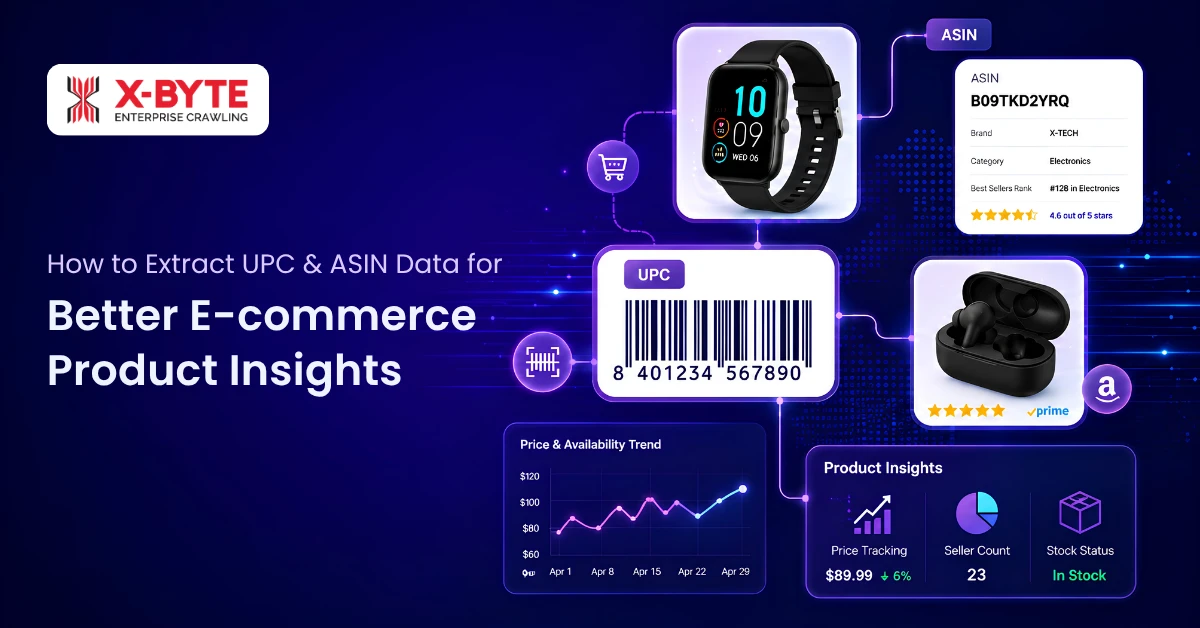
In the competitive eCommerce landscape, accurate product identification is essential for managing catalogs, monitoring competitors, and making data-driven business decisions. Product identifiers such as UPC (Universal Product Code) and ASIN (Amazon Standard Identification Number) help businesses organize product information, match listings, and analyze marketplace performance.
With thousands of products being added and updated daily across online marketplaces, manually collecting product identifiers and related information is time-consuming and inefficient. Businesses now use automated UPC and ASIN data extraction solutions to collect structured product information at scale.
UPC and ASIN data extraction enables retailers, brands, market researchers, and eCommerce businesses to analyze pricing trends, improve product catalogs, monitor competitors, and gain deeper insights into marketplace performance.
This guide explains what UPC and ASIN codes are, why businesses extract them, how product data extraction works, and how companies use this information to improve their eCommerce strategies.
What Are UPC and ASIN Codes?
UPC and ASIN are two important product identifiers used in the retail and eCommerce ecosystem. Although both help identify products, they serve different purposes.
A UPC is a globally recognized product identifier used across retail channels, while an ASIN is a marketplace-specific identifier used by Amazon to organize products within its catalog.
Understanding the difference between these identifiers helps businesses accurately track products, compare listings, and manage large-scale product datasets.
What Is a UPC Code?
A UPC (Universal Product Code) is a 12-digit barcode identifier assigned to retail products. It is commonly used by manufacturers, retailers, and distributors to uniquely identify products across different sales channels.
A UPC code generally contains three main components:
Manufacturer Identification Number
The first part identifies the company or manufacturer that created the product.
Product Number
The middle digits represent the specific product assigned by the manufacturer.
Check Digit
The final digit validates the accuracy of the UPC code using a mathematical calculation.
Businesses use UPC data extraction to collect product identifiers and connect product information across multiple systems.
Common uses of UPC extraction include:
- Product catalog management
- Inventory synchronization
- Product matching
- Retail analytics
- Competitor research
- Marketplace data analysis
For example, retailers can use UPC information to identify identical products across different platforms and compare pricing, availability, and product performance.
What Is an ASIN Code?
An ASIN (Amazon Standard Identification Number) is a unique 10-character identifier assigned to products listed on Amazon.
Every product available on Amazon has a specific ASIN that helps organize and manage product listings within Amazon’s catalog.
ASIN data extraction allows businesses to collect Amazon product identifiers along with valuable marketplace information.
Businesses use ASIN data for:
- Amazon product tracking
- Competitor analysis
- Product ranking monitoring
- Listing optimization
- Market research
- Product performance analysis
ASINs are commonly found within Amazon product URLs and product detail pages.
For sellers and brands operating on Amazon, ASIN data provides valuable insights into competitor listings, pricing strategies, customer feedback, and marketplace trends.
UPC vs ASIN: Understanding the Difference
Although UPC and ASIN both identify products, they serve different purposes.
| Feature | UPC | ASIN |
|---|---|---|
| Full Form | Universal Product Code | Amazon Standard Identification Number |
| Purpose | Global product identification | Amazon marketplace identification |
| Used By | Manufacturers and retailers | Amazon sellers and marketplace users |
| Format | 12-digit number | 10-character alphanumeric code |
| Scope | Multiple retail channels | Amazon ecosystem |
A single product may have a UPC for global retail identification and an ASIN for its Amazon marketplace listing.
Using both identifiers together helps businesses build accurate product databases, improve catalog matching, and analyze marketplace performance.
Why Extract UPC and ASIN Data?
Extracting UPC and ASIN data provides businesses with valuable product intelligence that supports better decision-making.
1. Product Matching and Catalog Management
Large eCommerce businesses often manage thousands or millions of products across multiple channels. Matching identical products accurately can become challenging without reliable identifiers.
UPC and ASIN extraction helps businesses:
- Match products across marketplaces
- Remove duplicate listings
- Maintain accurate product catalogs
- Improve product data quality
- Synchronize product information
Accurate product identification improves operational efficiency and reduces catalog management errors.
2. Competitor Price Monitoring
Pricing changes frequently in online marketplaces. Businesses need continuous visibility into competitor pricing to remain competitive.
By extracting UPC and ASIN data along with pricing information, companies can monitor:
- Product prices
- Discount changes
- Promotional offers
- Seller pricing strategies
- Marketplace fluctuations
This enables businesses to create smarter pricing strategies and respond quickly to market changes.
3. Product Research and Market Analysis
Product identifiers provide the foundation for understanding marketplace trends.
Businesses can analyze UPC and ASIN data to identify:
- Popular product categories
- Emerging market trends
- High-performing products
- Customer demand patterns
- Competitor positioning
This information helps companies make informed decisions about product launches, inventory planning, and market expansion.
4. Inventory Optimization
Accurate product data helps businesses improve inventory management.
By connecting UPC and ASIN information with product availability data, companies can:
- Track product availability
- Identify stock trends
- Improve demand forecasting
- Reduce inventory issues
- Optimize supply chain decisions
Inventory intelligence allows businesses to maintain the right products at the right time.
5. Brand Protection
Product identification data also supports brand monitoring and protection strategies.
Brands can use UPC and ASIN data extraction to:
- Identify unauthorized sellers
- Monitor duplicate listings
- Track product representation
- Verify product information
- Protect brand reputation
Maintaining accurate marketplace visibility helps brands improve customer trust.
What Product Data Can Be Extracted Along With UPC and ASIN?
UPC and ASIN extraction can be combined with additional product information to create complete eCommerce datasets.
Commonly extracted product fields include:
Product Information
- Product title
- Brand name
- Product category
- Product description
- Product specifications
- Product images
Pricing Information
- Current price
- Original price
- Discount details
- Seller pricing
- Price history
Marketplace Information
- ASIN
- UPC
- Product URL
- Seller information
- Product ranking
- Availability status
Customer Insights
- Ratings
- Reviews
- Review count
- Customer feedback
Combining identifiers with additional product attributes provides deeper eCommerce intelligence.
How Businesses Extract UPC and ASIN Data
Businesses can extract UPC and ASIN data using different approaches depending on their requirements.
1. Manual Extraction
Manual extraction involves collecting product identifiers individually from product pages.
This method may work for:
- Small product lists
- Limited research projects
- Occasional data collection
However, manual extraction becomes inefficient when businesses need thousands of product records.
Challenges include:
- Time-consuming processes
- Human errors
- Difficulty maintaining updated data
- Limited scalability
2. Automated Product Data Extraction
Automated product data extraction uses advanced scraping technologies and data collection systems to gather product information at scale.
A typical automated process includes:
Identify Target Products
Businesses define required products, categories, marketplaces, and data fields.
Collect Product Information
Automated systems collect UPC, ASIN, pricing, reviews, availability, and other required product attributes.
Structure Data
Raw information is cleaned, organized, and converted into usable formats such as CSV, JSON, databases, or APIs.
Analyze Insights
Businesses use structured datasets for pricing analysis, competitor research, catalog management, and market intelligence.
Challenges in UPC and ASIN Data Extraction
Extracting product identifiers at scale can involve several challenges.
Dynamic Website Structures
Many eCommerce websites use dynamic content loading, which can make traditional extraction methods ineffective.
Large Product Volumes
Collecting millions of product records requires scalable infrastructure and efficient data processing.
Data Accuracy
Incorrect product matching or outdated information can reduce the value of extracted datasets.
Website Changes
Online marketplaces frequently update layouts and structures, requiring flexible extraction systems.
Professional data extraction solutions help businesses overcome these challenges through scalable technology and continuous monitoring.
How eCommerce Data Extraction Services Help
Professional eCommerce data extraction services help businesses collect accurate and structured product intelligence without managing complex technical processes internally.
These services provide:
- Custom product data extraction
- UPC and ASIN datasets
- Competitor monitoring solutions
- Product catalog enrichment
- Pricing intelligence
- Automated data delivery
Businesses can use these solutions to transform marketplace data into actionable insights for growth.
Best Practices for Product Data Extraction
To achieve reliable product intelligence, businesses should follow these best practices:
Maintain Data Accuracy
Validate extracted product identifiers and regularly update datasets.
Use Structured Data Formats
Store information in organized formats that support analysis and integration.
Monitor Data Changes
Regular updates ensure businesses always work with current marketplace information.
Focus on Business Objectives
Collect only the product fields required for specific goals such as pricing analysis, catalog management, or market research.
Follow Ethical Data Collection Practices
Businesses should ensure their data collection methods follow applicable website policies and legal requirements.
Conclusion
UPC and ASIN data extraction plays an important role in modern eCommerce intelligence. These product identifiers help businesses organize catalogs, analyze competitors, monitor pricing, and understand marketplace opportunities.
By combining UPC and ASIN data with product details such as pricing, availability, reviews, and seller information, businesses can build powerful datasets for better decision-making.
Whether you are a retailer, brand, marketplace seller, or research company, structured product data extraction provides the insights needed to improve eCommerce strategies and stay competitive in a rapidly changing digital marketplace.
Frequently Asked Questions
 ✯ Alpesh Khunt ✯