
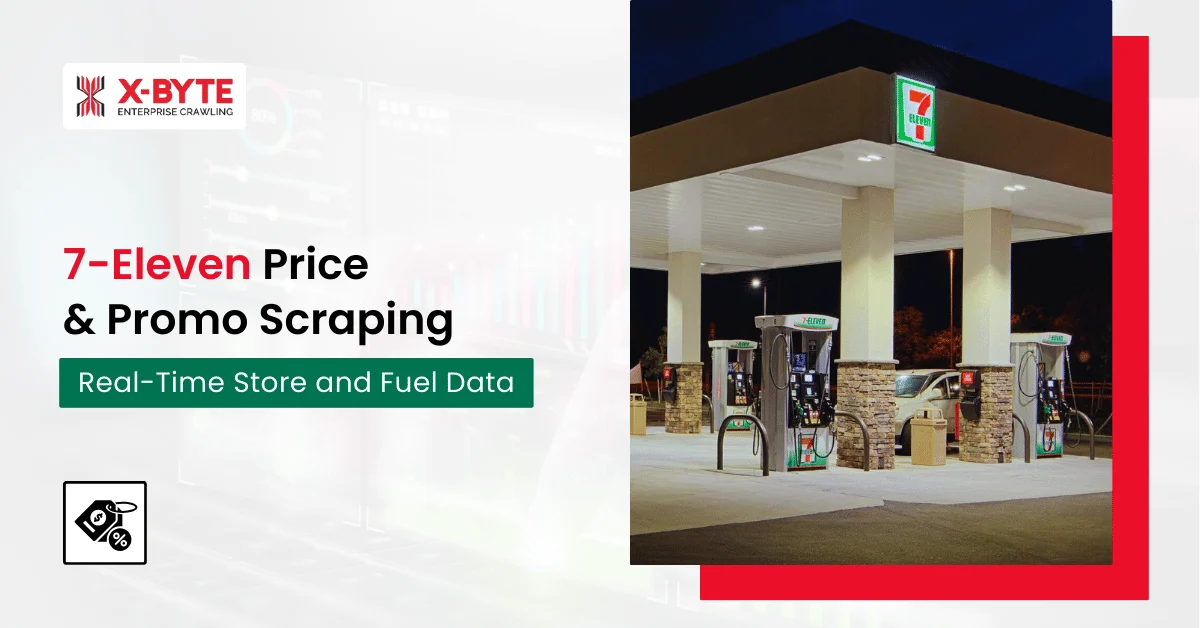
The ability to monitor ever fluctuating fuel prices, the cost of products in-store, available discounts and the local promotions that Track 7-Eleven offers have become a necessity to any brand or retailer active in the convenience and fuel market. The pricing changes during the day, the loyalty programs and the off-time promotions disappear in a matter of hours. This makes real-time data collection very instrumental in leading the pack in a market where each cent counts to the behavior of customers. Consequently, most companies today use technologies like 7-Eleven price scraping and 7-Eleven promo scraping to have real-time visibility of dynamic retailing and fuel trends.
Why 7-Eleven Price & Promo Data Is Important to Retail and Fuel Competitiveness?
7-Eleven fuel prices can change several times a day based on regional supply, competitor activity, and margin goals, and these swings have a real impact on profitability, especially in highly competitive areas. Tracking them over time reveals trends that signal margin risk, so operators can adjust prices proactively without sacrificing revenue. Pricing and promotions also vary from store to store by city, ZIP code, and market density, with loyalty rewards, limited-time offers, bundles, and BOGO deals all in play. Without automated tracking, retailers and brands can easily miss promotional shifts that influence customer decisions. Monitoring this data shows what competitors are offering, which promotions actually drive conversions, and where margin may be leaking.
Location Change in Fuel Prices
There are several times a day that fuel prices may vary at 7-Eleven on the basis of supply in the region, competitor activity and margin goals. Such hourly variations have a high influence on profitability particularly in high competition areas. By tracking these changes in time, the businesses can identify definite trends that show the presence of a margin and enable the latter to proactively adjust the price. With this level of granular data, fuel operators are able to remain in touch with market expectation without compromising on revenue.
Store Level Pricing/Promotion Variations.
Within the 7-Eleven stores, pricing varies by the city, ZIP code and market density. More than that, there are incentive programs of the loyalty program, limited-time promotions, bundles, and BOGO offers, which are common. Retailers and brands without automated tracking do run the danger of missing key promotional shifts that affect the decision of customers. The tracking of this information assists companies to compare what their competitors are currently providing, what promotions will lead to the conversion, and what margin leaks might exist.
Which Data Can 7-Eleven Scrape?
Companies can also obtain product-level retail information, fuel price information, and in-store discount information, loyalty rewards information, stock availability information and even banners on promotions when they open the regional store pages. This level of detail serves such use cases as real-time pricing analytics, automatic product monitoring, and on-demand competitive research.
Live Fuel Price Intelligence to Strategic Decision Making.
Real-time 7-Eleven fuel data turns raw price movements into decisions you can act on. By comparing your prices against nearby 7-Eleven stores as the market shifts, fuel retailers know exactly when to raise or lower prices, far faster and more accurately than manual surveys. The same continuous data also powers AI-based margin forecasting, tracking price changes, averages, and competitor behavior to flag margin pressure before it hits, so operators can set pricing strategies that stay both competitive and profitable.
Benchmarking of Regional Competitors
Fuel retailers need to be aware of the competitiveness between their prices and the prices of the neighboring 7-Elevens to remain competitive. Real time fuel scraping allows instant comparison with the regional competition, allowing the operator to know when to increase or reduce price due to real market trends. This method is far quicker and more precise than the traditional survey by hand.
Fuel Margin Prediction Models.
AI-based margin forecasting models are supported by real-time data as well. By monitoring changes in prices continuously, average changes in prices, and the actions of competitors, businesses can anticipate that the margin pressure will happen. These predictions will enable fuel operators to make more intelligent-based decisions, faster, and devise pricing policies that will be competitive and profitable.
7-Eleven Retailer, CPG Brand, and Fuel Operator Retailer Promo Scraping
Scraping promotions on 7-Eleven websites and mobile applications offers companies important information about the trends in discounts, performance of bundles, and consumer interaction. This will involve tracking Specials BOGO, Loyalty, seasonal and regional advertisements. Promo intelligence allows a brand to maximize the use of discounting, enhance positioning of products and make sure that their offers are competitive in the various markets. It aids in the fueling operators to compare the non-fuel promotions that affect the store traffic and convenience retail sales.
The way X-Byte Gathers 7-Eleven Data at Scale.
X-Byte uses advanced web data capture systems to power competitive price monitoring across thousands of 7-Eleven stores, collecting fuel and retail pricing down to the ZIP and neighborhood level for truly hyperlocal insight. The data can be delivered the way your team works best, whether as an API feed, a downloadable dataset, or a full dashboard with analytics and visualizations. Monitoring frequency is flexible too: hourly updates for fuel operators who need speed, and daily or event-based tracking for retailers and CPG brands watching promotions and product-level price changes.
Store-Level & ZIP-Level Coverage.
X-Byte implements high level web data capture systems to collect fuel and store pricing of thousands of 7-Eleven stores. It covers both the ZIP-level and neighborhood-level information, which allows hyperlocal pricing insight.
Raw Dataset, Dashboard or API Delivery.
Clients will have access to 7-Eleven fuel and retail information using APIs, downloadable data, or a complete dashboard with analytics and visualization options, depending on the use case. Such delivery formats are flexible to the analysts, data engineers, and marketing teams.
High-Frequency Monitoring (Hourly/Daily)
Hourly scraping may be used by businesses that need fast updates, e.g. fuel operators. Retailers and CPG brands can, in the meantime, use either daily or event-based monitoring to monitor the promotion or product-level price changes.
Application of 7-Eleven Price & Fuel Data in industry.
Competitive price monitoring and location intelligence built on 7-Eleven data support a range of industries, each with its own use case. Fuel retailers rely on real-time pricing to adjust rates day to day, staying competitive while protecting margins. CPG brands track in-store promotions to refine planograms, improve shelf execution, and measure promotion performance, which also strengthens their position when negotiating better placements. Market research agencies use 7-Eleven retail and fuel datasets to build competitive intelligence reports, analyzing regional trends, price movements, and promotional activity so their clients can make better-informed decisions.
Fuel Retailers
The real-time 7-Eleven fuel price data used by fuel operators is a dynamic way of changing their prices on a day-to-day basis. This will make them competitive and maximize margins.
CPG Brands
The companies of consumer packaged goods monitor in-store promotions at 7-Eleven to improve planograms, improve shelf activities, and gauge performance of promos. The analytics of promos also allow negotiating better placements by the brands.
Market Research Agencies
The 7-Eleven retail and fuel datasets are used by agencies to produce competitive intelligence reports. They examine the trend in the regions, the movement of price, and promotional activity to enable the clients to make better decisions.
Case Study: Improving Market Share with 7-Eleven Price Intelligence.
Take the case of a fuel retailer which serves various metropolitan areas. Due to the location of the business, the company experienced uneven margins and defusing competitiveness as neighboring 7-Eleven outlets were changing prices every hour. The retailer realized real-time visibility of the fuel prices in all the 7-Eleven stores in question by incorporating a real-time scraping system. That enabled the team to be more responsive, which enhanced their ability to respond to price matches dynamically and reduced revenue loss. In weeks, the retailer was experiencing increased store traffic and a rise in fuel volume in the competitive ZIP codes.
Why X-Byte to scrape 7-Eleven Price and Promo?
- 99% data accuracy
- Automated scraping programs.
- National 7-Eleven store and fuel reach.
- Scalable and compliance sensitive data extraction systems.
The infrastructure of X-Byte enables tracking of fuel with high frequency, searching of large amounts of store data, and promotion monitoring in detail of companies in the fields of retail, CPG and energy.
Conclusion
Price and promo scraping in real time 7-Eleven offers strategic benefit to any company in the convenience retail or fuel sector. Tracking live fuel prices, examining dynamic promotions, and store-level pricing, the companies can make faster decisions, gain more margins, and remain competitive in volatile markets. Whether it is fuel benchmarking, product level analytics, or nationwide promotional intelligence, it has an automated data extraction that provides a strong platform to make accurate and data-driven decisions.
Frequently Asked Questions
 ✯ Alpesh Khunt ✯

Related Blogs
How to Prepare Reliable Web Data for AI Agents and RAG Applications
Web Data Extraction API vs. Custom Data Extraction: Which Approach Fits Your Project?