
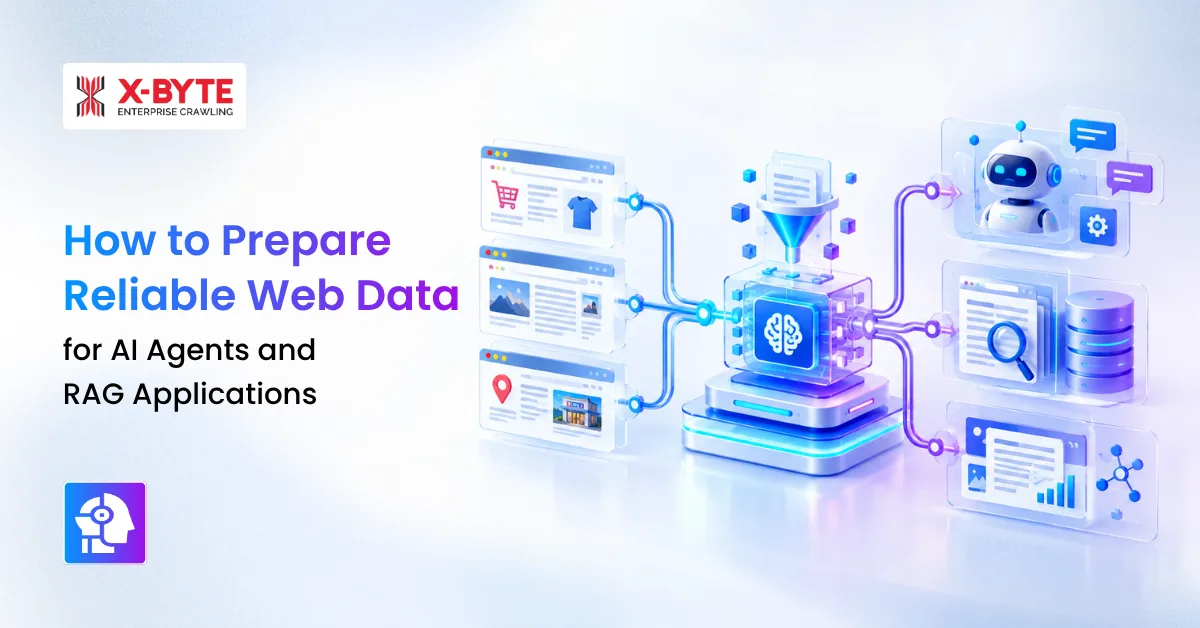
AI agents and retrieval-augmented generation (RAG) applications depend on accurate, relevant, and up-to-date information to deliver useful answers. However, web data often contains duplicate records, outdated content, inconsistent formatting, and information from unreliable sources. When these issues enter a retrieval pipeline, they can reduce answer quality and make it harder to trace incorrect responses.
Preparing reliable web data for AI applications requires more than collecting pages and converting them into a searchable format. Teams need a structured process for extracting relevant information, cleaning and validating records, preserving source metadata, and keeping datasets current. They must also prepare documents for retrieval through appropriate chunking, indexing, and evaluation.
This guide explains how to build a reliable web data pipeline for AI agents and RAG applications, with practical Python examples, data quality checks, and ongoing maintenance strategies. You will also learn how to evaluate an in-house approach against managed data extraction services.
Why Does Data Quality Carry So Much Weight in AI Projects?
Poor information is not a small annoyance that engineers patch later, because it compounds into real financial damage across the business. According to Gartner, poor data quality costs organizations roughly $12.9 million every year on average, and that figure rarely appears on any single budget line. The problem is often invisible until it is expensive, which is why about 59% of organizations do not actively measure their own data quality at all.
For AI specifically, the stakes climb even higher, since retrieval systems repeat whatever they are fed. Research published at NAACL shows that grounding a model with retrieval significantly reduces hallucination and helps it generalize to new domains, and later enterprise studies place that improvement anywhere from 40% to 71% in document-based knowledge scenarios. That gain only holds when the underlying information is accurate, well structured, and current. Little wonder that, by one industry estimate, around 70% of enterprise generative AI production applications now rely on RAG. In short, the model is rarely the weak link; the data feeding it usually is.
What Makes Web Data Reliable for AI Systems?
Reliability is not a feeling, and it is not guaranteed by volume either. A dataset earns trust only when it holds up against a few hard properties, and the list below shows what each one means in practice. Dataset size matters, but it should not be treated as a substitute for quality. A smaller, well-validated dataset may serve a specific retrieval task better than a much larger collection containing duplicates, outdated records, or irrelevant content.
- Accuracy means every field reflects the real-world value at the moment it was captured, with no silent drift from formatting errors or broken parsers.
- Completeness is about coverage, since missing prices, dates, or identifiers push the model into guessing, and guessing is how hallucinations begin.
- Consistency across sources matters, because the same product or entity should never appear under three conflicting names in one index.
- Freshness, the heart of strong data freshness practice, keeps stale snapshots from poisoning answers long after the original page has changed.
- Provenance ties each record back to a known origin, which is what makes real source validation possible instead of a hopeful assumption.
How Do You Build a Reliable Data Pipeline, Step by Step?
A dependable pipeline is a sequence of deliberate stages, and skipping any one of them tends to surface later as a production incident. The ordered process below turns raw pages into structured web data your agent can actually reason over. The infographic file shared with this article maps the same flow visually, so you can embed it right here in the post.
- Define the target and schema first. Decide exactly which fields you need and how they should look before a single page is fetched, because an unclear schema produces unusable output no matter how good the crawler is.
- Collect from verified sources. Pull only from domains you have checked for authority and stability, since low-quality origins contaminate everything downstream and make later source validation far harder.
- Parse into a clean structure. Convert messy HTML into consistent JSON or tabular records, normalizing dates, currencies, and units so the same concept always looks the same.
- Deduplication and enrichment. The same entity often appears more than once across sources, so those duplicates are collapsed into a single clean record. Any remaining gaps get filled from a trusted secondary source, and every row keeps its capture time and origin URL, which is what makes it traceable later.
- Validate before indexing. Run automated checks for format, range, and completeness, and reject records that fail rather than letting them quietly enter your retrieval layer.
Each stage should log what it rejected and why, because that record becomes your early warning system when something upstream changes.
What Does This Actually Look Like in Code?
Theory is easy; the real work lives in the implementation details. Below are the five technical patterns that most often separate a demo from a production feed. Treat these as starting templates rather than finished systems.
Schema validation catches malformed records before they ever reach your index. A lightweight JSON Schema check works well:
from jsonschema import validate, ValidationError

product_schema = {
    "type": "object",
    "required": ["product_id", "title", "price", "currency", "captured_at", "source_url"],
    "properties": {
        "price": {"type": "number", "minimum": 0},
        "currency": {"type": "string", "pattern": "^[A-Z]{3}$"},
        "captured_at": {"type": "string", "format": "date-time"},
    },
}

def is_valid(record):
    try:
        validate(instance=record, schema=product_schema)
        return True
    except ValidationError as err:
        log_rejection(record, reason=err.message)   # keep the audit trail
        return False
Deduplication collapses the same entity captured from different pages. A stable content key beats naive string matching:
import hashlib

def entity_key(record):
    basis = f"{record['brand'].lower()}|{record['model'].lower()}|{record['gtin']}"
    return hashlib.sha256(basis.encode()).hexdigest()
Metadata and provenance make source validation auditable. Every record should carry where it came from and when, so a wrong answer is always traceable back to its origin:
  "product_id": "SKU-4821",
  "title": "Noise-cancelling headphones",
  "price": 199.0,
  "currency": "USD",
  "source_url": "https://example-retailer.com/p/4821",
  "captured_at": "2026-10-19T14:05:00Z",
  "source_trust_score": 0.92
}
Chunking decides how your text is split before embedding, and it heavily shapes retrieval quality. Chunk documents according to their structure and intended use. Headings, paragraphs, tables, and semantic boundaries can provide better context than fixed token limits alone. A modest overlap may help preserve continuity, but chunk size and overlap should be tested against representative questions rather than selected using a universal default.
def chunk(tokens, size=400, overlap=60):
    step = size - overlap
    return [tokens[i:i + size] for i in range(0, len(tokens), step)]
Retrieval evaluation tells you whether any of this is working. Track precision@k and recall@k on a labeled question set, and add a faithfulness check that confirms each answer is supported by its retrieved context. A simple precision@k looks like this:
def precision_at_k(retrieved, relevant, k=5):
    top = retrieved[:k]
    hits = sum(1 for doc in top if doc in relevant)
    return hits / k
Teams that measure these numbers every release ship reliable AI data; teams that eyeball a few answers usually do not.
Which Checks Matter Most Before Data Reaches Your Model?
Not every validation step deserves equal attention, and knowing where to focus saves both time and money. The table below maps each quality dimension to the check that protects it and the failure it prevents, so your team can prioritize without guesswork.
| Quality dimension | Primary check | What it prevents |
| Accuracy | Field-level format and value validation | Wrong answers from corrupted or mis-parsed fields |
| Completeness | Required-field coverage scan | Gaps that push the model into guessing |
| Freshness | Timestamp and recrawl scheduling | Stale facts delivered as if current |
| Source trust | Domain scoring and source validation | Low-quality origins polluting the index |
| Consistency | Deduplication and entity resolution | One entity appearing under conflicting names |
These checks reduce common data quality failures, but they do not guarantee that every record is accurate. Combine automated validation with source-level verification, conflict detection, and periodic sampling. For RAG applications, evaluate whether the indexed content actually supports the questions users are likely to ask.
How Do RAG Pipelines Stay Fresh and Trustworthy Over Time?
Freshness is where many teams lose the game, because data that was perfect at launch slowly rots as the real world moves on. A product changes price, a policy page is rewritten, a company rebrands, and your index keeps serving yesterday’s truth. Maintaining strong data freshness is therefore not a one-time task but a recurring discipline built into the pipeline itself.
Here are the pillars that keep retrieval systems reliable long after deployment:
- Scheduled recrawls matched to how fast each source actually changes, so volatile pages are refreshed often and stable ones are left alone.
- Change detection that flags only what moved, which keeps compute costs sane while still catching meaningful updates quickly.
- Continuous source validation, where origins are periodically re-scored, and any domain that degrades in quality is demoted or dropped.
- Version tracking on every record, giving you a clear audit trail when an answer looks wrong and you need to trace its origin.
This ongoing care is also where the market is heading. Gartner projects that 40% of enterprise applications will include task-specific AI agents by 2026, up from less than 5% in 2025, and every one of those agents will need trustworthy information flowing in continuously.
In production, data collection frequency should reflect how quickly the underlying information changes. For example, a price-monitoring pipeline may need more frequent checks for products with volatile prices than for pages that rarely change. The appropriate refresh interval depends on the source, the business requirement, and the cost of collecting and processing updates.
When documenting a production deployment, include the initial data quality problem, the change made to the pipeline, and the measured result. Useful metrics include field-level accuracy, source coverage, refresh lag, and the proportion of records rejected during validation.
This kind of hands-on experience is what separates a checklist from a working pipeline, and it is worth capturing from your own team as documented, repeatable practice.
Power AI Agents with Reliable, AI-Ready Data
Build a strong foundation for AI agents and RAG applications with clean, structured, and up-to-date web data tailored to your business needs.
What Mistakes Quietly Break AI Data Projects?
Most failures are not dramatic crashes, and that is precisely what makes them dangerous. They hide inside pipelines that look healthy on the surface while slowly degrading answer quality. The pitfalls below are the ones that most often turn a promising project into an expensive disappointment.
- One-time scraping. Treating collection as a single event rather than an ongoing feed, which guarantees your model drifts out of date.
- Skipping provenance. Storing records without their origin, so validation becomes impossible and bad data cannot be traced.
- Over-trusting volume. Assuming more rows mean better performance, when noisy, duplicated structured web data actively harms retrieval accuracy.
- No rejection logging. Discarding failed records silently, which removes your only early signal that an upstream source has broken.
Avoiding these four traps costs far less than the rework caused by any one of them, and the fix is usually process rather than technology.
How Does XByte Prepare AI-Ready Data Differently From an In-House Build?
Building and maintaining this entire chain in-house is possible, yet it demands real engineering time that most teams would rather spend on their actual product. A specialist partner changes the math, and the specifics are where the difference shows.
- Quality and compliance built in: Data quality and responsible collection. A managed data extraction partner should define measurable quality criteria, document source restrictions, and establish validation and monitoring procedures. If XByte’s 99% data quality target is a documented service commitment, explain how it is measured, which fields or records it covers, and what happens when the target is missed. Assess data access against applicable laws, contractual requirements, and website policies rather than assuming that publicly accessible content is automatically unrestricted.
- Automation at the core: Collection is driven by a blend of AI, RPA, and ML through AI-powered web scraping, which means validation and extraction scale without a linear increase in headcount.
- Real-time, managed feeds: Rather than a static dump, delivery comes as scalable feeds and custom APIs, with enterprise web crawling handling the maintenance burden that usually sinks internal projects.
- Proven track record: More than 13 years of operation, 2,000-plus clients, and 4,500-plus completed projects mean the edge cases have mostly been seen before.
Conclusion: Where Should You Take Your Data Strategy Next?
Reliable AI agents and RAG applications need more than a capable language model. They require relevant source material, consistent data structures, reliable validation, and a process for keeping information current. By tracking accuracy, completeness, provenance, freshness, and retrieval performance, teams can identify data quality issues before they undermine user trust.
Reliable AI agents and RAG applications need more than a capable language model. They require relevant source material, consistent data structures, reliable validation, and a process for keeping information current. By tracking accuracy, completeness, provenance, freshness, and retrieval performance, teams can identify data quality issues before they undermine user trust.
If maintaining extraction infrastructure internally is not the right fit, a managed data extraction partner such as XByte can help you evaluate an alternative. The goal is to build a dependable flow of information that supports your AI application as its requirements grow.
 ✯ Alpesh Khunt ✯

Related Blogs
How to Prepare Reliable Web Data for AI Agents and RAG Applications
Web Data Extraction API vs. Custom Data Extraction: Which Approach Fits Your Project?