

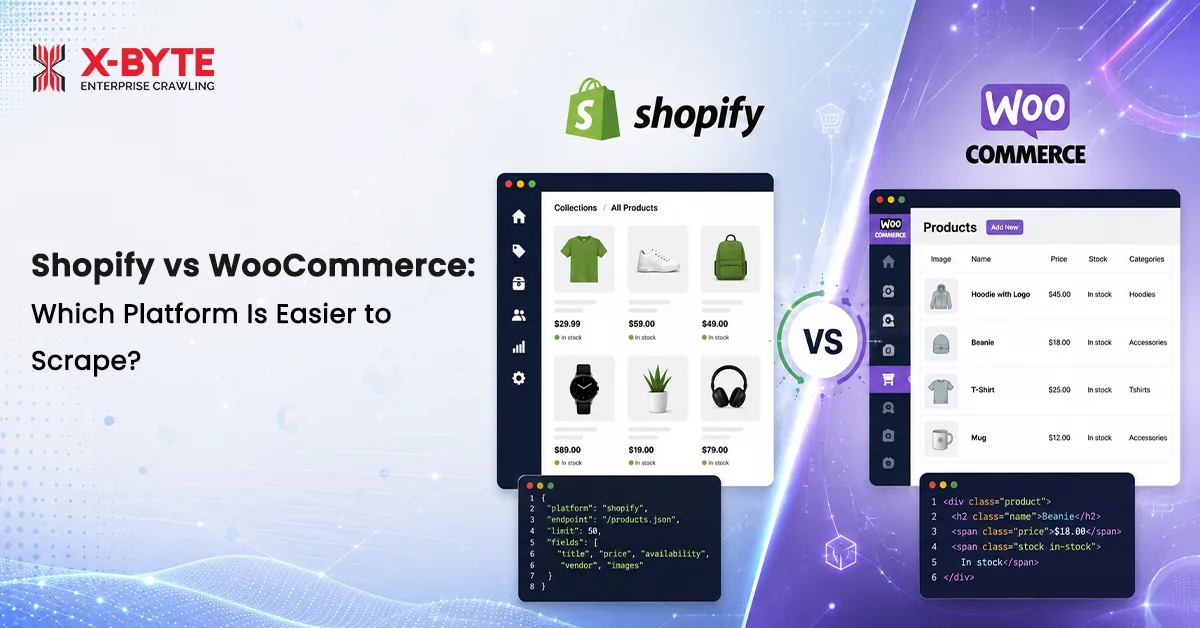
For businesses that rely on ecommerce data for price monitoring, competitor analysis, or market research, choosing the right scraping strategy starts with understanding the platform behind the store. Shopify and WooCommerce power millions of online stores worldwide, but they differ significantly in how they structure and expose product data.
Those differences directly impact scraping efficiency, maintenance costs, and data quality. While Shopify is known for its standardized architecture and predictable product endpoints, WooCommerce offers greater flexibility that can also introduce complexity.
This blog compares Shopify vs WooCommerce from a web scraping perspective, explaining how each platform serves product data, the challenges involved, and when APIs or HTML scraping are the better choice. By the end, you’ll understand which platform is easier to scrape and how to build a reliable ecommerce data extraction strategy for long-term success.
Why Businesses Compare Shopify and WooCommerce for Web Scraping?
Modern ecommerce businesses generate enormous amounts of valuable product information, making web scraping an essential tool for retailers, brands, and market intelligence teams. Whether the goal is monitoring competitor prices, tracking inventory availability, analyzing promotions, or building product catalogs, the underlying ecommerce platform determines how easily that data can be collected.
Shopify and WooCommerce dominate the ecommerce landscape, but they take very different approaches to managing product information. Shopify offers a standardized infrastructure that simplifies automated data extraction across multiple stores, while WooCommerce allows extensive customization that often requires store-specific scraping logic. Understanding these architectural differences helps businesses select the right scraping approach, reduce maintenance costs, and build scalable data collection pipelines that deliver consistent, high-quality ecommerce intelligence.
What is an E-commerce Platform Easy to Scrape?
Before we compare the two, let us define what “easy” means here. A platform is easy to scrape when its data is structured, consistent, and reachable without heavy tricks. When you build a product data scraper, three factors decide how smooth the job will be. These factors shape your cost, your speed, and how often your scraper breaks.
- Data structure. Is product data served as clean JSON, or buried inside messy HTML that changes with every theme?
- Consistency across stores. Does every store on the platform look the same under the hood, or does each one need a custom parser?
- Access method. Can you reach a public endpoint directly, or must you render JavaScript and fight anti-bot walls?
When a platform scores well on all three, your scraping tool stays stable for months. When it scores poorly, you end up rewriting selectors again and again. Keep these three ideas in mind as we look at each platform, because they explain the whole Shopify vs WooCommerce story.
Common Challenges in Ecommerce Web Scraping
Regardless of the platform, ecommerce web scraping comes with technical challenges that affect data accuracy and scraper performance. Modern online stores frequently update their layouts, implement anti-bot protections, and use dynamic content loading to improve user experiences, making automated extraction more complex.
Some of the most common challenges include:
- Frequently changing HTML structures that break scraping scripts.
- JavaScript-rendered product information requiring browser automation.
- Rate limits and CAPTCHA systems that restrict large-scale data collection.
- Pagination, infinite scrolling, and dynamic product loading.
- Maintaining consistent product matching across thousands of stores.
Because these challenges exist across most ecommerce platforms, selecting a platform with a predictable data structure or accessible APIs can significantly reduce maintenance effort and improve long-term scraping reliability.
How Does Shopify Structure Its Data for Scraping?
Shopify is a hosted, closed platform, and that turns out to be a gift for scrapers. Because every store runs on the same core system, the technical layout stays almost identical from shop to shop. This is the single biggest reason Shopify scraping feels predictable. Most Shopify stores expose a public JSON feed at a standard path, which means you can often skip HTML parsing entirely.
The built-in JSON endpoint gives you titles, prices, variants, SKUs, and images in a clean, machine-ready format. Because the structure barely changes between stores, a Shopify Scraper you build for one shop usually works on the next with little to no editing. Reports from the field confirm this pattern clearly.
According to ScrapingBee, Shopify’s hosted design and highly standardized structure make it easier to extract product data consistently across many different stores.
Why Shopify Wins on Consistency
- Most Shopify stores expose the same public product path, so one endpoint works across nearly all of them.
- The data returns as clean JSON, which means you avoid guessing at CSS classes or theme-specific markup.
- Product and pagination URLs are predictable and follow a set pattern making it simple to loop through them.
- Prices are always returned in a cents-based format, so you get consistent values every time.
The trade-off is that larger stores on Shopify Plus may use React or Vue front ends and stronger anti-bot protection. In those cases you may need a headless browser or a scraping API that handles rendering. Still, for the vast majority of catalogs, Shopify data extraction remains one of the cleanest jobs in ecommerce.
How Does WooCommerce Handle Scraping Differently?
WooCommerce is a different animal. It is an open-source plugin that sits on top of WordPress, so it gives merchants huge freedom. That freedom is exactly what makes WooCommerce scraping harder to predict. Every store can look completely different under the hood, because the layout depends on the theme, the plugins, and the choices of each store owner.
Many WooCommerce stores render product data straight into the HTML on the server side. When that happens, a simple HTML scraper can grab titles and prices from tags and CSS classes with ease. The problem is that those classes shift from theme to theme, so a parser built for one store may fail on another. This theme dependence is the core challenge of WooCommerce data extraction.
The WooCommerce Store API Advantage
There is good news, though. Modern WooCommerce installs (version 4.0 and above) often expose a public Store REST API at a standard path. When this API is active, you get structured JSON without touching the HTML at all. That single feature can flip a hard job into an easy one.
- The public Store API returns names, SKUs, prices, stock status, and categories as clean JSON.
- Unlike Shopify, WooCommerce often exposes ratings and review counts directly in the public API.
- Prices may arrive in cents or dollars, so your parser must handle both formats.
- The API is not always enabled, so coverage across stores is uneven.
So WooCommerce swings both ways. When the REST API is on, scraping is fast and reliable. When it is off, you are back to theme-specific HTML parsing, JavaScript rendering, and rotating residential proxies. This unevenness is the heart of the Shopify vs WooCommerce scraping difference.
Shopify vs WooCommerce: Side-by-Side Scraping Comparison
The table below sums up the ease of scraping for both platforms. Use it as a quick reference when you plan your next data extraction project.
| Evaluation criterion | Shopify | WooCommerce |
| Data format | Served as structured JSON through a public endpoint | Varies — either JSON from the Store API or product data embedded in HTML |
| Cross-store consistency | Highly uniform, since every store shares the same core | Inconsistent, because the theme and plugins shape each store |
| Public API availability | Standard product feed, available on nearly all stores | Store REST API on modern installs, though not always enabled |
| Parser reuse | A single parser typically works across most stores | Often requires adjustments for individual stores |
| Price formatting | Consistent, always cents-based | May be returned in cents or dollars, depending on configuration |
| Additional data exposed | Variants, images, and core product details | The same, plus ratings and review counts through the API |
| Anti-bot measures | More common on larger Shopify Plus stores | Depends on the host and any security plugins in use |
| Overall assessment | The more predictable option for most projects | Straightforward with the API enabled, demanding without it |
Why Do Both Platforms Matter for Data Teams?
Scale is the reason. These two platforms sit at the top of the ecommerce world, so your web scraping strategy has to account for both. The numbers make this very clear, and they show why neither platform can be ignored in a serious market research project.
- Shopify holds roughly 26.2% of the ecommerce platform market and leads among high-traffic sites.
- WooCommerce powers around 4.5 million active stores, and by raw store count it tracks even higher than Shopify.
- Together, the two platforms power more than half of all ecommerce websites online.
- WooCommerce runs on WordPress, which gives it a massive global footprint and huge catalog variety.
What does this mean in practice? If you build a price monitoring or competitor analysis pipeline, you will meet both platforms often. A smart data collection plan uses a fast JSON approach for Shopify and a flexible, API-first approach for WooCommerce, with HTML parsing as a backup.
Is It Legal to Scrape Shopify and WooCommerce Stores?
This is the question that keeps managers up at night, and it deserves a careful answer. Scraping public product data is generally accepted in major jurisdictions, because you are reading the same information any browser or app already sees. The public Store API endpoints on both platforms are built to serve exactly that data to the public. Still, “generally accepted” is not the same as “anything goes.”
Best Practices for Responsible Scraping
Responsible scraping rests on a few core disciplines. Before conducting any extraction at commercial scale, examine the store’s terms of service to establish where its limits lie. The site’s robots.txt file warrants the same attention, and request rates should be paced so that server performance is never compromised. Collection should extend only to product information already visible to any visitor, leaving personal and account data entirely untouched. Maintaining a record of what has been gathered is equally advisable, as it provides a clear reference should the process later come under review.
These disciplines offer protection well beyond compliance alone. They keep the work firmly within ethical bounds, preserve the standing of your IP addresses, and allow data pipelines to operate without interruption over time. The objective throughout is dependable competitive intelligence rather than disruption.
The Verdict: Which Platform Is Easier to Scrape?
Here is the honest, direct answer. Shopify is easier to scrape for most projects, because its hosted design creates one predictable structure across nearly every store. You point your Shopify scraper at a standard JSON feed and get clean data with very little maintenance. That consistency saves time, money, and engineering headaches.
WooCommerce can be just as easy — but only when the Store REST API is active. When it is not, its theme-driven variety turns each store into a small custom project. So WooCommerce rewards flexibility, while Shopify rewards standardization. The right choice depends on which stores are actually in your target list.
For a data team building broad ecommerce scraping coverage, the smartest move is to master both. Use a lean JSON workflow for Shopify and a resilient, API-first workflow for WooCommerce that can fall back to HTML parsing when needed. Cover both, and no catalog on the web is out of reach.
Get Reliable Data From Any eCommerce Platform
Custom data scraping solutions built for Shopify, WooCommerce, and other leading platforms.
Final Thoughts
So, Shopify vs WooCommerce — which is easier to scrape? Shopify takes the crown for pure consistency, while WooCommerce offers surprising ease whenever its public API is switched on. Both platforms are too big to skip, and both reward a scraper who understands their structure. When you match your web scraping method to the platform, you get clean, reliable data that powers smarter pricing and sharper market research.
Building a scalable pipeline across both platforms is exactly what our team does every day. If you want accurate, compliant ecommerce data extraction without the maintenance burden, the experts at X-Byte Enterprise Crawling can help you design a custom, scalable data scraping solution that fits your exact needs. To go deeper, explore our related guide on ecommerce data scraping services and turn raw store data into a real competitive edge.
 ✯ Alpesh Khunt ✯

Related Blogs

Why Shopee Data Extraction Is the Secret Weapon for Modern Singaporean Retailers
What Are the Best Practices for Extracting Contact Information with Web Scraping?