


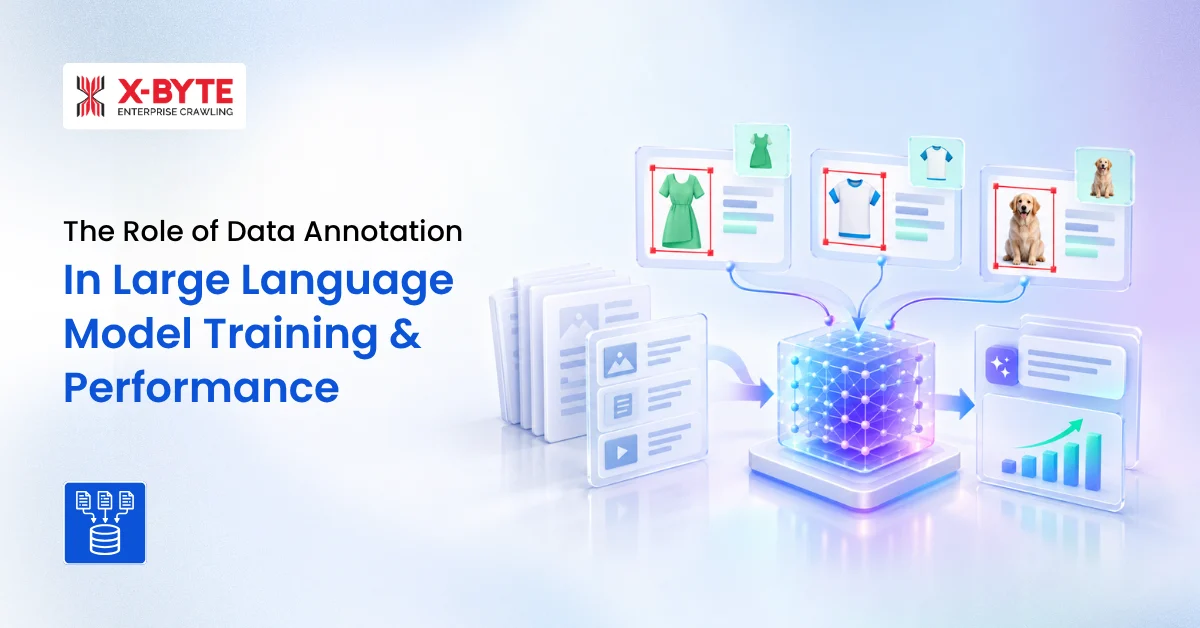
Why do some large language models produce useful, reliable responses while others struggle with accuracy, safety, or instruction following? One important factor is the quality of the data used to train and evaluate them.
Data annotation gives AI systems structured human feedback. Annotators can label content, create instruction-response examples, rank model outputs, identify safety issues, and evaluate whether a response meets defined criteria. These signals become especially important during supervised fine-tuning, preference optimization, safety training, and evaluation.
But annotation is not simply a matter of labeling more data. Label quality, consistency, taxonomy design, domain expertise, and coverage of edge cases can all affect how useful those datasets are.
This blog explains the role of data annotation in large language model training, the major annotation types used for LLMs, common quality challenges, and how businesses can source high-quality labeled data at scale.
What Is Data Annotation, and Why Do LLMs Depend on It?
Data annotation means attaching meaning to raw information so a machine can learn from it. A human might tag a sentence as sarcastic, flag a paragraph as harmful, or rank one chatbot reply above another. These labels become the answer key the model studies during training.
Pretraining and annotation are not the same job. During pretraining, language models typically learn from large-scale datasets using self-supervised objectives such as next-token prediction. Human annotation is generally more prominent in later stages, including supervised fine-tuning, preference optimization, safety training, and evaluation. Annotation enters later, during supervised fine-tuning and preference optimization, where humans shape how the model behaves rather than what raw facts it knows.
As LLM adoption expands, organizations need more high-quality training, preference, safety, and evaluation datasets. This makes scalable annotation workflows increasingly important for teams developing, fine-tuning, and evaluating AI systems.
Where Does Data Annotation Fit Into the LLM Training Pipeline?
Modern large language model training unfolds in distinct stages, and human labels do very different jobs at each one. Treating the whole thing as “labeled data goes in, smart model comes out” misses what actually happens under the hood.
The pipeline generally moves through these phases:
- Pretraining exposes the model to massive unlabeled text so it learns grammar, facts, and reasoning patterns through next-token prediction.
- Supervised fine-tuning (SFT) uses human-written or human-labeled examples that show the model how to follow instructions properly.
- Preference optimization relies on annotators ranking multiple responses, feeding techniques like RLHF and Direct Preference Optimization.
- Safety and red-team labeling flags harmful, biased, or unsafe outputs so the model learns firm boundaries.
- Evaluation datasets built by human experts measure whether the model actually improved.
Human-generated labels and evaluations become particularly important in the post-pretraining stages, where teams shape instruction following, preferences, safety behavior, and model evaluation. Pretraining is largely automated, but alignment, the part that makes an assistant helpful and safe, runs on carefully labeled human judgment.
Why Does Annotation Quality Decide AI Performance?
The quality of training and evaluation data can have a significant impact on model behavior. Inconsistent, incomplete, or biased labels can introduce problems that become visible during fine-tuning and evaluation. Feed it inconsistent or biased labels, and those flaws surface in model behavior and downstream outputs. This is why serious AI teams obsess over annotation quality long before they worry about model architecture.
Several quality factors carry real weight:
- Inter-annotator agreement: Measures how consistently different annotators apply the same labeling guidelines.
- Clear taxonomy and guidelines: Categories should be specific enough that annotators can apply them consistently.
- Domain expertise: Specialized datasets may require reviewers with knowledge of the relevant subject area.
- Edge-case coverage: Datasets should include difficult and uncommon examples, not only straightforward cases.
The InstructGPT research illustrated an important point: a smaller model that receives effective instruction tuning and human feedback can outperform a much larger base model on certain evaluations of helpfulness and instruction following. The result highlighted the importance of training and preference data alongside model scale.
What Types of Data Annotation Do LLMs Actually Use?
Different training goals call for different labeling methods. The table below maps the most common annotation types against their purpose and their real role inside model development.
| Annotation Type | What It Captures | Common LLM/AI Use |
| Instruction-response pairs | How a model should respond to prompts | Supervised fine-tuning |
| Response ranking | Relative quality or preference between responses | Preference optimization / RLHF |
| Safety classification | Harmful, unsafe, or policy-sensitive content | Safety training and evaluation |
| Entity annotation | People, organizations, places, products, etc. | Information extraction and NLP tasks |
| Sentiment/intent labeling | User sentiment or intent | Classification and conversational applications |
No single method works alone. A production-grade assistant blends all of these, layering instruction data, preference signals, and safety labels into one coherent training recipe.
How Does Data Annotation Improve LLM Performance?
Instruction following
Annotated instruction-response pairs help models learn how to interpret and respond to user requests.
Response quality
Preference data allows teams to distinguish stronger responses from weaker alternatives.
Safety
Safety annotations help identify content that requires refusal, modification, escalation, or other safeguards.
Domain adaptation
Expert-labeled examples can help adapt models to specialized terminology and workflows.
Evaluation
Human-created evaluation datasets help teams measure whether model changes actually improve performance.
What Makes Data Annotation So Hard to Get Right?
Annotation sounds simple until you try it at scale. Millions of examples, dozens of labels, and guidelines that keep shifting add up to a real operational headache. Teams that wave this off tend to ship weaker models than the competition.
- Guidelines rarely stay put. Give the same instructions to a team over a few weeks and interpretations slowly diverge, so your label consistency erodes without anyone noticing.
- Fatigue is the enemy of good labeling. Repetitive shifts wear people down, and a tired annotator makes calls a fresh one never would.
- Cost and speed pull against each other. Careful expert labeling is neither cheap nor fast, and something usually gives.
- Synthetic data looks like an easy shortcut. Letting an AI generate its own labels can work, but it just as easily amplifies biases already lurking in the system.
Human-in-the-loop systems take much of the sting out of these problems. Machines pre-label the obvious cases, humans review the uncertain ones, and this active-learning split keeps data labeling both affordable and accurate. That balance is exactly why the leading providers build their platforms around it.
How Should Businesses Source High-Quality Labeled Data?
Few companies can staff a full annotation team on their own. Recruiting, training, and policing quality eats more time than most teams expect, and the math rarely works out in-house. For organizations that lack the internal workforce or domain expertise to manage large annotation projects, outsourcing can provide access to trained annotators, quality-control workflows, and scalable production capacity.
So what actually separates a good partner from a risky one? A few things are worth checking before you sign anything:
- Subject-matter fluency is non-negotiable for specialized data. A medical or legal dataset labeled by someone who only knows the tool, not the field, introduces systematic errors into your training data and model behavior.
- Ask how they measure agreement between labelers. Real quality control means several review passes and hard numbers on consistency, not one person eyeballing the batch and calling it done.
- Volume flexibility separates less experienced providers from vendors equipped for enterprise-scale projects. Your partner should handle a fifty-record pilot and a two-million-record push without missing deadlines on either.
- Then there’s security. Sensitive inputs pass through many hands during data collection and labeling, and each handoff is a place where a weak provider leaks something they shouldn’t.
A seasoned data partner earns its fee precisely here, in the unglamorous discipline of doing all four consistently.
Improve LLM Performance With High-Quality Data
Get accurate, high-quality annotated datasets designed to improve large language model training, accuracy, and performance.
What Is the Future of Data Annotation for LLMs?
The old picture of annotation, a room full of people tagging data by hand, is fading fast. What replaces it is messier and more interesting.
One big shift is the rise of expert annotators. Early labeling work leaned on general crowds, but frontier models now need PhDs, lawyers, and doctors to judge answers a layperson simply cannot evaluate. Can a random reviewer tell whether a model’s cancer-treatment summary is accurate? Rarely. So the pay, and the bar, keeps climbing.
Another change is the blurring line between human and machine labeling. Models increasingly draft their own labels, and humans step in only to correct or approve. This “AI-assisted annotation” speeds things up, though it carries a quiet risk: using model-generated labels can create feedback loops if the generated labels are not independently reviewed.
There’s also growing pressure around fairness and pay for the people behind the data. Reporting on labor conditions in the annotation industry has pushed vendors toward more transparent practices.
As models grow smarter, the humans teaching them need to grow sharper too, and data annotation is fast becoming a skilled profession rather than a side task.
Conclusion
Data annotation plays an important role in helping organizations develop, fine-tune, evaluate, and improve large language models. While pretraining relies heavily on self-supervised learning, human-generated instruction data, preference signals, safety labels, and evaluation datasets can strongly influence how a model behaves in real-world use.
For businesses, the priority should not simply be collecting more labeled data. Consistent guidelines, qualified annotators, strong quality-control processes, representative datasets, and secure workflows are equally important.
As LLM development becomes more specialized, combining AI-assisted labeling with expert human review can help organizations scale annotation while maintaining quality.
If your team needs scalable support for AI data preparation and annotation, explore X-Byte Enterprise Crawling’s data annotation services to see how managed data workflows can support your LLM training and AI projects.
 ✯ Alpesh Khunt ✯

Related Blogs
The Role of Data Annotation in Large Language Model Training and Performance
How Web Scraping Is Used to Extract eCommerce Data From eBay