

Imagine a sales team preparing for its next big campaign. They know exactly which company to approach. However, finding the right decision makers, business emails, phone numbers, and other contact details can quickly become a time consuming task. Hours are spent jumping between company websites, directories, and public pages, only to end up with incomplete, outdated, or inconsistent information.
That’s where contact information web scraping steps in. Instead of collecting contact details manually, businesses can automate the process. However, collecting more data does not always mean collecting better data. Without the right scraping techniques, businesses can face duplicate records, missing fields, inaccurate details, and poor-quality datasets.
The real value lies in building a reliable process that identifies the right sources, extracts relevant contact information, cleans and validates the data, and structures it for practical use. In this guide, we will explore the best practices and techniques for contact data scraping.
Before diving into these practices, it is important to understand what web data scraping is and how it works.
What is Web Data Scraping?
Web data scraping is the process of extracting large volumes of data from websites. It allows businesses to collect information from multiple online sources and organize it into a structured format. Today, web scraping has become an important data collection method for businesses and individuals because it can gather information from the internet quickly and efficiently.
Using a reliable web scraping service for contact information can further improve the efficiency of the extraction process. This is particularly useful for market research, lead generation for sales and marketing teams, and price monitoring for competitive retail and travel businesses.
Web data scraping also plays an important role in supplying data for machine learning models and AI applications. For example, website images can train computer vision models, text can train language models, and customer behavior data can improve recommendation systems.
By automating data collection and scaling it across a wide range of sources, web scraping helps businesses create robust, accurate, and well-structured datasets for analysis, AI applications, and decision-making.
Web scraping from X-Byte Enterprise Crawling, a leading web data scraping company, is especially useful if the public website you want to get data from doesn’t have an API, or only provides limited access to web data.
How Do Web Data Scrapers Work?
Web data scrapers can extract all available information from a website or only the specific data points the user needs. Defining the required data fields in advance helps the scraper focus on relevant information and improves extraction efficiency.
Now that we have covered what web data scraping means, let’s look at how the scraping process actually works:
- Input: Provide URLs and specify what data you want to extract. (e.g., product types and ratings)
- Request: Scrape visits each URL like a browser (sends HTTP GET).
- Load: Downloads HTML (runs JavaScript if needed for dynamic pages).
- Parse: Turns HTML into a navigable structure.
- Extract: Finds and gathers only the targeted data using selectors.
- Clean: Trims, converts, and organizes data into rows.
- Paginate: Follows “Next” links and repeats until done.
- Save: Exports clean data as CSV, Excel, JSON, or database.
What is Web Data Scraping Used for?
Now that we understand how web data scraping works, let’s look at some of the common ways businesses use it to collect valuable information and support data-driven decisions.
Market Research
Web scraping can support market research by helping companies collect large volumes of data from relevant online sources. This data can help businesses analyze consumer trends, understand market movements, identify opportunities, and make better strategic decisions.
Sentiment Analysis
Businesses that want to understand how consumers feel about their products or brands can use web scraping to collect publicly available data from social media platforms, review websites, and other online sources. The collected data is then analyzed to identify common opinions, concerns, and customer sentiment.
Price Monitoring
Web scraping can help companies collect pricing data for their own products and competing products. By tracking these prices over time, businesses can identify pricing gaps, monitor competitor movements, and determine more effective pricing strategies.
News Monitoring
Web scraping news websites can help businesses monitor relevant developments and industry trends. This is particularly valuable for companies that depend on timely information or operate in industries where news and market events can quickly influence business performance.
Email Marketing
Web scraping can also support lead generation by helping businesses collect publicly available business contact information from relevant sources. However, collected data should be properly verified and used in accordance with applicable privacy, data protection, and outreach requirements.
These use cases demonstrate the broader value of web scraping. However, when the goal is specifically to build reliable prospect data, the process needs to be more targeted and structured. This is where the right contact information scraping practices become important.
Build Reliable Contact Data Pipelines
Get accurate, structured contact data from relevant online sources with scalable web data solutions tailored to your business needs.
Best Practices for Contact Information Scraping
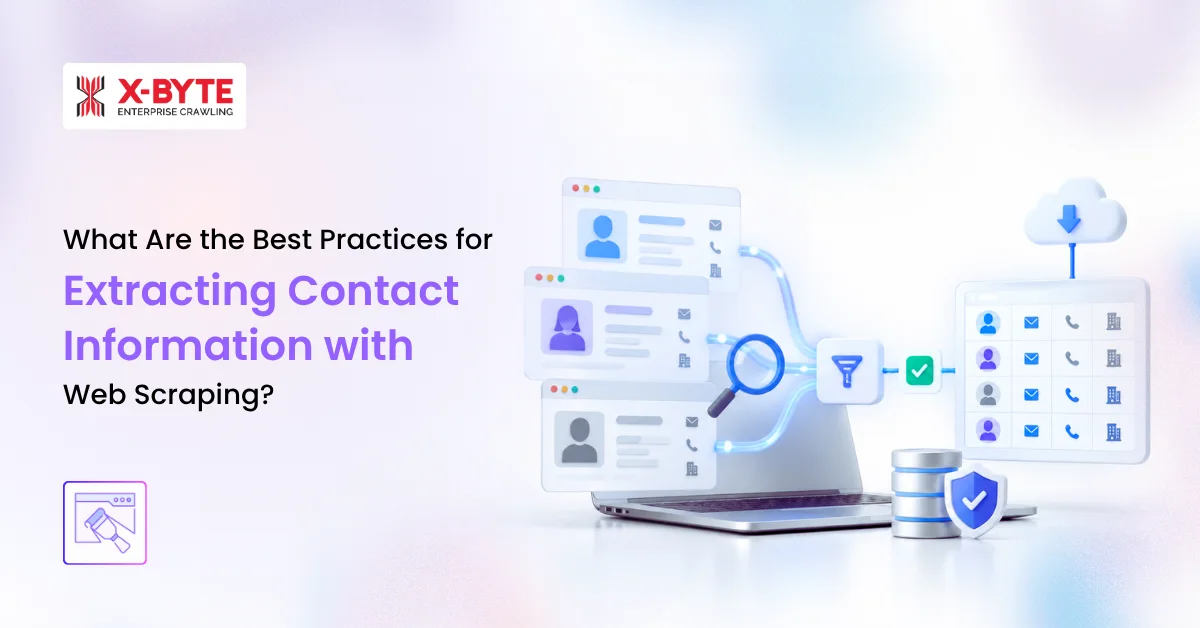
Effective contact information scraping is not a single-step process. Instead, it is a structured pipeline that builds, enriches, verifies, and delivers prospect data in stages. Following a systematic approach helps businesses improve data quality while reducing wasted effort.
1. Define Your Target Customer Profile
Before scraping anything, it is important to define exactly who you are looking for. Consider industry, company size, geography, technology stack, funding stage, and decision-maker titles. The more precise your ICP, the more targeted your scraping and the higher your eventual conversion rate.
2. Source Identification
The next step is to map your ICP to the web sources that are most likely to contain matching companies and contacts. For instance, you can utilize Crunchbase and company websites for technology companies and Google Maps and industry directories for local businesses.
3. Data Extraction
Scrape each source for the specific fields your ICP requires. This stage is where volume matters; you may need to process hundreds of thousands of company pages, directory listings, or event pages to build a sufficient pipeline. X-Byte Enterprise Crawling offers AI-powered scrapers that can handle contact data extraction at scale, while their managed services handle the anti-bot complexity of heavily protected sources.
4. Enrichment
The scraped data is often incomplete, and that’s where the enrichment phase kicks in. Data enrichment helps fill these gaps by combining third-party APIs, scraping additional sources, or using waterfall enrichment techniques to collect missing information from multiple providers until the required fields are complete.
5. Verification
Before any scraped contact enters your outreach workflow, we verify it. Email verification is done at the SMTP level, not just format validity. Phone numbers are also verified to confirm they’re active. In short, we verify each company’s data to confirm the organization still exists and matches your ICP criteria.
6. Delivery to Sales System
The final step pushes verified, enriched prospect data into the systems your sales team uses: CRM, outreach tools, or a shared Google Sheet for manual review and assignment.
Final Thoughts
When approached as a structured, ongoing process, contact information scraping can transform one of the most time-consuming parts of the sales process (finding the right people to talk to) from a manual research task into an automated pipeline. X-Byte Enterprise Crawling combines targeted scraping, multi-source enrichment, rigorous verification, and human validation to deliver accurate, relevant, and up-to-date prospect data.
The key is to treat contact scraping as a pipeline, not a one-time extraction. Define your ICP, identify the best sources, extract and enrich systematically, verify before outreach, and continuously refresh before data decays. With X-Byte Enterprise Crawling, businesses can automate contact data collection and build reliable prospect lists that support more effective sales and marketing campaigns. Get in touch with us today to build a scalable contact data pipeline tailored to your business needs.
 ✯ Alpesh Khunt ✯

Related Blogs
What Are the Best Practices for Extracting Contact Information with Web Scraping?
The Role of Data Annotation in Large Language Model Training and Performance