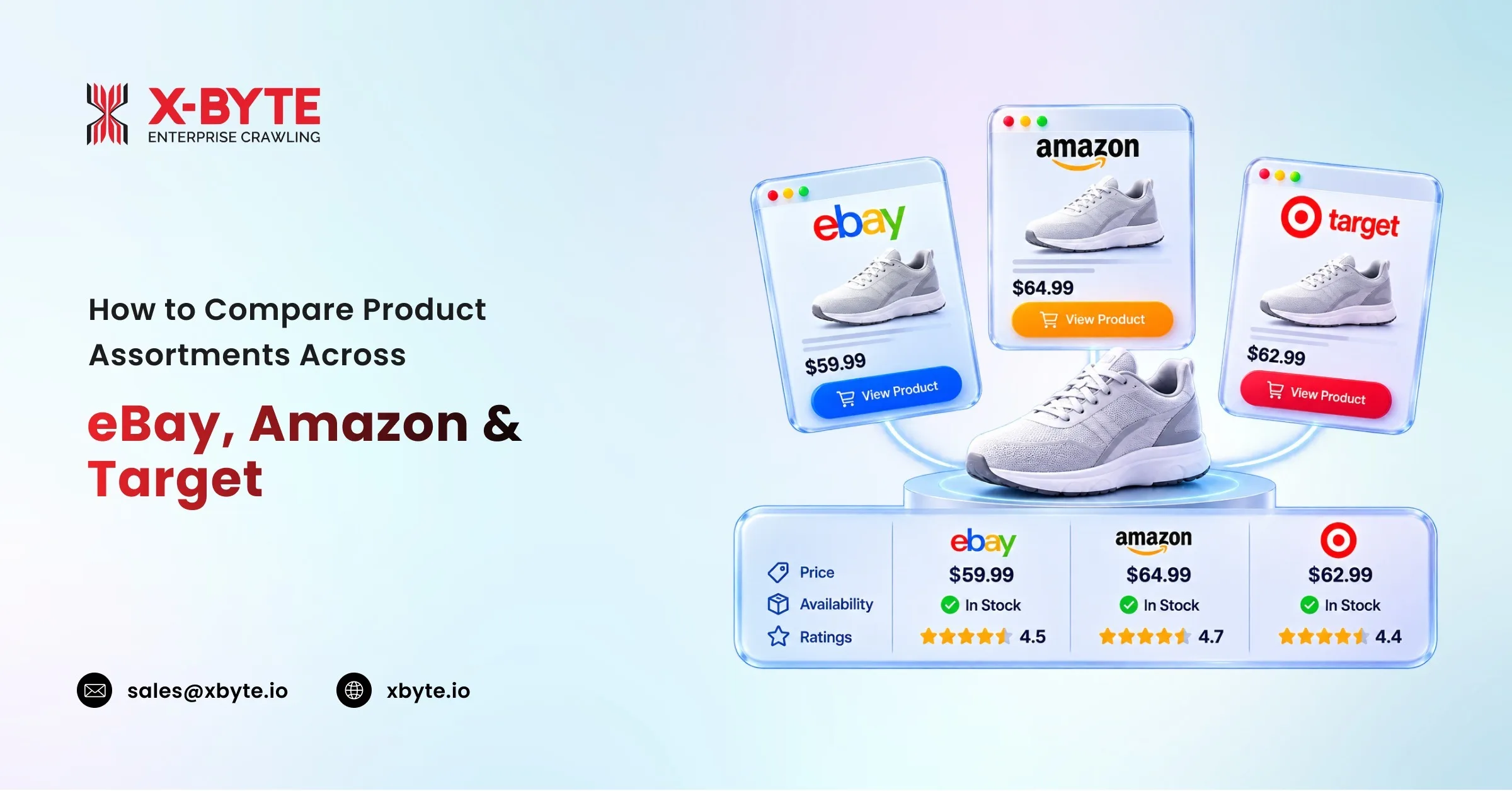
Did you know 53% of consumers always or often compare the same product across multiple marketplaces before buying? Shoppers browse an average of three platforms before deciding what to buy. For retailers and e-commerce businesses, this creates a crucial challenge: understanding how their product assortments compare with competitors on marketplaces like eBay, Amazon, and Target.
The challenge goes beyond comparing product prices. Each marketplace has its own catalog structure, product attributes, listing formats, and seller ecosystem. The same product might appear under different titles, categories, or variations, making accurate comparisons difficult. Without structured marketplace data, identifying assortment gaps, tracking competing products, and spotting new market opportunities can quickly become time-consuming.
Product assortment analysis across eBay, Amazon, and Target helps retailers understand which products competitors offer, where their catalogs overlap, and which categories offer growth opportunities. Combined with e-commerce competitor analysis, automated web scraping, and product matching, businesses can collect and standardize marketplace listings at scale.
In this guide, we will explore how to compare product assortments across these three marketplaces, which product attributes to track, and how structured marketplace intelligence can support smarter assortment planning and competitive decisions.
Let’s start by understanding product assortment.
Let’s start by understanding product assortment.
The process of evaluating the range of products a retailer offers and comparing it with the assortments available across competing marketplaces is known as product assortment analysis. Product assortment helps businesses understand which product categories, brands, SKUs, sizes, colors, etc., competitors carry, where their catalogs overlap, and which products are missing from their own offerings.
For marketplaces like Amazon, eBay, and Target, this analysis provides valuable insights into competitor positioning, product availability, category coverage, and changing customer preferences. By collecting and comparing structured product data across these platforms, retailers can identify assortment gaps, discover emerging product opportunities, and make more informed inventory and merchandising decisions. Instead of relying on manual catalog checks, businesses can use automated product data extraction to analyze product assortments at scale.
Amazon vs eBay vs Target: Why Compare Product Assortments Between E-Commerce Platforms
Comparing product assortments across eBay, Amazon, and Target gives retailers a clearer picture of how competitors position their catalogs and meet customer demand. Each marketplace has a different mix of brands, product categories, sellers, and product variations. In these cases, product assortment analysis helps businesses identify gaps in their offerings, understand competitor strategies, and spot opportunities to strengthen their product selection.
Have a look at some of the important reasons retailers should compare product assortments across these marketplaces.
Understand Competitor Product Selection
Understanding what competitors sell is just as important as knowing how they price their products. Comparing listings across different e-commerce platforms helps businesses examine competitor product ranges, brand selections, product variations, and category coverage. This type of e-commerce competitive intelligence provides a clearer view of how competing retailers structure their assortments and which products they prioritize. Retailers can use these insights to refine their merchandising strategies and build product selections that remain competitive.
Identify Missing Products and Assortment Gaps
Are your competitors selling products that are missing from your catalog? Comparing product assortments helps retailers identify missing SKUs, unavailable product variations, and categories where competitors offer a wider selection. For instance, eBay might list multiple variations of a specific home appliance, while the same category on Amazon and Target may have a more limited selection. Identifying these differences helps retailers uncover assortment gaps and decide which products are worth adding to their catalogs.
Find Opportunities to Expand Product Offerings
Once retailers understand competitor assortments, they can identify opportunities to introduce new products, expand existing categories, or add variations that are missing from their catalogs. For instance, if competing marketplaces offer a broader selection of smart home devices or fitness accessories, retailers can investigate those categories for potential expansion. Merging marketplace data extraction with competitor product insights makes it easier to spot these opportunities, evaluate competing offerings, and make informed decisions about future catalog expansion.
Evaluate Product Variety and Market Coverage
A large product catalog doesn’t always mean better market coverage. Retailers also need to understand how much variety their competitors offer within individual categories. Cross-platform product comparison helps businesses evaluate differences in brands, sizes, colors, models, specifications, and other product variations. It also reveals whether competitors serve a broad range of customer preferences or focus on specific product segments. This information helps retailers assess their assortment depth and identify areas where their product variety could improve.
What Product Data Should You Compare Across Marketplaces?
Comparing product assortments across eBay, Amazon, and Target involves more than counting product listings. Retailers need to examine important product attributes to understand catalog differences, identify competing products, and spot assortment gaps. Here are the key data points worth comparing.
Brand Names and Product Categories
Not every marketplace carries the same brands or focuses on the same product categories. Comparing brand names and category listings helps retailers understand which brands competitors prioritize and where they offer a wider selection. These insights can also reveal popular product segments and categories worth exploring.
Product Titles, Descriptions, and Specifications
Product titles, descriptions, and specifications reveal what competitors are actually selling. Compare details such as product features, dimensions, materials, and technical specifications. Since the same product may have different titles or descriptions across marketplaces, examining these attributes helps retailers identify equivalent listings and make more accurate comparisons.
Product Prices and Discount Ranges
Product prices and discounts offer additional context about competitor positioning. Retailers can compare regular prices, promotional offers, and discount ranges for equivalent products across Target, Amazon, and eBay, thus helping them understand pricing differences and identify opportunities to make their own offerings more competitive.
SKU Counts and Product Variations
SKU counts help retailers understand the depth of competing product catalogs. However, it’s equally important to look at variations such as sizes, colors, models, and pack quantities. Comparing these details across marketplaces helps businesses identify missing options and understand how competitors cater to different customer preferences.
Product Availability and Stock Status
A product listed on a marketplace isn’t necessarily available for purchase. Comparing stock status and availability indicators helps retailers understand which products competitors currently offer. It also highlights potential supply gaps and reveals where competing marketplaces have a stronger product selection.
How to Compare Product Assortments Across eBay, Target, and Amazon
Comparing products across marketplaces can seem tiresome, but with a structured approach, it becomes much more manageable. Here’s a simple guide to help you navigate this process effectively.
Step 1: Collect Product Listings
Initially, start by gathering product information from Amazon, Target, and eBay. Look for key details like product titles, descriptions, brand names, SKUs, categories, prices, and availability. You can also use automated scraping tools from X-Byte Enterprise Crawling to gather information seamlessly, saving you time and money. Once you have everything collected, organize it in a structured format like CSV, JSON, or Excel, making it easier for analysis later.
Step 2: Sort Out Into Common Categories
Each marketplace- Amazon, eBay, and Target,- may label common products in different ways. So, it is important to standardize these categories to make comparisons easier. For example, one site might list a product under “kitchen essentials” while another might list it under “Home and Kitchen Essentials.” By grouping similar items together and aligning their categories and attributes, you can simplify the comparison process significantly.
Step 3: Match Similar Products
The same product can be labeled in different marketplaces with different titles and descriptions. To accurately match equivalent items, use identifiers like UPCs, GTINs, model numbers and brand names. Moreover, you can also use product matching tools that compare titles, images, and specifications. This step ensures you are comparing pears with pears and helps prevent duplicate listings in your analysis.
Step 4: Compare Product Availability
With your organized and matched listings, dive into comparing how many products are available in each category across the platforms. Check out the unique SKUs, the variety of brands, and how deep their assortments are. For instance, you might find that Target offers a broad range of gaming consoles, while eBay has fewer options but includes popular brands. These insights can illuminate your competitors’ strategies and help you assess your own market coverage.
Step 5: Spot Missing Products and Gaps
Take a moment to identify products or brands present on some platforms but absent on others. If Amazon and Target have a wide range of models of a well known home device, but eBay only offers a limited range, that’s a signal for potential opportunity. This step is important for spotting gaps in your catalog and deciding where to focus your product offerings.
Step 6: Keep Track of Changes
The last step is to keep track of all the changes because product assortments are always changing, with new listings being added and old ones getting phased out. Frequently collecting data allows you to track these changes and observe how competitor catalogs evolve over time. By automating this data extraction process, you can stay on top of emerging product categories and respond more effectively to shifts in the marketplace.
By following the above steps, businesses can make informed decisions about product assortments, ensuring they can stay competitive and relevant in the ever changing online retail world.
How Web Scraping Helps Automate Product Assortment Comparison
With the help of web scraping, retailers can not just collect product data, but also compare it with multiple e-commerce websites without manually checking hundreds of thousands of listings. It automates data collection, organizes product details, and supports cross-platform product comparison to provide a consistent view of competitor product offerings.
Collect Product Data at Scale
Web scraping automates the collection of product listings from platforms like Amazon, Target, and eBay. Retailers can gather product titles, brands, categories, SKUs, prices, and availability across hundreds of thousands of listings.
Monitor Product Catalog Changes
Product catalogs change regularly as retailers add new products, remove outdated listings, or update product variations. Automated scraping helps track these changes and keep retailers informed about evolving competitor offerings.
Standardize and Structure Marketplace Data
Different marketplaces like Amazon, eBay, and Target often use different product titles, category names, and attribute formats. Web scraping services from X-Byte Enterprise Crawling help organize and standardize these details into consistent datasets, making product assortment analysis and cross-platform comparisons easier.
Build Centralized Product Comparison Datasets
Scraped data from different marketplaces can be consolidated into a centralized dataset. Retailers can use structured formats like CSV, Excel, or JSON to compare product ranges, SKU counts, brand availability, and category coverage in one place.
Generate Actionable Retail Intelligence
Organized marketplace data helps retailers identify assortment gaps, discover new product possibilities, and understand competitor strategies. These insights support better product selection, assortment planning, and e-commerce competitive intelligence.
Conclusion
In the end, comparing product assortments across Target, eBay, and Amazon helps retailers identify catalog gaps, understand competitor offerings, and discover new product opportunities. Effective product assortment analysis allows businesses to make informed decisions about product selection, category expansion, and competitive positioning.
X-Byte Enterprise Crawling simplifies this process with scalable e-commerce product data extraction. It collects, organizes, and delivers structured marketplace data to support product comparisons and ongoing competitor analysis. Explore X-Byte’s web scraping solutions to collect crucial e-commerce data and make smarter retail decisions.