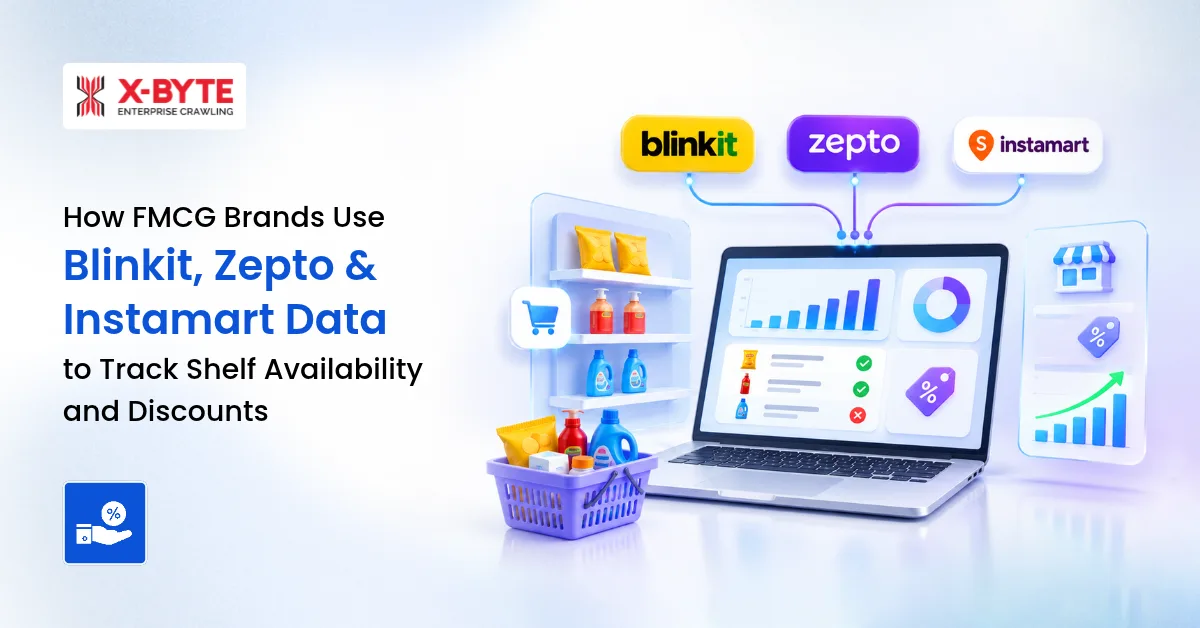
Every consumer brand wants its products visible the second a shopper opens Blinkit, Zepto, or Swiggy Instamart. The catch is that these digital shelves change by the minute, stock vanishes without warning, and rival brands roll out coupons that pull buyers away before anyone reacts. This is where quick commerce data becomes a working tool for FMCG brands, not just a report that lands in an inbox. Across this blog you will see how brands collect live signals from the leading apps, what shelf availability and discount tracking actually reveal, how the data pipeline works behind the scenes, and which numbers deserve attention every day. The aim stays practical, so you finish with a clear picture of how digital shelf monitoring turns a crowded app into a channel a brand can plan around.
Quick commerce data for FMCG brands helps solve this visibility gap by bringing product listings, stock status, selling prices, discounts, and competitor activity into a structured view. With regular data collection and analysis, teams can identify stockouts, compare promotions, spot assortment gaps, and respond to market changes faster. This guide explains how brands use quick commerce data to monitor shelf availability and discounts across India’s leading platforms.
Why Does Quick Commerce Data Matter for FMCG Brands?
Quick commerce has changed how consumers discover and purchase everyday products. Platforms such as Blinkit, Zepto, and Swiggy Instamart give FMCG brands access to customers who expect products to be available within minutes. However, maintaining consistent visibility across these platforms requires more than listing products.
A brand may have strong demand in one city but face repeated stockouts in another. Similarly, a competitor’s discount or a missing product listing can affect visibility even when the brand’s overall distribution remains strong.
Quick commerce data helps FMCG teams understand these differences through:
- Product availability: Identify SKUs that are unavailable across specific cities and pincodes.
- Competitor pricing: Compare selling prices, MRP, and promotional offers across platforms.
- Assortment coverage: Find products missing from relevant locations or platform catalogs.
- Digital shelf visibility: Monitor search rankings, category placements, and product listing quality.
- Promotion tracking: Understand when competitors introduce discounts, bundles, or other offers.
For category managers, sales teams, and supply planners, these insights provide a clearer picture of how products perform across quick commerce channels.
How Is Quick Commerce Data Actually Collected and Validated?
Benefits are easy to promise; the hard part is the pipeline underneath. A dependable FMCG price intelligence setup usually runs through four stages, and each one matters because quick commerce catalogs are hyper-local and refresh constantly.
- Collection cadence. Listings are captured per pincode on a schedule, often several times a day for fast-moving categories and hourly during festive or sale windows, since prices and stock on these apps rarely hold steady for long.
- Extraction at scale. Because availability differs across dark stores, the crawler rotates through geo-locations and respects each platform’s rate limits, which keeps the feed complete without tripping blocks.
- SKU matching. The messy part is tying a brand’s catalog to the app’s listing, so fuzzy matching on pack size, brand, and variant is used to avoid comparing a 500 ml bottle to a 1 litre one.
- Validation. Raw records pass through checks for duplicates, price outliers, and currency or unit errors before anything reaches a dashboard, which is what separates trustworthy data from noise.
What Can Shelf Availability Data Tell FMCG Brands?
Digital shelf availability monitoring helps FMCG brands understand whether their products are listed and available to shoppers across quick commerce platforms. Tracking these signals at the city and pincode levels can reveal distribution gaps that broader sales reports may overlook.
Here are five important areas brands should monitor:
1. Product Stock Availability
Identify which SKUs are listed as in stock, out of stock, or unavailable across different locations. Repeated stockouts can indicate replenishment issues or gaps in local inventory coverage.
2. Digital Assortment Coverage
Check whether the complete product range is available across relevant locations. Missing pack sizes, variants, or newly launched products can limit category coverage.
3. Competitor Share of Shelf
Compare the number of visible product listings and their placement against competing brands within the same category. This helps teams understand their relative digital presence.
4. Product Listing Accuracy
Monitor product titles, images, descriptions, pack sizes, and other listing attributes. Incorrect information can create confusion and affect product discovery.
5. Search and Category Visibility
Track where products appear for relevant search terms and category pages. Ranking or placement changes can help brands identify potential visibility issues.
By combining these signals, FMCG teams can identify where products are underrepresented and prioritize corrective action across their quick commerce distribution network.
How Does a Brand React When the Data Flags a Problem?
Here is a practical example. A packaged-snacks brand sells a ₹99 multipack, and on a Friday evening its dashboard flags that the pack is out of stock in 180 of 400 Bengaluru pincodes, just as weekend demand climbs. The same feed shows a direct competitor launching a 25 percent coupon on Zepto in those exact zones. Within the hour, the supply team pushes replenishment requests to the affected dark stores, while the pricing team clears a matching promotion on Blinkit and Instamart so the gap does not widen. By Saturday morning, availability recovers above 90 percent and the competitor’s coupon no longer owns the category page alone. Without near-real-time digital shelf monitoring, that same brand would likely have learned about the slump days later from a sales dip, long after the weekend was lost.
How Do Brands Track Discounts Across Blinkit, Zepto, and Instamart?
Discounts on these apps move almost as fast as the deliveries, so manual checking cannot keep up. Brands lean on automated price monitoring that captures the selling price, the printed MRP, and the live offer for every SKU on a fixed schedule. Once Blinkit data, Zepto data, and Instamart data sit side by side, teams compare how the same pack is priced on three apps in the same hour. That answers the questions pricing managers care about: whether a partner is breaching agreed price floors, whether a rival just undercut a hero product, and whether a promotion is reaching the shelf as planned. The table below lists the core data points most FMCG teams track across all three platforms.
Table 1 — Core quick commerce data points tracked across Blinkit, Zepto, and Instamart
| Data point | What it shows | Why FMCG brands track it |
| Selling price & MRP | Live price versus printed MRP per SKU | Protects margins and spots price erosion early |
| Discount percentage | Depth of every active offer and coupon | Keeps promotions competitive without over-discounting |
| Stock availability | In-stock or out-of-stock by pincode | Prevents lost sales from silent stockouts |
| Search ranking | Position on category and keyword pages | Improves visibility and ad-spend decisions |
| New launches | Fresh SKUs entering a category | Tracks rival moves and white-space openings |
| Competitor promotions | Banners, combos, and bundle offers | Guides faster, data-backed counter-offers |
Which Quick Commerce Metrics Should FMCG Teams Monitor Daily?
Tracking the right metrics helps FMCG teams identify operational issues without getting overwhelmed by large volumes of platform data. The following KPIs provide a practical starting point.
| KPI | What to measure | Why it matters |
| Product availability rate | Available listings as a percentage of monitored listings | Identifies stockout patterns |
| Out-of-stock frequency | Number of unavailable observations over a period | Highlights recurring availability issues |
| Price competitiveness | Price difference against comparable competitor products | Supports pricing decisions |
| Discount depth | Promotional reduction against MRP | Helps evaluate promotional intensity |
| Digital assortment coverage | Available target SKUs against planned assortment | Identifies distribution gaps |
| Search visibility | Product ranking for selected keywords | Measures discoverability |
| Listing accuracy | Percentage of listings with correct product information | Maintains catalog quality |
| Competitor promotion frequency | Number of observed promotional changes | Tracks competitor activity |
For example, availability rate can be calculated as:
Availability Rate = (Available Product Listings / Total Monitored Product Listings) × 100
Teams should calculate these metrics using consistent SKU, location, and observation definitions. Daily monitoring can be useful for fast-moving categories, while less volatile products may require a different reporting frequency.
What Are the Business Benefits of Quick Commerce Data Tracking?
The payoff of quick commerce data scraping for FMCG shows up in faster decisions rather than prettier charts. When availability and pricing feeds land on time, supply teams refill dark stores before a stockout spreads, and pricing teams answer a rival discount in hours instead of days. Marketing gains too, because clean FMCG data shows which keywords and placements win visibility, so ad budgets follow evidence rather than hunches. Over a quarter, these small wins stack into steadier availability, protected margins, and an honest view of where a brand is leaking share. This is why many brands now work with a specialist team such as xByte.io for structured, platform-ready quick commerce feeds across every major app, rather than stitching together partial data in-house.
What Should FMCG Brands Look for in a Quick Commerce Data Partner?
Choosing a quick commerce data provider requires more than checking whether it can extract product prices. FMCG brands need consistent, accurate, and structured information that supports their monitoring and reporting requirements.
Before selecting a provider, evaluate these factors:
1. Multi-Platform Coverage
The provider should support relevant quick commerce platforms, including Blinkit, Zepto, and Swiggy Instamart, based on the required data scope.
2. Location-Level Data Collection
Check whether the provider can capture product information across selected cities and pincodes. Location-level coverage is particularly important because availability and pricing can vary by service area.
3. SKU Matching Accuracy
Ask how the provider identifies identical products across different platforms. Accurate matching should account for brand, variant, quantity, pack size, and product identifiers.
4. Data Refresh Frequency
The collection schedule should match business requirements. Fast-moving products and promotional campaigns may need more frequent monitoring.
5. Data Validation and Historical Records
Check whether the provider validates missing values, duplicate listings, price changes, and inconsistent product attributes. Historical records also help teams analyze pricing and availability trends.
6. Integration and Delivery Formats
The extracted information should be available in formats that work with existing analytics systems, such as CSV, JSON, APIs, or business intelligence dashboards.
7. Scalability and Compliance
Evaluate whether the provider can handle larger product catalogs and location coverage while following applicable platform terms, access restrictions, and data protection requirements.
A suitable provider should offer more than raw extracted information. It should deliver structured quick commerce data that FMCG teams can integrate into their existing workflows and use for informed decisions.
Conclusion
Blinkit, Zepto, and Swiggy Instamart have made digital shelf monitoring an important part of FMCG channel management. Tracking product availability, competitor prices, promotional offers, and listing visibility helps brands identify distribution gaps and respond to market changes with better information.
However, the value of quick commerce data depends on its accuracy, location coverage, and consistency. A structured data extraction process gives category managers, pricing teams, and supply planners a clearer view of product performance across platforms.
If your business needs reliable quick commerce data for FMCG market intelligence, X-Byte Enterprise Crawling can help with structured data extraction and delivery solutions. Connect with the team to discuss your data requirements and monitoring goals.