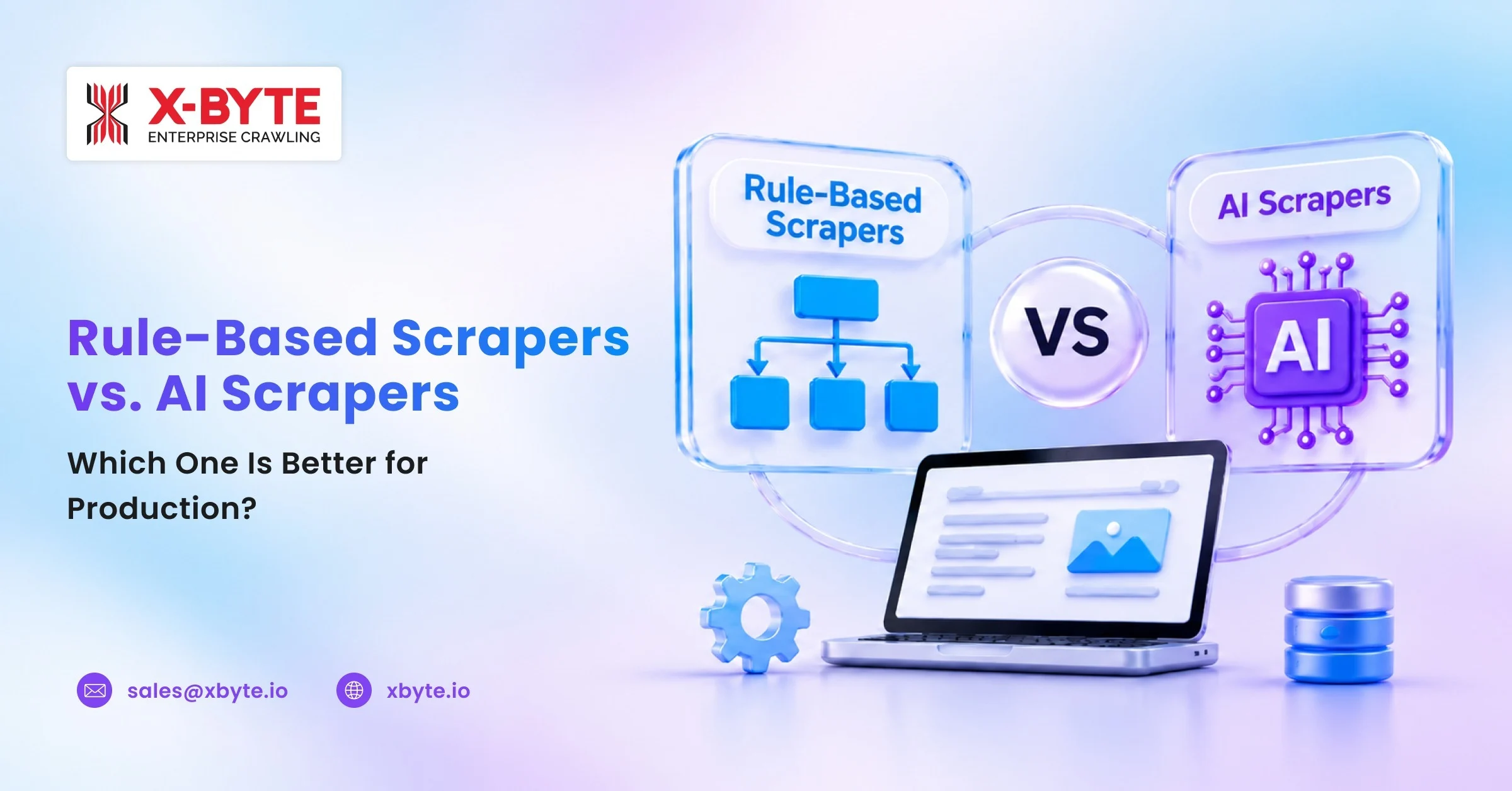
Rule-based scrapers are generally better for stable websites and high-volume data extraction where speed and predictable costs matter. AI scrapers are more suitable for websites with changing layouts, complex structures, or inconsistent content. For production environments handling different types of websites, a hybrid approach can combine the speed of rule-based extraction with the flexibility of AI-powered scraping.
Choosing between rule-based scrapers and AI scrapers involves more than comparing extraction methods. Businesses must consider how accurately each approach captures data, how much maintenance it requires, and whether it can handle growing workloads without increasing operational costs. A scraper that performs well during initial development may become difficult to maintain when websites change their layouts or introduce new content structures.
What Are Rule-Based Scrapers?
Rule-based scrapers extract website data using predefined instructions, such as CSS selectors, XPath expressions, and regular expressions. Developers configure these rules to identify specific elements on a webpage, including product names, prices, descriptions, ratings, and availability. Once configured, the scraper follows the same extraction logic across multiple URLs and converts the collected information into structured formats such as JSON or CSV.
This approach works particularly well when websites have consistent HTML structures and predictable page layouts. Since the scraper follows predefined instructions rather than making AI model calls, it can process large volumes of pages with relatively low computational overhead.
What Are AI Scrapers?
AI-powered web scrapers use artificial intelligence techniques, including machine learning, large language models (LLMs), and computer vision, to identify and extract information from website content. Unlike traditional scrapers that depend primarily on predefined selectors, AI-based systems can interpret page content, recognize relationships between elements, and map relevant information to requested fields.
AI-powered web scrapers use artificial intelligence techniques, including machine learning, large language models (LLMs), and computer vision, to identify and extract information from website content. Unlike traditional scrapers that depend primarily on predefined selectors, AI-based systems can interpret page content, recognize relationships between elements, and map relevant information to requested fields.
For businesses collecting data from multiple ecommerce platforms, directories, or content-heavy websites, AI-assisted extraction can simplify field identification and reduce repetitive selector maintenance. However, its performance still depends on model quality, input data, extraction instructions, and validation processes.
Key Capabilities of AI-Powered Scrapers
- Flexible field identification: Recognizes relevant information even when HTML structures differ.
- Context-aware extraction: Identifies information based on its meaning and surrounding content.
- Reduced selector dependency: Minimizes the need to create and maintain selectors for every page template.
- Unstructured data processing: Helps extract information from descriptions, reviews, and inconsistent content.
- AI-assisted validation: Can flag missing or unusual values when confidence scoring and validation mechanisms are implemented.
Rule-Based Scrapers vs. AI Scrapers: A Side-by-Side Comparison
Here is how the two approaches stack up on the factors that decide success once a project reaches production.
| Factor | Rule-Based Scrapers | AI Scrapers |
| Setup speed | Slower; selectors written by hand | Faster; the model infers fields |
| Cost per page | Lowest | Higher, due to model calls |
| Maintenance | High when sites change often | Low; adapts to layout shifts |
| Accuracy on clean pages | Very high | Very high |
| Accuracy on messy pages | Low | High |
| Scalability | Excellent for fixed structures | Scales well, but cost grows with volume |
| Error handling | Fails silently when selectors break | Degrades gracefully; flags low-confidence fields |
| Monitoring | Needs selector-health checks | Needs confidence and accuracy checks |
| Infrastructure | Lightweight HTTP and parsers | Heavier; model or API calls |
| Data consistency | Very consistent while layout holds | Consistent when validation is in place |
| Ideal use case | Fixed, repetitive data extraction | Complex, shifting web scraping jobs |
At a Glance: Which Approach Fits Your Production Needs?
The infographic distills the trade-off into one frame. Rule-based scrapers lead on speed and cost; AI scrapers lead on resilience and low upkeep. For the majority of live workloads, the strongest answer blends the two so each method does what it does best.
How to Choose the Right Web Scraping Technology for Your Business?
Selecting between rule-based and AI-powered scraping requires evaluating your data requirements, website complexity, and long-term operational needs. The following factors can help businesses make a more informed decision.
1. Evaluate Your Target Websites
Start by examining the HTML structures and content formats of your target websites. If most websites have consistent layouts, rule-based extraction may be sufficient. If page structures vary significantly, AI-assisted extraction may offer greater flexibility.
2. Estimate Your Data Extraction Volume
Consider how many pages you need to process daily or monthly. High-volume extraction from predictable websites generally favors rule-based scrapers because they avoid repeated AI inference costs.
3. Calculate Maintenance Requirements
Look beyond initial development costs. Estimate how frequently selectors need updates, how much engineering time is spent resolving failures, and whether AI-assisted extraction can reduce recurring maintenance.
4. Define Data Accuracy Requirements
Identify which fields are critical to your business. Product prices, availability, ratings, and identifiers may require different validation rules. Choose an approach that supports consistent extraction and reliable error detection.
5. Consider Integration and Scalability
Evaluate how easily the scraping system integrates with databases, analytics platforms, APIs, and existing data pipelines. The solution should support increasing workloads without compromising processing performance or data quality.
6. Consider a Hybrid Architecture
If your project includes both stable and frequently changing websites, a hybrid approach may be worth evaluating. It allows businesses to use predefined rules for predictable pages and AI-assisted extraction for more complex cases.
Conclusion
Choosing between rule-based scrapers and AI scrapers depends on your production requirements, website complexity, and operational budget. Rule-based extraction remains a practical choice for stable websites and high-volume workloads, while AI-powered scraping offers greater flexibility when dealing with changing layouts and unstructured content.
For businesses managing multiple websites and complex data pipelines, a hybrid scraping architecture can combine the strengths of both approaches. The key is to prioritize extraction accuracy, scalability, data validation, and long-term maintenance rather than focusing only on initial development costs.
Looking to build a reliable production scraping pipeline? X-Byte Enterprise Crawling offers web scraping services, data extraction solutions, and scraping APIs to support different business requirements. Explore our solutions to identify the right approach for your data collection needs.