

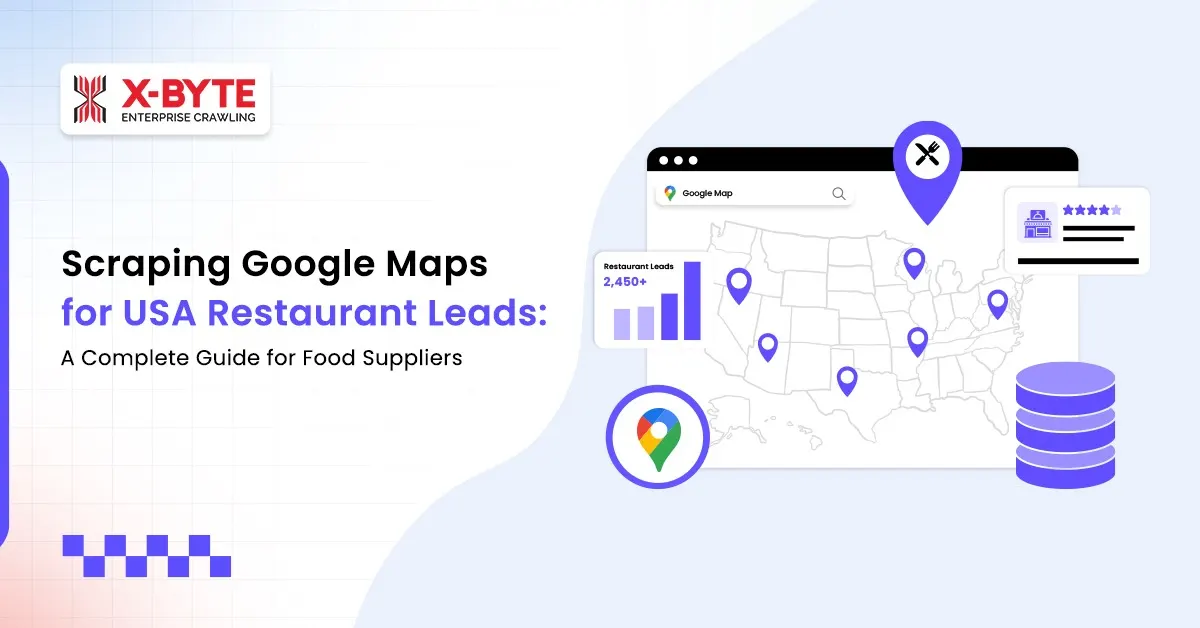
Finding qualified restaurant leads across the United States can be challenging for food suppliers. With hundreds of thousands of restaurants operating nationwide, manually identifying businesses, collecting contact details, and keeping lead lists up to date requires significant time and resources. This is where Google Maps restaurant data scraping becomes a valuable solution. By extracting publicly available business information from Google Maps, suppliers can build accurate, location-specific restaurant databases that support targeted sales outreach and business expansion.
A well-executed Google Maps data scraping strategy provides access to essential details such as business names, addresses, phone numbers, websites, ratings, operating hours, and other publicly available information. Instead of spending weeks researching potential customers, sales teams can focus on connecting with verified restaurant prospects and building long-term partnerships. Whether you’re targeting independent restaurants, regional chains, or specific cuisines, restaurant lead generation through Google Maps helps streamline prospecting while improving efficiency.
In this blog, you will learn what restaurant data can be extracted from Google Maps, how the scraping process works, its legal considerations, and best practices for building a high-quality USA restaurant lead database that supports sustainable business growth.
Why Do Food Suppliers Need Restaurant Leads From Google Maps?
Food suppliers work in a competitive market where relationships drive revenue. A single restaurant client can order the same products week after week for years. So the value of one good lead is high, and the cost of missing leads is real. Google Maps Data Scraping helps you find these clients faster and at scale.
Here are the main reasons suppliers turn to this method:
- Massive reach: Almost every restaurant, cafe, and food outlet in the country shows up on Google Maps, so you rarely run out of prospects to pursue.
- Fresh information: Owners tend to keep their listings updated because it helps customers find them, and that habit works in your favor when you pull contact details.
- Local targeting: Need clients only in Texas or just within a few zip codes around Dallas? You can narrow your search down to the exact area your trucks already cover.
- Cost efficiency: Buying old lead lists from brokers drains your budget, while automated collection pulls current data for a small share of that price.
- Better sales focus: Instead of digging around for phone numbers all afternoon, your reps get to spend their hours actually talking to buyers.
When you combine these benefits, the return on investment becomes clear. Suppliers who use restaurant lead generation through Google Maps often build pipelines that would take months to create by hand.
What Restaurant Data Can You Extract from Google Maps?
Before you start any project, you should know exactly what fields you can collect. Google Maps listings are rich with detail, and each field serves a different purpose in your sales process. The right restaurant data extraction approach captures everything your team needs.
The most valuable data points include the following:
- Business name and category, so you know at a glance whether you’re looking at a pizzeria or a fine-dining spot
- Address: right down to the city, state, and zip code
- Contact details: you can call directly, which is often the fastest way to reach a busy owner
- Website and email, though the email isn’t always listed and sometimes needs a bit of digging
- Star ratings along with the total number of reviews behind that score
- Opening hours and price range, both handy for timing your pitch and gauging the venue’s scale
- Photos and menu links show up on some listings, too, even if they aren’t there for everyone
This structured restaurant data lets you segment your outreach with precision. For example, you might target only high-rated establishments in a certain metro area. Or you might focus on newly opened venues that need fresh supply partners. The flexibility here is one of the strongest advantages of Google Maps scraping.
How Does the Google Maps Scraping Process Work?
The scraping process may sound technical, but the idea is simple. A web scraping tool visits Google Maps, reads the listings that match your search, and saves the details into a clean file. Let us break the workflow into clear steps so that you see how a web scraping project comes together
Here is the typical flow:
- Start by defining your target: Decide which restaurant types, cuisines, and regions actually fit what you supply, since a broad net just wastes time later.
- Set your search terms next: A phrase like “Italian restaurant Chicago” tells the tool exactly where to look, and you can run dozens of these across different cities.
- Let the scraper do the heavy lifting: Once it runs, it works through each listing and pulls the data fields on its own, no babysitting required.
- Clean up what comes back: This is where you strip out duplicates, tidy the formatting, and get every phone number into the same style.
- Export it somewhere useful: A CSV or Excel file drops straight into most CRMs, so your reps can start dialing right away.
- Finish by structuring and verifying: Fill in the emails that were missing and double-check a sample of records to be sure the details hold up.
Each step matters, and skipping any of them hurts your data quality. A well-run lead generation pipeline treats data cleaning as seriously as the extraction itself. Many teams use professional services because building and maintaining scrapers in-house takes engineering time.
DIY Scraping Vs Professional Data Services: Which Is Better?
Many food suppliers ask whether they should build their own scraper or hire experts. The honest answer depends on your resources, volume, and long-term goals. The table below compares both paths so you can decide with confidence.
| Factor | Building It Yourself | Hiring a Data Service |
| Getting Started | You’re looking at weeks of coding before the first lead lands | Most providers hand you data within a few days |
| Skills Needed | Someone on your team has to know how to code and debug | You just describe what you want and wait |
| Data Accuracy | Only as good as the scraper you managed to build | Records come cleaned and checked before they reach you |
| Upkeep | When Google shifts its layout, the fix is on you | The provider patches breakages behind the scenes |
| Scaling Up | Pulling ten thousand listings is a real strain | Large volumes are just another Tuesday for them |
| Real Cost | The engineering hours add up quietly over time | You pay a set price and know it upfront |
| Staying Compliant | Figuring out the legal side falls to your team | Compliance guidance is baked into the service |
As the table shows, a DIY route can work for small, one-time needs. But for steady, large-scale USA restaurant leads, a professional service usually delivers better value. You avoid the headaches of broken code, blocked requests, and messy exports.
Get Clean, Accurate Restaurant Leads
Custom data scraping solutions for restaurant leads, built around your business goals.
Is Scraping Google Maps Legal and Ethical?
Legal issues are not to be taken lightly, and all vendors should treat them with the seriousness they deserve. In most cases, it is perfectly acceptable to collect business information that a company has already made public. The rules around data use, privacy, and the terms of service for a platform still apply, though, and it is in ignoring them that trouble typically begins. If you approach local business data extraction responsibly, you protect your brand and your reputation with customers.
Keep these principles in mind:
- Stick to public business data: Names, addresses, and phone numbers listed for a company are fair game, but leave personal details about individuals out of it.
- Remember the privacy laws: Rules like California’s CCPA come into play the moment any personal information enters your files, so know what applies before you start.
- Don’t interrupt the source: A well-behaved scraper spaces out its requests instead of flooding the servers, which is both polite and safer for you.
- Honor opt-out requests: If a business asks to be left off your list, take it off, no questions asked.
- Depend on partners you trust: A solid provider bakes compliance into how they work, which saves you from guessing where the lines are.
When you follow these practices, your restaurant lead generation stays both effective and responsible. Ethics and results are not opposites here. In fact, clean and lawful data usually performs better because it reflects real, reachable businesses.
Practical Tips to Get the Most From Your Restaurant Leads
Collecting data is only half the job. The real value appears when your sales team turns those leads into customers. To help you succeed, here are field-tested tips that improve your results after the data extraction is done.
| Tips | Why It Matters |
| Segment before you sell | A supplier pitching seafood to a steakhouse wastes everyone’s time. Grouping leads by cuisine, location, or rating means each message actually fits the restaurant receiving it. |
| Check the details before reaching out | Numbers change and inboxes go dead. A quick verification pass spares your reps from chasing contacts that no longer exist and lifts the odds of a reply. |
| Make the message personal | Owners can spot a mass email instantly. Mentioning their name or a recent five-star review signals that a real person looked at their business. |
| Watch which segments convert | Some groups will close far more often than others. Once you see that pattern in your numbers, you know exactly where to send more effort. |
| Update on a set schedule | Restaurants shut down, move, and switch owners throughout the year. A quarterly cleanup keeps stale records from dragging down the whole list. |
These practices turn a raw file of restaurant lead generation into a reliable revenue engine. Suppliers who treat their data as a living asset consistently outperform those who let it go stale.
Conclusion
Finding the right restaurants to supply should not feel like searching for a needle in a haystack. Scraping Google Maps for USA restaurant leads provides food suppliers with a quick, cost-effective and scalable method for generating a robust B2B restaurant sales pipeline. You gain access to accurate contact information, location-based targeting, and up-to-date business data that is difficult to obtain through manual research.
Throughout this guide, we covered what data you can extract, how the process works, and how to stay both legal and ethical. We also compared DIY methods against professional services and shared practical tips to convert leads into loyal clients. With the right strategy and data partner, building a high-quality restaurant lead database becomes much more efficient.
When you are ready to grow your client base with trusted restaurant data, a managed solution can save you time and effort. Visit X-Byte to see how professional Google Maps data scraping can power your next stage of growth. Your future customers are already listed and waiting to hear from you.
 ✯ Alpesh Khunt ✯

Related Blogs

The Role of Data Annotation in Large Language Model Training and Performance
How Web Scraping Is Used to Extract eCommerce Data From eBay