Did you know that US online grocery sales surged 20.7% year over year in the third quarter of 2026, capturing a record 20.9% share of total grocery spending? (Source: Brick Meets Click) What does this growth mean?
That simply means consumers are increasingly embracing digital grocery platforms for everyday shopping, creating new opportunities for retailers, grocery brands, and market intelligence companies. Among the platforms contributing to this ever growing landscape, Shipt offers valuable insights into product assortment, pricing trends, store-level availability, and local grocery markets.
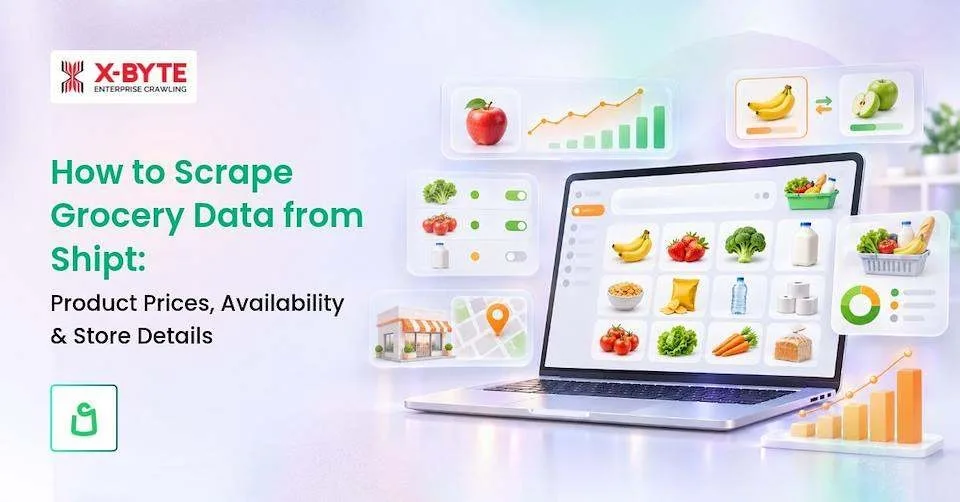
But keeping up with constantly changing grocery prices, promotional offers, and product availability across multiple locations is no easy task. How can businesses track these changes without spending hours manually checking product listings? That’s where Shipt data scraping comes into play. Through automated Shipt web scraping, businesses can collect structured grocery information, including product names, brand details, regular prices, discounts, stock status, and store information, at scale.
Whether you want to scrape Shipt prices for competitor benchmarking, monitor Shipt product prices to identify fluctuations, or scrape Shipt product availability to understand local inventory patterns, automated data extraction makes the process significantly more efficient. Similarly, Shipt grocery data scraping and product data scraping help businesses build comprehensive datasets for pricing intelligence, assortment analysis, demand forecasting, and market research. With accurate grocery product and store data, businesses can gain a clearer picture of local grocery competition and changing consumer markets.
In this guide, we will walk you through how to scrape grocery data from Shipt, the key data fields you can collect, the extraction process, and the business applications of this information.
Let’s get started.
What is Shipt Grocery Data Scraping?
Shipt web scraping is the process of extracting publicly available data from Shipt’s storefronts, such as product names, prices, sale tags, stock status and store details, and organizing it into a structured format. Teams use this data to understand how prices move across stores, how often items sell out, and how a store’s range compares with its competitors.
Shipt grocery product data scraping differs from simply browsing the app. Instead of checking a handful of items by hand, a scraper can capture hundreds of thousands of listings across multiple stores and time periods, then save them as CSV or JSON files for analysis. That scale is the main reason businesses invest in structured data.
Why Do Businesses Scrape Shipt Product Data?
Shipt is more than an online grocery delivery platform; it provides a valuable view of local grocery markets, product assortment, pricing strategies, and store-level availability. For retailers, grocery brands, CPG companies, and market research firms, this information can reveal how products are positioned and how competitors respond to changing market conditions. However, manually tracking thousands of grocery listings across different stores and locations can quickly become time-consuming and inefficient.
This is why businesses rely on Shipt product data scraping to collect structured product information at scale. By extracting product names, brand details, prices, discounts, ratings, availability indicators, and store information, companies can build datasets that support several business objectives. Here are some reasons why organizations invest in Shipt grocery data scraping:
Monitor Product Availability Across Stores
A product listed online may not always be available at every store location. Through Shipt product availability scraping, businesses can collect store-level availability indicators and identify changes in product listings. This information helps retailers understand local assortment differences, spot potential stock gaps, and improve inventory planning.
Track Competitor Prices and Promotions
Grocery prices and promotional offers can vary across retailers, products, and locations. Businesses use Shipt price scraping to track listed prices, discounts, and promotional changes across competing grocery stores. These insights help retailers benchmark their pricing strategies, identify competitive gaps, and make informed pricing decisions.
Strengthen Location-Based Market Intelligence
Grocery preferences and product availability often differ from one region to another. With Shipt store data extraction, businesses can gather crucial store details and connect product listings with location-specific information. This makes it easier to compare grocery assortments, evaluate regional pricing differences, and identify market opportunities across service areas.
Understand Product Assortments and Market Trends
Which grocery brands are gaining visibility? What product categories are expanding across different locations? Shipt product data scraping helps businesses answer these questions by collecting product names, categories, brands, sizes, and other listing attributes. These datasets support assortment benchmarking, category research, and emerging product trend identification.
Support Data-Driven Business Decisions
Consistent access to structured Shipt grocery product data gives businesses a stronger foundation for analytics and reporting. Historical pricing records, product attributes, promotional details, and availability signals can feed into business intelligence dashboards, forecasting models, and automated monitoring systems. Instead of relying on occasional manual checks, teams can work with regularly refreshed datasets to make faster, evidence-based decisions.
Key Data Points to Collect From Shipt
Using Shipt grocery data scraping, businesses can gather structured data such as:
- Category
- Brand
- Product name
- Reviews
- Price
- Discount
- Stock status
- Ratings
- Package size
- Seller info
- Delivery time
- Image URL
How to Scrape Product Data from Shipt: A Step-by-Step Approach
1. Define Your Scope
Start by listing the stores, locations and product categories that matter to your analysis. A narrow scope, such as meat and dairy products in five neighborhoods, is easier to maintain and validate than a national crawl on day one.
2. Review Shipt’s Terms and Access Rules
Before collecting anything, read Shipt’s current terms and conditions of service and privacy policy. Many platforms limit automated access or restrict commercial reuse of their content. Check robots.txt and any published data-use guidelines as well. If your requirements are large or ongoing, contact Shipt directly to ask about data access options. Legal review is worth the time, because a project that breaks platform rules can be shut down at any point.
3. Map the Data Structure
After you have decided your access approach, identify where each field appears on the storefront. Product titles, prices, badges, and availability labels often sit in different page elements, and layouts can change without notice. Documenting these fields in a simple schema keeps the project organized and makes future updates easier.
4. Collect Responsibly
Good collection practices protect both your data and the platform. Keep request volumes modest, schedule runs during off-peak hours, cache results where possible, and avoid collecting personal information about customers or shoppers. Only collect data that your analysis needs.
5. Clean and Normalize
Raw listings are rarely consistent. The same product may appear as “8 lb” in one listing and “1ct” in another, and prices may include or exclude promotions. Normalize units, standardize brand names, remove duplicates and flag missing values before analysis begins.
6. Store, Monitor and Refresh
Save each snapshot with its timestamp, then set up monitoring to catch layout changes and failed runs. A data pipeline that quietly returns empty results is more dangerous than one that stops loudly.
Common Challenges in Shipt Grocery Data Scraping
Extracting data from Shipt involves several technical and operational hurdles that impact the efficiency of Shipt grocery data scraping.
Dynamic Shields
Shipt is backed by a front-end behavior-based fence that detects and blocks automated scraping attempts.
Policy Constraints
Another challenge while scraping Shipt grocery data is policy constraints. Scraping without compliance may conflict with platform rules or data protection standards.
Layout Volatility
Then there’s layout volatility, meaning frequent interface and layout changes break scrapers and require constant script updates.
Access Blocks
Finally, access blocks can trigger IP bans with frequent data requests, disrupting scraper performance and consistency.
Conclusion
Shipt grocery delivery app data scraping holds immense potential for businesses and consumers alike. By harnessing data, users can gain critical insights into market trends, pricing strategies, and consumer preferences, helping them optimize their shopping experience and stay ahead of the competition.
At X-Byte Enterprise Crawling, we understand the importance of Shipt grocery data collection for businesses and consumers alike. By leveraging data, our clients can access high-quality information on market trends, pricing strategies, and consumer preferences. This empowers them to improve their shopping experience and maintain a competitive advantage in the marketplace.